New to buying sapphires? Start with our Ultimate Sapphire Buying Guide — the complete resource for colour, origin, treatment, and pricing.

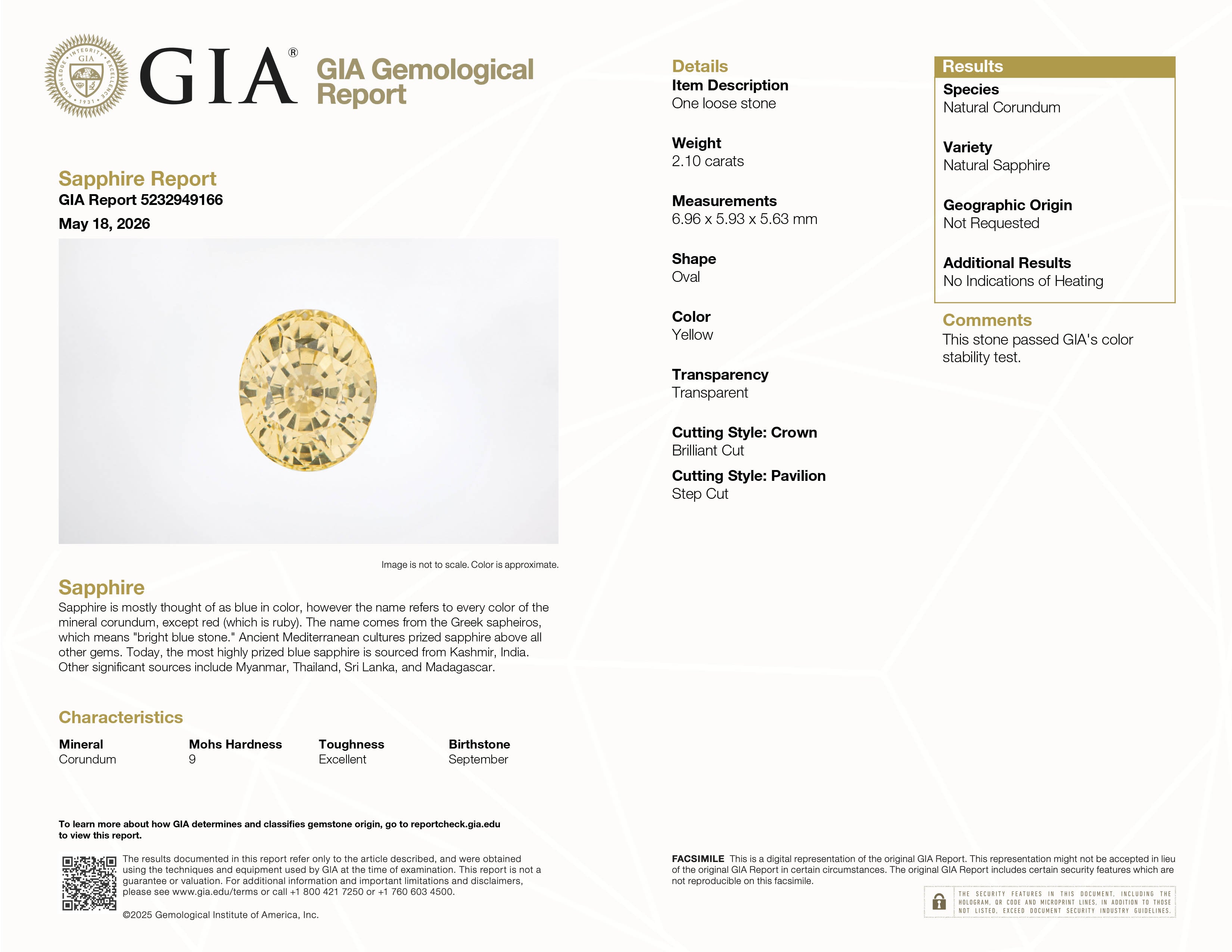
When buying a natural sapphire above a few hundred dollars, you will encounter laboratory reports as part of the transaction. GIA — the Gemological Institute of America — is the most widely recognised gemological laboratory globally, and its sapphire reports are accepted as authoritative by dealers, auction houses, and buyers across every major market.

But a GIA report is not a simple quality score. It is a technical document that requires some interpretation to use correctly. Many buyers glance at a report, see that it says "natural" and move on — missing the most important information on the page. This guide explains every section of a GIA sapphire report, what each field actually means, and how to use the document to make a confident purchasing decision.


What a GIA Sapphire Report Is — and What It Is Not

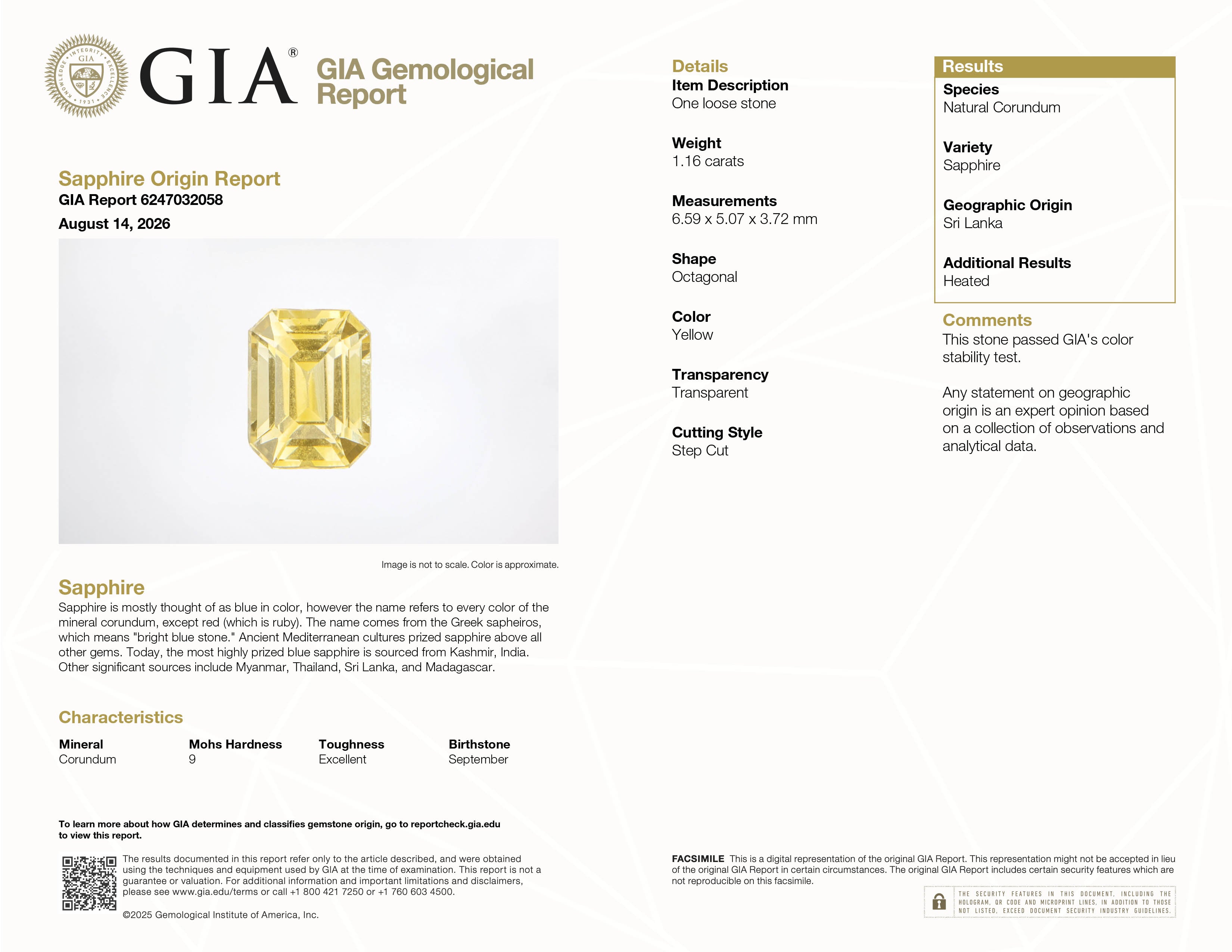
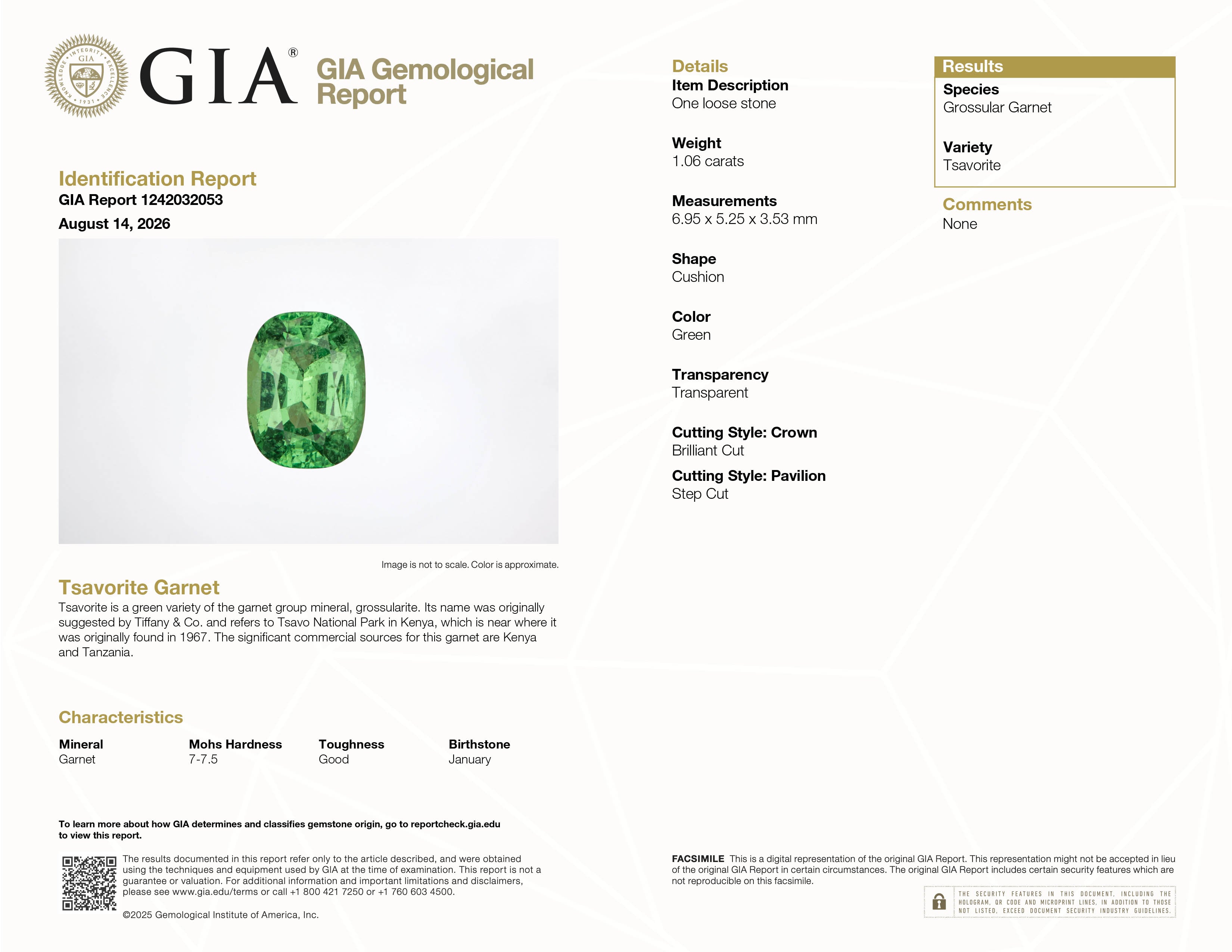
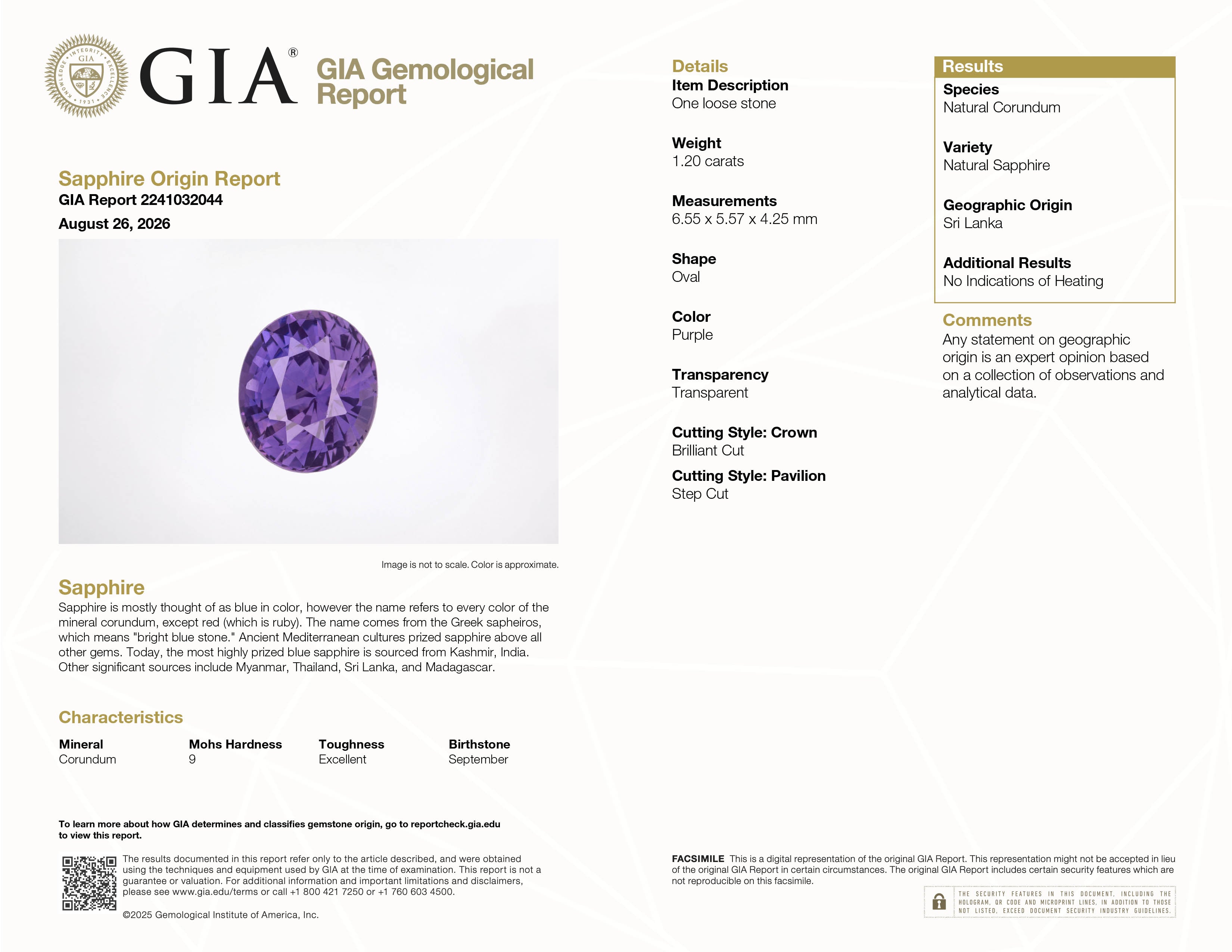
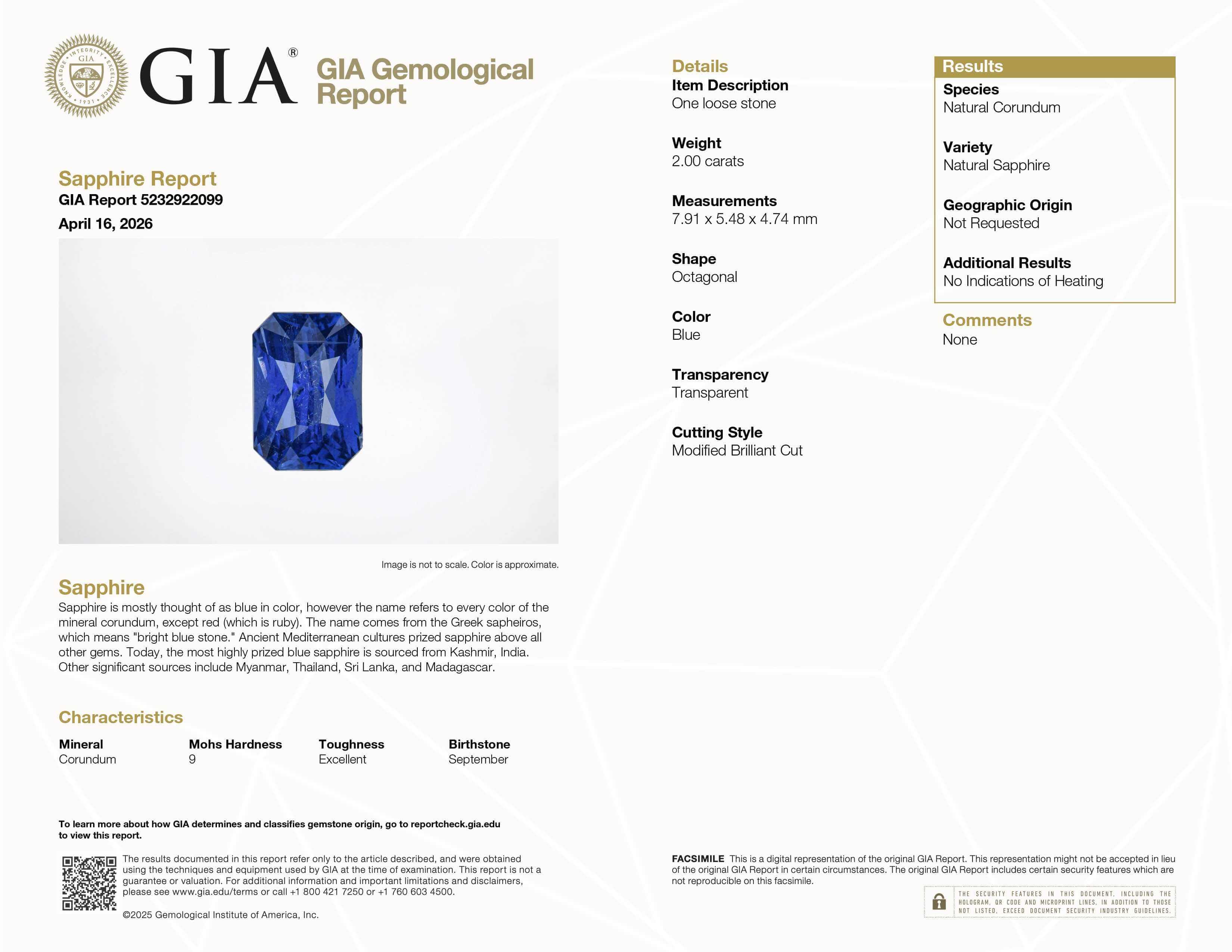
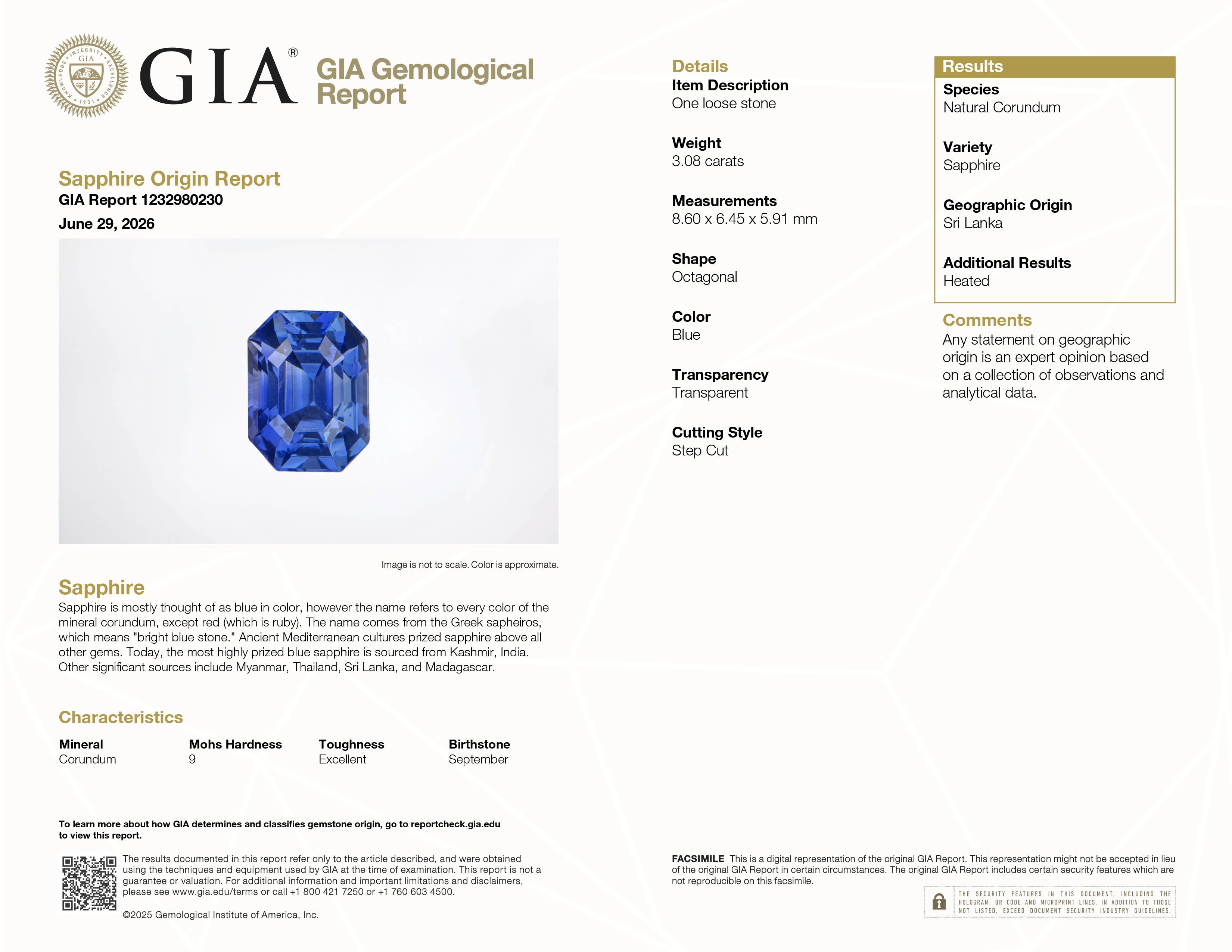
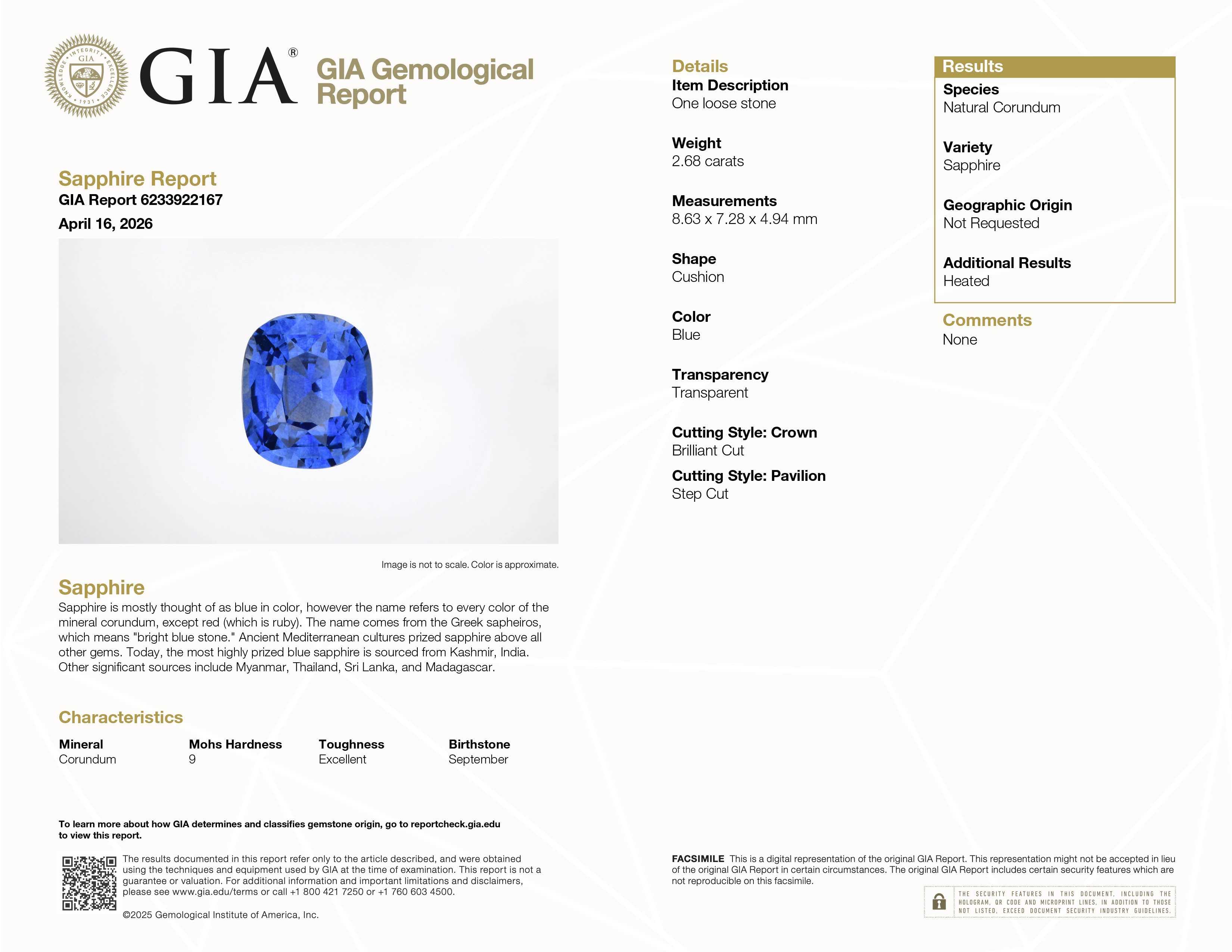
A GIA sapphire report is an objective third-party assessment of a specific stone prepared by trained gemologists with no financial interest in the sale. It confirms what the stone is, describes its physical characteristics, and states what treatments — if any — it has undergone.

A GIA report is not a valuation. It does not assign a market price or dollar value to the stone. It does not grade quality on a simple good-better-best scale the way diamonds are graded. And it is not a guarantee of future value or a certificate of investment grade.

What it does provide is verification — independent confirmation that the stone is what the seller says it is, has the characteristics described in the listing, and has been assessed for treatment by professionals whose findings are not influenced by the sale price.


GIA Sapphire Report Types

GIA issues several types of reports for colored stones. For sapphires, the two most relevant are:

GIA Colored Stone Report

The standard report for natural colored stones. Covers species and variety, colour description, clarity grade, cut style, measurements, weight, and treatment. Does not include geographic origin opinion unless specifically requested and upgraded to the Colored Stone Report with Origin.

GIA Colored Stone Report with Geographic Origin

Includes everything in the standard report plus an opinion on geographic origin — where in the world the stone likely formed based on gemological evidence including trace element chemistry, inclusion characteristics, and spectroscopic analysis. For blue sapphires where origin meaningfully affects value (Kashmir, Burma, Ceylon), this upgrade is worth the additional cost.

GIA eReport

A digital-only version of the Colored Stone Report, accessible online via the report number. Increasingly common for lower-value stones where the physical paper report cost is disproportionate. Carries the same gemological authority as the paper version but no physical document is issued.


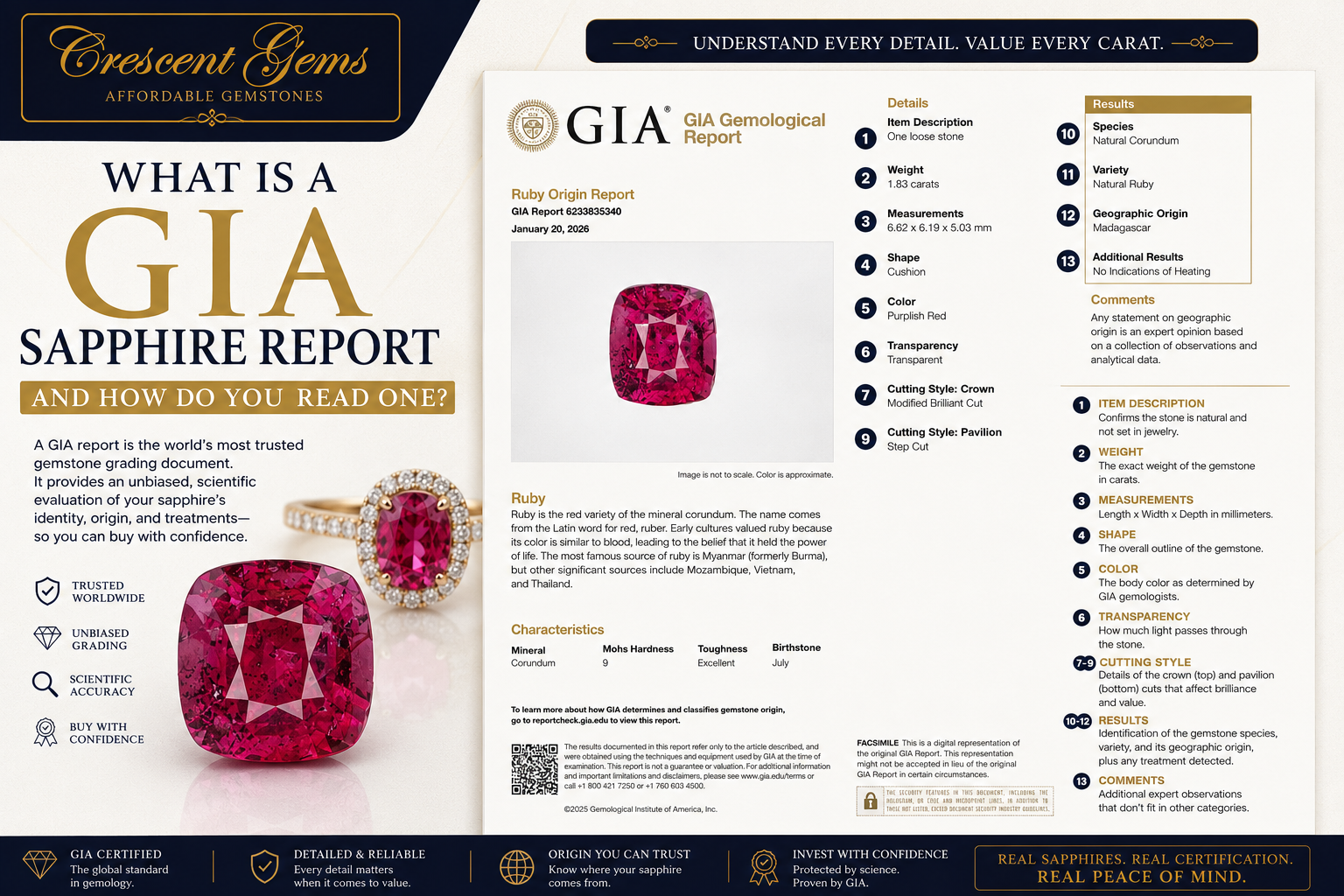
Reading a GIA Sapphire Report: Field by Field

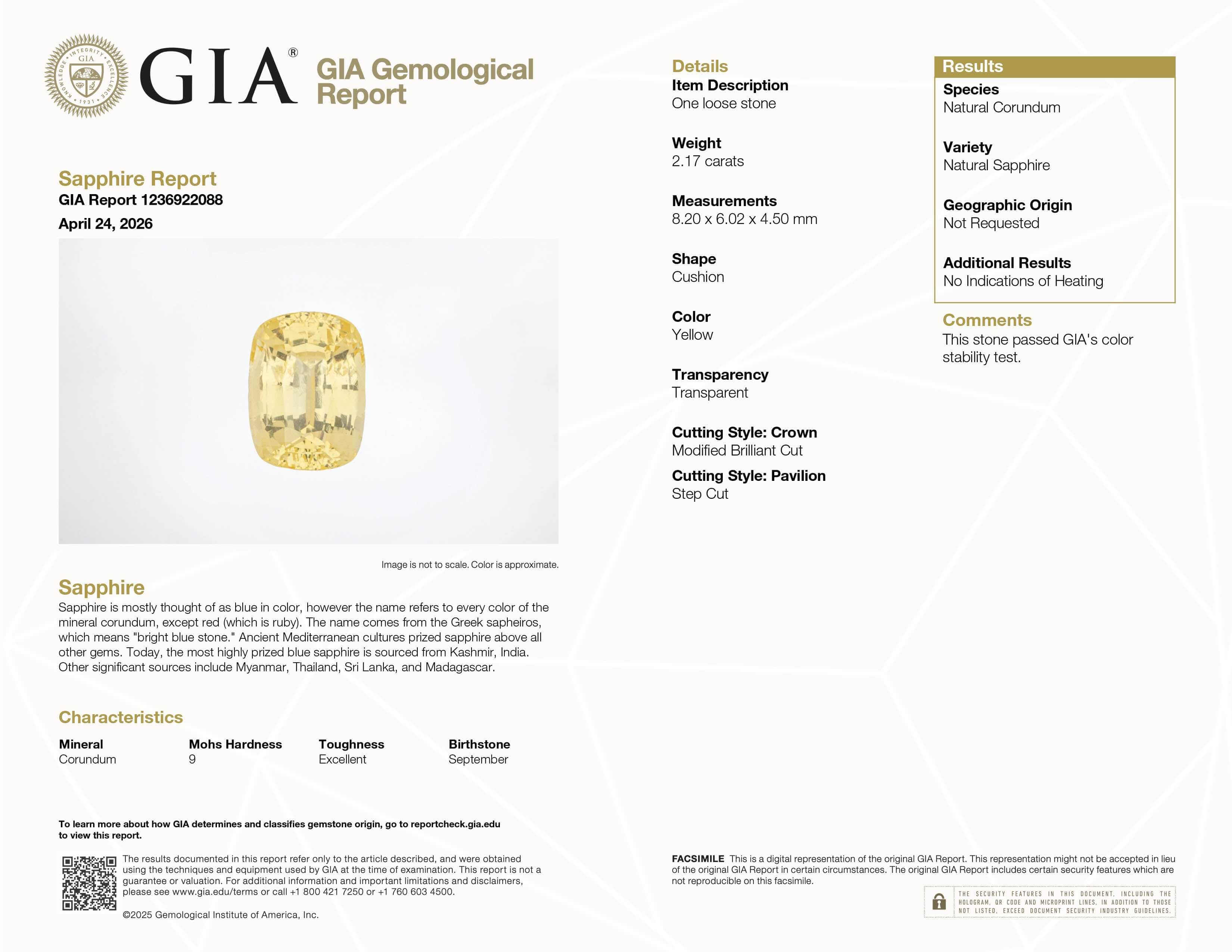
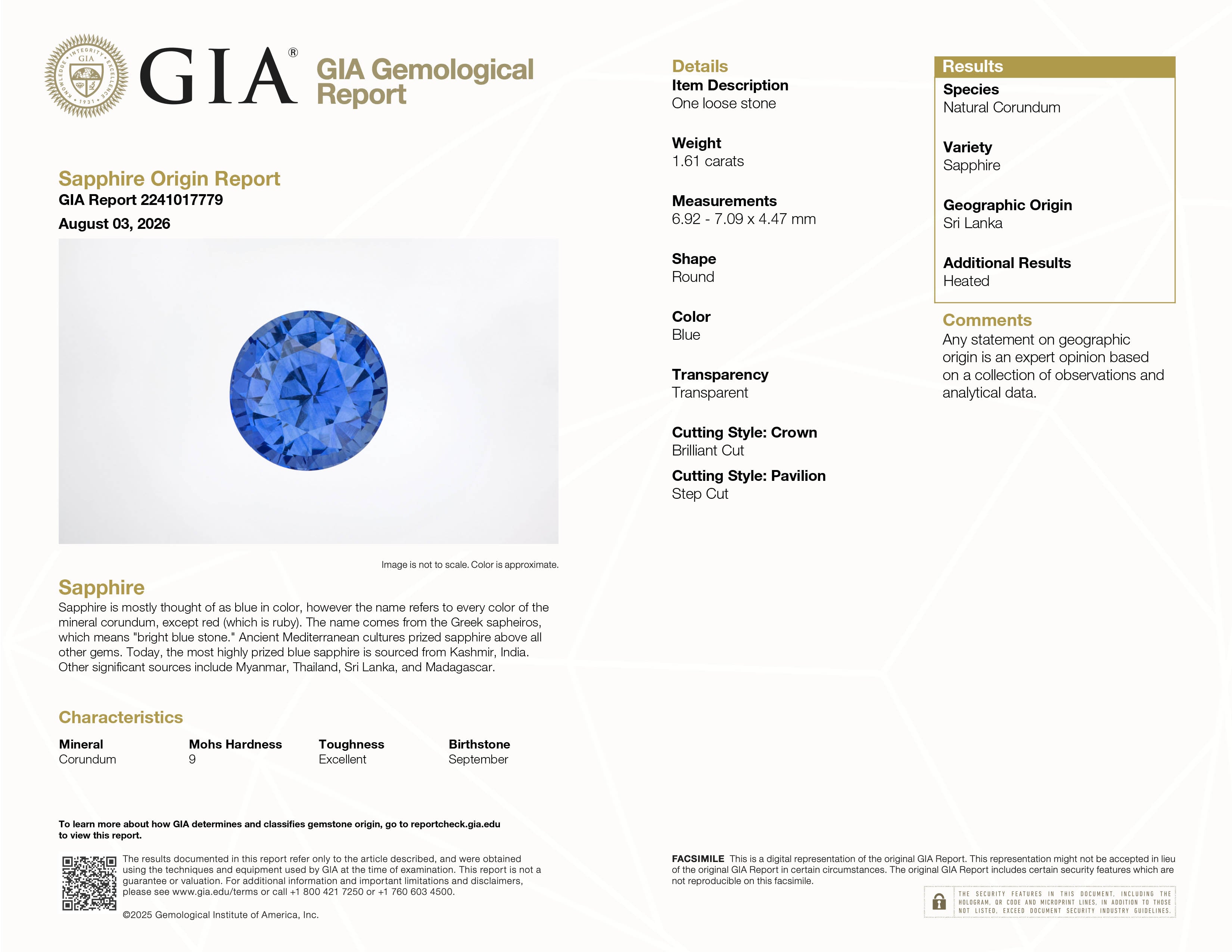
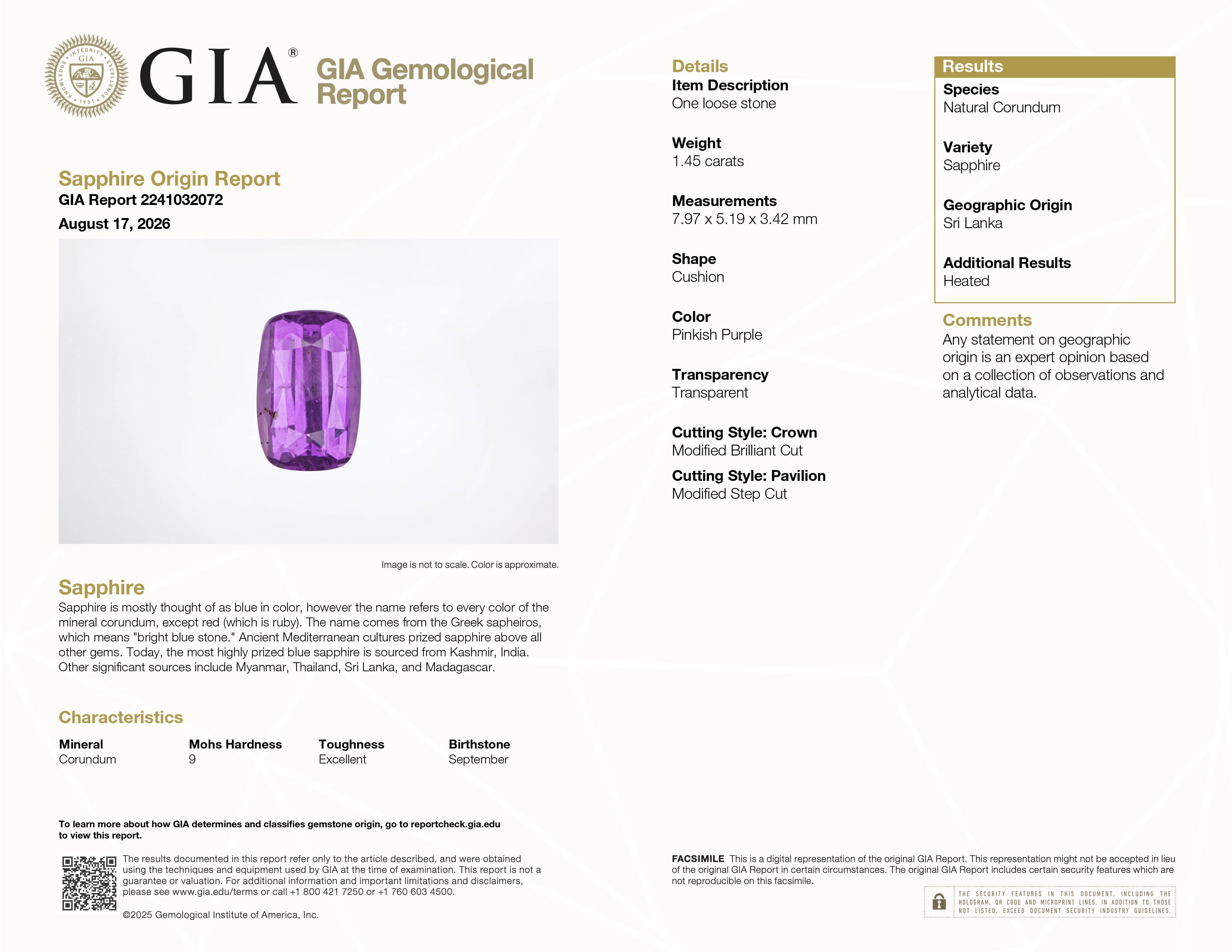
Report Number

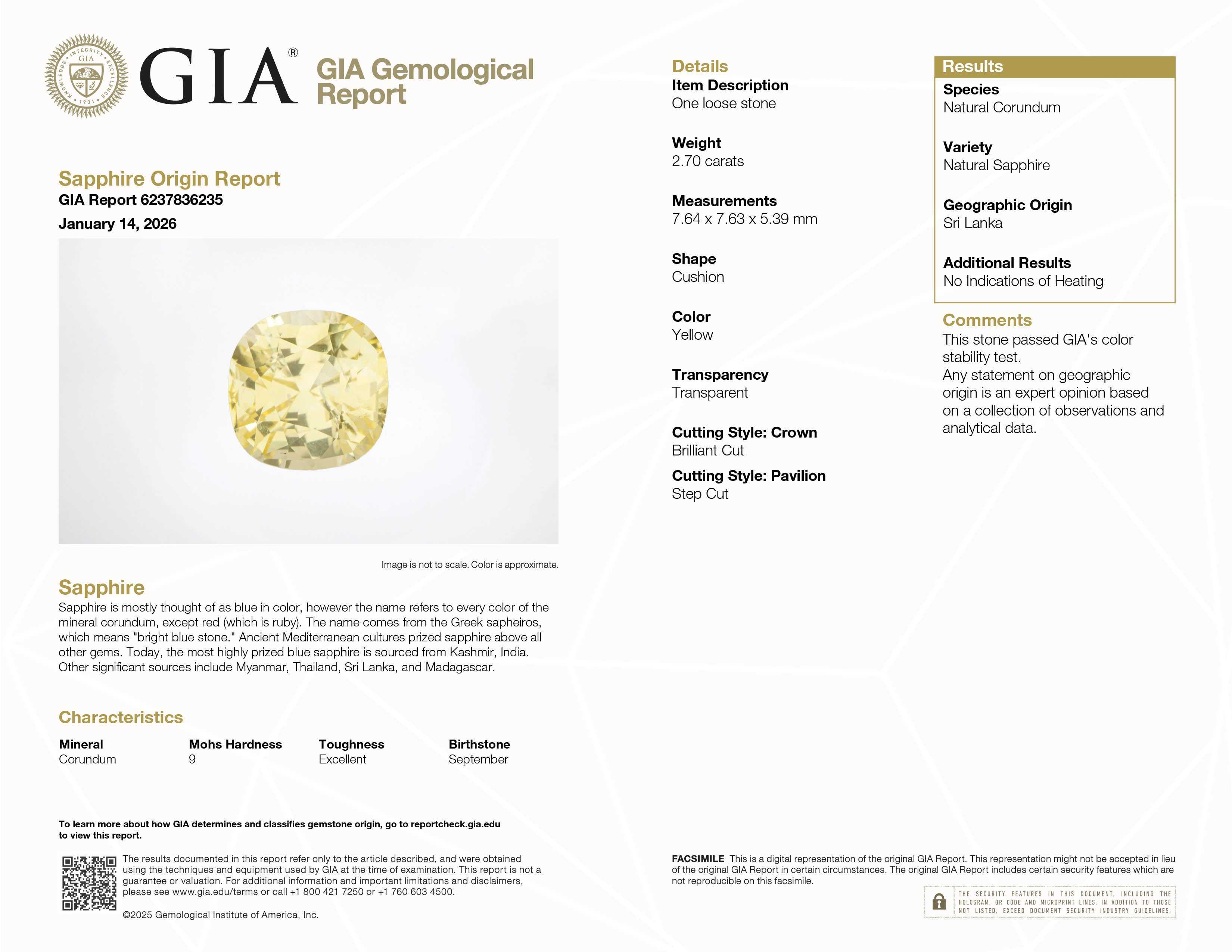
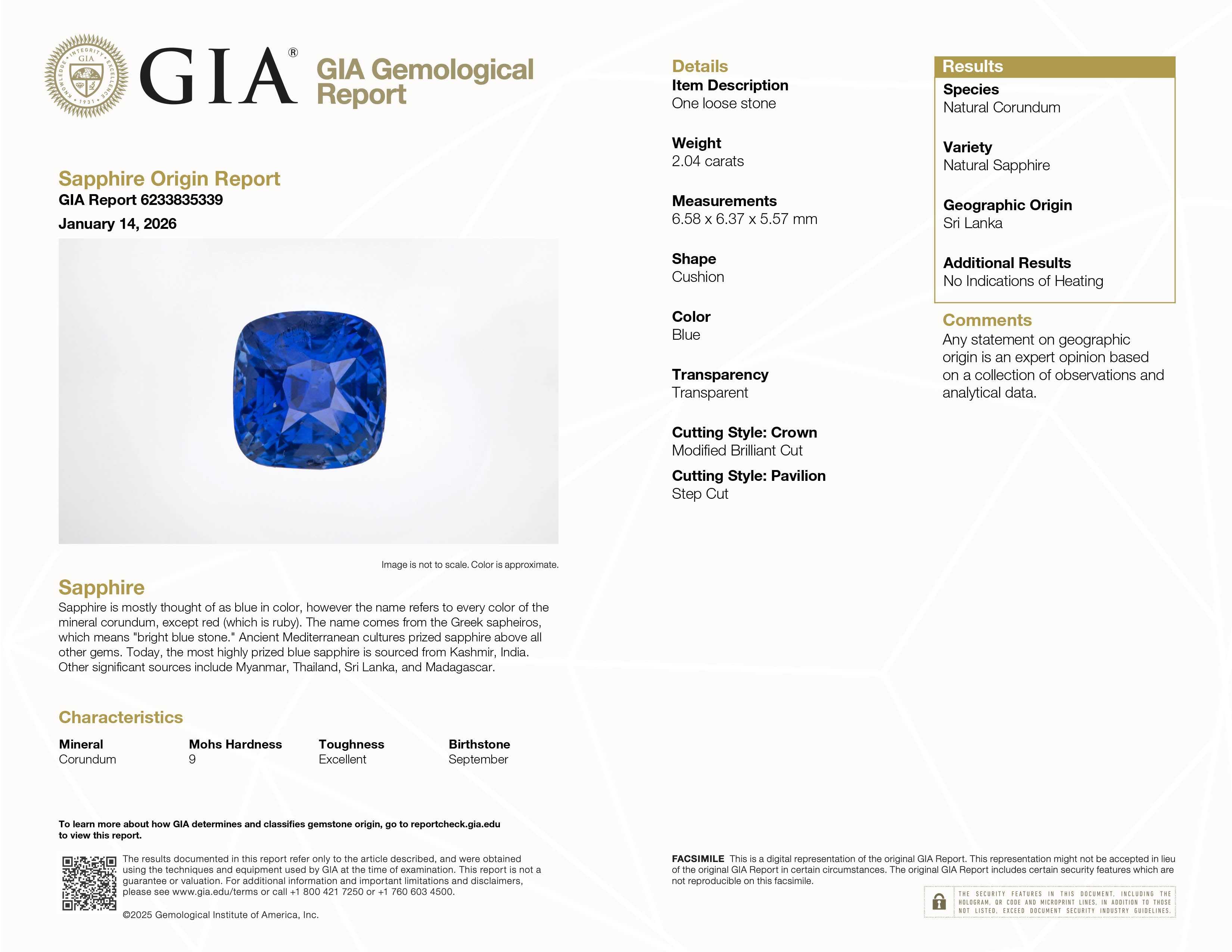
A unique identifier assigned to this specific stone. Every GIA report number is verifiable through GIA's Report Check tool at gia.edu/report-check. Enter the number and the database returns the full report details — confirming the report is genuine and that the stone in front of you matches the documented stone.

Always verify the report number before purchasing. A fraudulent practice occasionally encountered is presenting a genuine GIA report alongside a different stone. Verifying online takes thirty seconds and eliminates this risk entirely.

The report number is also laser-inscribed on the girdle of many certified stones — a thin line of microscopic text visible under 10x magnification that allows the stone and report to be matched even if the paper document is lost.

Date

The date the report was issued. GIA reports do not expire, but an older report date — particularly for a stone that has changed hands multiple times — is worth noting. A report issued ten years ago on a stone now being sold as recently certified warrants closer inspection of the stone against the report's measurements and characteristics.

Shape and Cutting Style

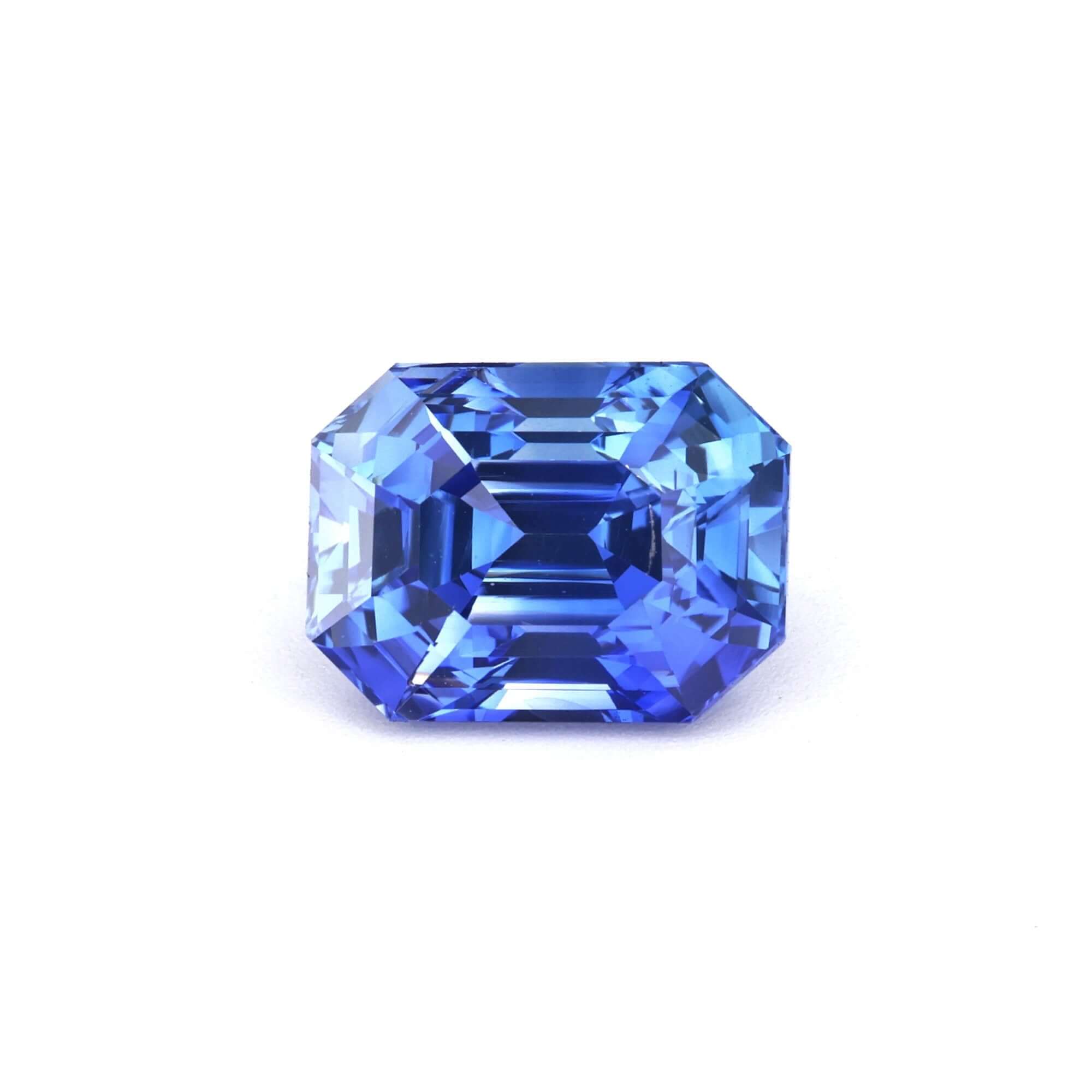
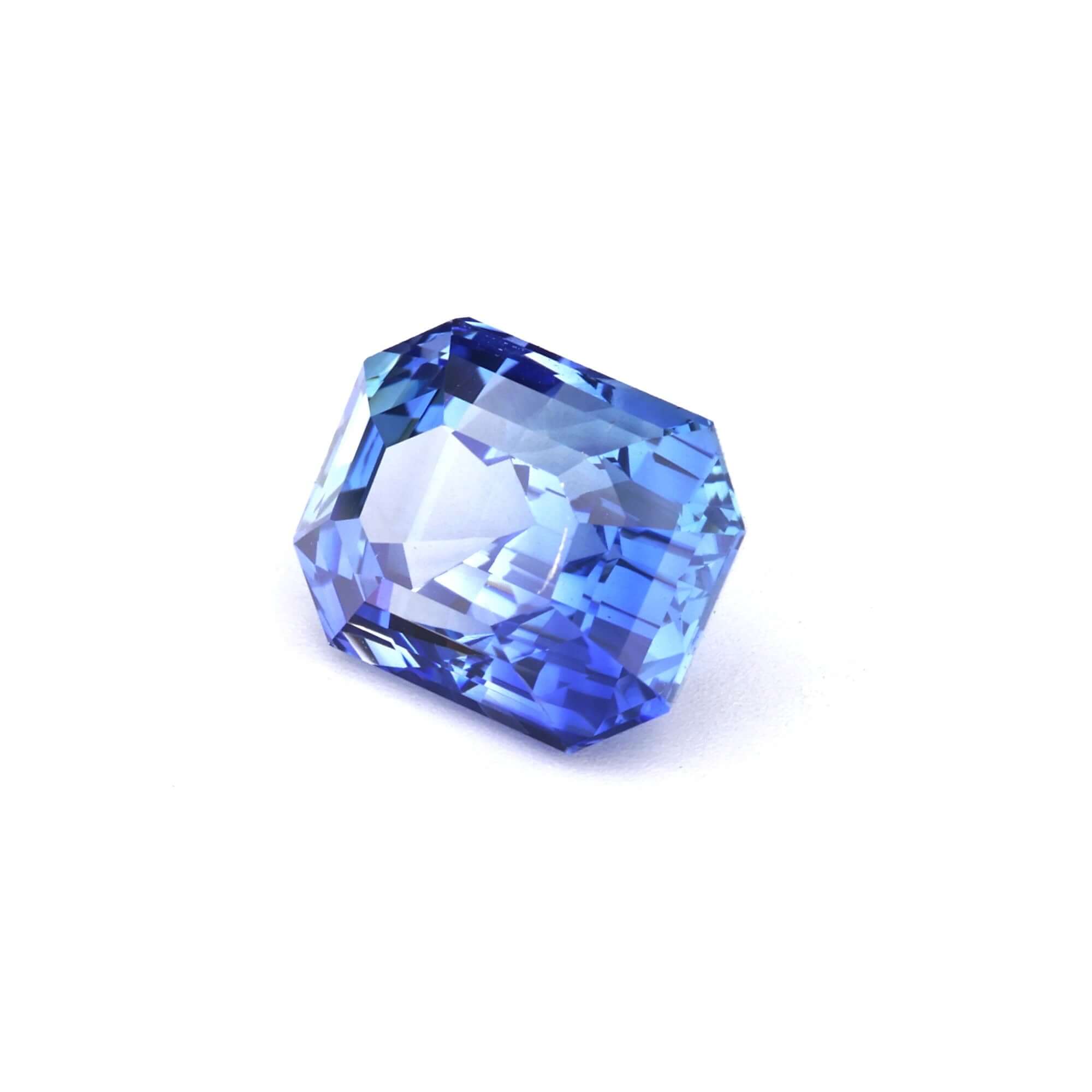
Describes the physical shape of the stone (oval, cushion, round, pear, emerald cut, etc.) and the cutting style of the facet arrangement (brilliant, mixed, step). This confirms you are looking at the same stone that was graded — the combination of shape, cutting style, and measurements should match what you see in front of you.

Measurements

States the physical dimensions of the stone in millimetres, typically length × width × depth for fancy shapes, or diameter (minimum–maximum) × depth for round stones. This is one of the most useful fields for ring buyers: it tells you exactly how large the stone will appear face-up in a setting, independent of carat weight.

Two sapphires of identical carat weight can have very different face-up sizes if they are cut to different depth proportions. A stone cut deep to retain weight appears smaller face-up than a shallower-cut stone of the same weight. Millimetre measurements tell you the actual visible size.

Weight

The carat weight of the stone, stated to two decimal places. One carat equals 0.2 grams. Verify this against the seller's listing — the reported weight and the listed weight should match exactly.

Species and Variety

For a blue sapphire, this field reads:

  • Species: Corundum
  • Variety: Sapphire

Corundum is the mineral species — aluminium oxide (Al₂O₃). Sapphire is the variety name for all corundum that is not red (red corundum is ruby). This field confirms the stone is genuine corundum and not a simulant, synthetic, or different mineral species.

If this field reads anything other than "Corundum / Sapphire" — for example, "Synthetic Corundum" or "Glass" — the stone is not a natural sapphire.

Natural vs Synthetic

Stated explicitly on the report. Natural means the stone formed in the earth through geological processes. Synthetic means it was created in a laboratory. A genuine GIA sapphire report on a natural stone will not describe the stone as synthetic — but confirming this field takes two seconds and eliminates any ambiguity.

Colour

GIA describes color in colored stones using three components:

  • Hue — the primary and secondary color present. For blue sapphires, GIA uses terms such as "Blue," "Violetish Blue," "Bluish Violet," or "Strongly Violetish Blue." A stone described as "Violetish Blue" has blue as its primary hue with violet as a secondary. A stone described as "Bluish Violet" has violet dominant — a distinction that matters to collectors and affects value.
  • Tone — described on a scale from very light to very dark. For blue sapphires, medium to medium-dark is the most commercially desirable range. A "Dark" tone descriptor indicates a heavily saturated, potentially blackish stone under low light. A "Light" tone indicates a pastel, potentially washed-out appearance.
  • Saturation — described from grayish/brownish (low saturation) through moderately strong to vivid (high saturation). "Vivid" saturation is the highest descriptor GIA uses and indicates the most intense, pure colour without grey or brown modifiers.

GIA does not assign a simple A/B/C or Excellent/Good/Poor grade to colored stone color. The written description is the grade. Learning to read hue, tone, and saturation descriptions accurately is the key to interpreting colored stone reports.

Example: A report reading "Violetish Blue / Medium / Vivid Saturation" describes a blue sapphire with a slight violet secondary hue, medium tone (not too light, not too dark), and vivid saturation (clean, intense color without grey). This combination in a Ceylon sapphire represents excellent commercial quality.

Clarity Grade

GIA grades colored stone clarity using the following scale:

  • Eye Clean (EC) — no inclusions visible to the unaided eye at normal viewing distance
  • Slightly Included (SI) — inclusions visible to the unaided eye with some effort
  • Moderately Included (MI) — inclusions noticeable to the unaided eye
  • Heavily Included (HI) — inclusions obvious and potentially affecting transparency
  • Severely Included (SeI) — inclusions so numerous or significant they affect durability or transparency

For engagement ring center stones, Eye Clean (EC) is the standard to look for. Slightly Included (SI) stones may be acceptable depending on the nature of the inclusions — a fine fingerprint inclusion not visible face-up affects the grade less than a dark crystal inclusion visible through the table. Ask the seller to describe what the inclusions are before accepting SI clarity for a center stone.

Cut Grade

GIA does not assign a cut grade to colored stones the way it does for round brilliant diamonds. This reflects the reality that colored stones are cut to optimise color, not to meet standardised brilliance parameters. A sapphire cut deep to concentrate color would be penalised under diamond cut grading criteria but is correct practice for sapphire.

The report states the cutting style and shape but makes no evaluative judgment about cut quality. Evaluating cut quality — checking for windows, extinction, and symmetry — requires looking at the stone directly, not reading the report.

Treatment

This is the most important field on a GIA sapphire report for most buyers. GIA states treatment findings using specific language:

  • "No indications of heating" — the stone shows no gemological evidence of heat treatment. This is the standard language confirming unheated status. Note that it says "no indications" rather than "not heated" — GIA reports what it can and cannot detect, not an absolute statement of the stone's history.
  • "Indications of heating" — evidence of heat treatment is present. This is standard for most commercial sapphires and does not reduce the stone's suitability for jewelry use.
  • "Evidence of heating with residues in fissures" — heat treatment with flux healing; a more aggressive form of treatment. This should be noted as it affects value more significantly than standard heating.
  • "Beryllium" — if beryllium diffusion treatment has been applied, this is stated separately. Beryllium diffusion is a more significant treatment that introduces a foreign element into the stone and affects value considerably. Any orange or yellow sapphire should be checked specifically for this.
  • "None" or "No indications of clarity enhancement" — no fracture filling or other clarity treatment detected.

Read this field carefully. "No treatment" and "no indications of heating" are slightly different statements. The first says no treatment of any kind was detected. The second specifically addresses heat. For a complete picture, check both the colour enhancement field and the clarity enhancement field separately.

Geographic Origin (on upgraded reports)

When geographic origin is included, GIA states an opinion — not a certainty — based on gemological evidence. The report uses language such as "consistent with an origin of Sri Lanka" or "geographic origin: Kashmir." Origin determination is a probabilistic assessment, not a proof of provenance.

Origin designations and their significance for blue sapphire:

  • Sri Lanka (Ceylon) — the most commercially significant origin for fine blue sapphire; medium to medium-vivid blues with slight violet secondary hue; available across a wide price range
  • Myanmar (Burma) — second most coveted origin; tends toward pure, intense blue; significant premium over Ceylon; 2–4x price multiple for confirmed Burmese material of comparable quality
  • Kashmir — the most prized origin; production effectively ended in the early 20th century; any confirmed Kashmir origin dramatically increases value; fine examples above 2ct regularly sell at $50,000–$200,000+ per carat at auction
  • Madagascar — significant commercial producer; some material approaches Ceylon character; generally lower premium than the three primary origins
  • No determination — GIA was unable to determine origin from available evidence; this does not mean the stone is from a lesser origin, only that the evidence was inconclusive

Comments

An optional field used to note specific characteristics that do not fit standard report fields. Common entries include notes on colour distribution (e.g. "colour concentrated in specific zones"), unusual inclusion types, or specific clarity characteristics. Read this section carefully — important qualifications sometimes appear here rather than in the main graded fields.

The Plotting Diagram

On full paper reports, a diagram of the stone shows the location, type, and relative size of significant inclusions using standardised symbols. Red symbols indicate inclusions; green symbols indicate blemishes (surface features). The diagram allows you to locate specific inclusions on the actual stone using a loupe.

Compare the plotting diagram to the actual stone — inclusions should appear where marked. If the stone shows significant inclusions not plotted on the diagram, it may not be the same stone the report was issued for.


How to Verify a GIA Report Is Genuine

Verifying a GIA report takes under a minute and should be done before any significant purchase.

  1. Go to gia.edu/report-check
  2. Enter the report number shown on the document
  3. The database returns the full report — confirm all fields match the physical document and the stone being sold
  4. Check the girdle of the stone under 10x magnification for the laser inscription matching the report number

If the report number does not appear in GIA's database, the report is not genuine. If the database returns a report but the details (weight, measurements, species) do not match the stone or document presented, the report belongs to a different stone.


GIA vs Other Laboratories: When GIA Is and Is Not the Right Choice

GIA is the most widely recognised laboratory globally, but it is not always the most appropriate choice for every sapphire.

AGL (American Gemological Laboratories) is often preferred by American collectors for its detailed treatment analysis and quality designation ("Fine," "Exceptional") that GIA does not include. AGL reports are particularly strong for treatment disclosure and are respected by the US auction market.

Gübelin (Switzerland) is the preferred laboratory for auction-grade stones, particularly for Kashmir and Burma origin determination. Gübelin origin opinions are considered the most authoritative in the market and are required by some auction houses for stones being presented as Kashmir or Burmese.

SSEF (Swiss Gemmological Institute) is similarly authoritative for origin determination, particularly Ceylon, Kashmir, and Burma. SSEF and Gübelin reports are often paired on important stones going to auction.

GRS (Gem Research Swisslab) uses its own quality terminology, notably the designation "Pigeon's Blood" for fine rubies and "Royal Blue" for fine blue sapphires — these are GRS-specific quality descriptors that have no standardised meaning outside GRS reports but are recognised by many collectors.

For most buyers purchasing a Ceylon sapphire for engagement ring use, a GIA report is fully sufficient and the most straightforward to present and verify. For investment-grade purchases above $5,000 per carat — particularly any stone being considered as Kashmir or Burmese — Gübelin or SSEF confirmation adds meaningful value and market confidence.


What a GIA Report Cannot Tell You

Understanding the limits of a GIA report is as important as understanding what it confirms.

  • It does not assess cut quality. A beautifully proportioned stone and a windowed, poorly balanced stone can receive identical GIA reports. Visual assessment of the stone itself is irreplaceable.
  • It does not assign a value. The report contains no price information. Market value is determined by current trading conditions, comparable sales, and the specific combination of characteristics in the stone.
  • Origin is an opinion, not a proof. GIA states that origin determination is based on available gemological evidence. It is possible for a stone to be described as "consistent with Sri Lanka" without absolute certainty that it originated there.
  • It does not guarantee future treatment detection. If a stone is subsequently treated after the report is issued — an unusual but possible scenario for certain treatments — the report does not reflect that treatment. The report date represents the state of the stone when examined.
  • Beryllium requires specific testing. Standard GIA reports test for heat treatment but beryllium diffusion requires additional LA-ICP-MS analysis. Confirm whether beryllium testing was included, particularly for yellow and orange sapphires.

Practical Checklist: Using a GIA Report When Buying a Sapphire

  1. Verify the report number at gia.edu/report-check — confirm all details match
  2. Check the girdle inscription under magnification — confirm it matches the report number
  3. Read the Species and Variety field — confirm it reads "Corundum / Sapphire" and "Natural"
  4. Read the Treatment field in full — note whether it says "no indications of heating" or "indications of heating"; check for any mention of beryllium or flux
  5. Read the Colour description — hue, tone, and saturation; assess whether this matches what you see in the stone under normal viewing conditions
  6. Check the Clarity grade — confirm eye-clean (EC) for a center stone, or understand what the inclusions are if SI is stated
  7. Confirm the measurements match the listing — check both millimetre dimensions and carat weight
  8. Read the Comments field — note any qualifications or specific characteristics mentioned
  9. Review the plotting diagram if present — locate noted inclusions on the actual stone
  10. Confirm the report date is consistent with when the stone was acquired by the current seller

A GIA report is a powerful tool when read correctly. It removes the buyer's dependence on the seller's word for the most critical facts about a stone — what it is, what has been done to it, and where it came from. Used alongside a direct assessment of the stone itself, it provides the foundation for a confident, well-documented purchase.

Crescent Gems references laboratory certification on all applicable listings, with report numbers stated directly on product pages for certified stones. For stones without existing certification, we can facilitate GIA or other laboratory submission on request.

Browse certified natural sapphires at Crescent Gems →

Continue Learning
Return to the Ultimate Sapphire Buying Guide for the full picture on colours, origins, shapes, certification, and pricing — everything you need to buy a natural loose sapphire with confidence.


Ahmed Shareek — Crescent Gems

Ahmed Shareek

Proprietor — Crescent Gems

A gem dealer with over 25 years of experience sourcing natural sapphires from Sri Lanka, Ahmed brings hands-on expertise in mining, heat treatment, cutting, and stone selection. With deep roots in the Ceylon gem trade, he offers first hand knowledge of origin, quality, and craftsmanship behind every piece of guidance on this site.

Latest Stories

View all

The Ultimate Guide to Buying Natural Loose Sapphires

The Ultimate Guide to Buying Natural Loose Sapphires

The definitive guide to buying a natural loose sapphire: colour, origin, treatment, cut, shape, certification, pricing, and engagement rings, with links to every Crescent Gems guide and collection.

Read moreabout The Ultimate Guide to Buying Natural Loose Sapphires

The Ratnapura Gem Market — How Sapphires Are Traded at the Source

The Ratnapura Gem Market — How Sapphires Are Traded at the Source

New to buying sapphires? Start with our Ultimate Sapphire Buying Guide — the complete resource for color, origin, treatment, and pricing. Ratnapura means "City of Gems" in Sinhalese, and it is not a poetic name — it is a literal...

Read moreabout The Ratnapura Gem Market — How Sapphires Are Traded at the Source

Madagascar Sapphire — The Modern Origin That Rivals Ceylon

Madagascar Sapphire — The Modern Origin That Rivals Ceylon

New to buying sapphires? Start with our Ultimate Sapphire Buying Guide — the complete resource for color, origin, treatment, and pricing. If you have shopped for sapphires in the past decade, you have encountered Madagascar material — whether the listing...

Read moreabout Madagascar Sapphire — The Modern Origin That Rivals Ceylon

Montana Sapphire vs. Ceylon Sapphire — How America's Sapphire Compares to Sri Lanka's

Montana Sapphire vs. Ceylon Sapphire — How America's Sapphire Compares to Sri Lanka's

New to buying sapphires? Start with our Ultimate Sapphire Buying Guide — the complete resource for color, origin, treatment, and pricing. The United States has its own sapphire origin — and it is a good one. Montana has produced gem-quality...

Read moreabout Montana Sapphire vs. Ceylon Sapphire — How America's Sapphire Compares to Sri Lanka's

Sapphire vs. Spinel — The Overlooked Comparison Every Collector Should Understand

Sapphire vs. Spinel — The Overlooked Comparison Every Collector Should Understand

New to buying sapphires? Start with our Ultimate Sapphire Buying Guide — the complete resource for color, origin, treatment, and pricing. For most of gemological history, spinel did not even have its own name. The great "rubies" of royal collections...

Read moreabout Sapphire vs. Spinel — The Overlooked Comparison Every Collector Should Understand

Why Buy from Crescent Gems
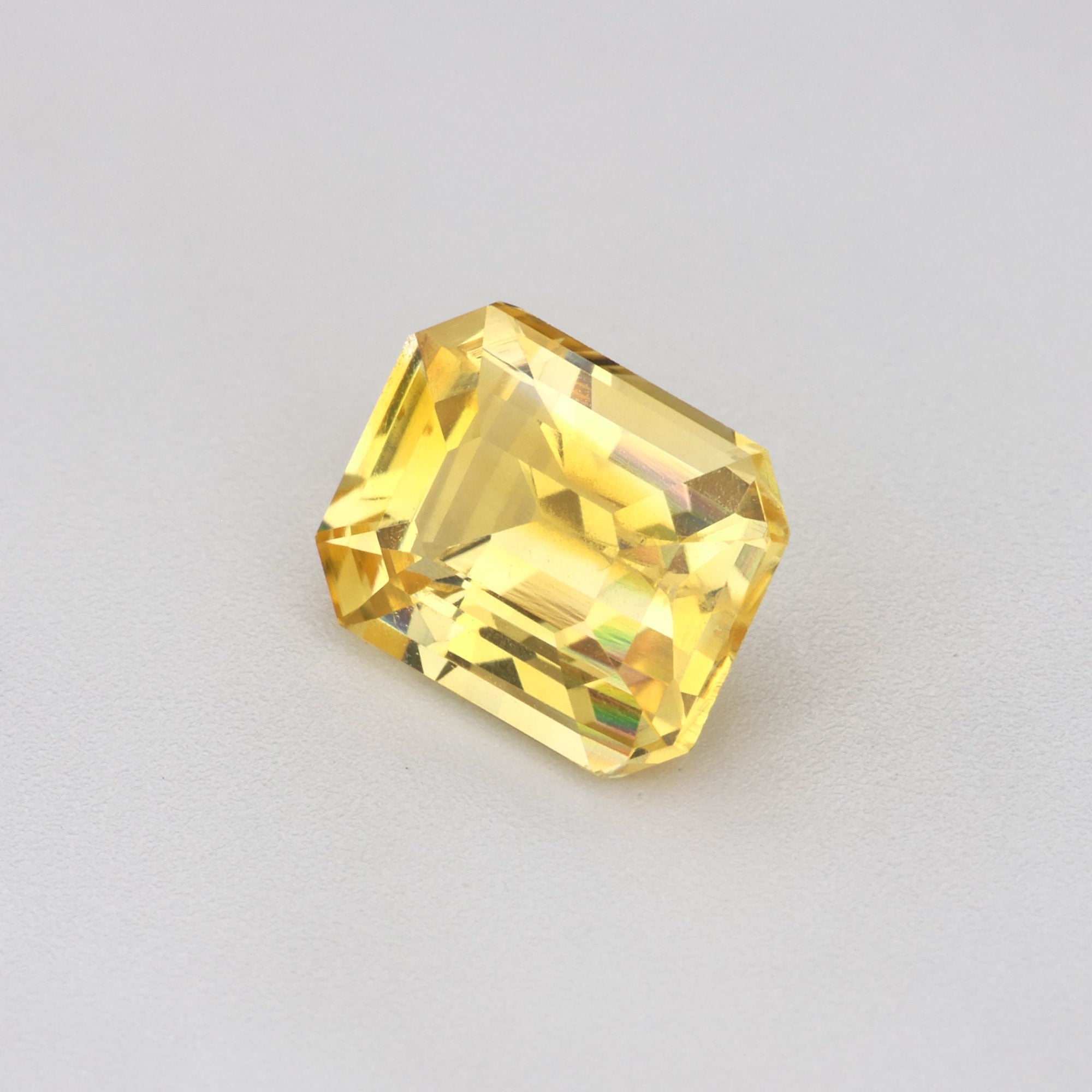
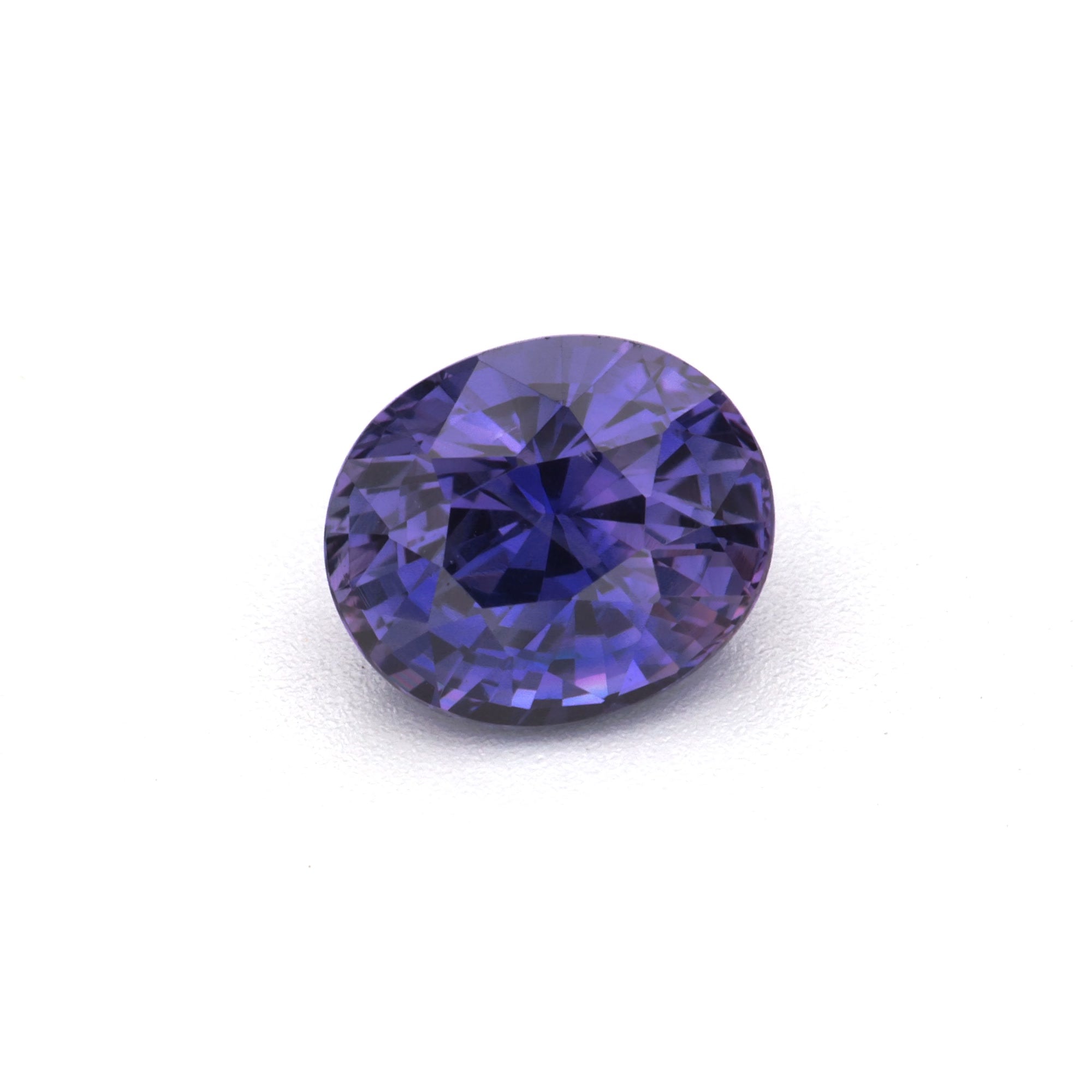
Sourcing Gemstones for an engagement ring or piece of jewelry is a very personal experience, Its a act of love, Its a Investment that you do only a few times in your life. Before you spend thousands of $$$ You need to be able to trust the seller and make sure you are choosing the right stone. Here at Crescent gems we tick all the boxes.

Wide Selection of well cut gemstones from around the world.

Affordably priced ~ We source our gemstones direct from mining countries, we cut/recut most of our gemstones in-house.

We stock and sell ONLY Natural earth Mined stones. NO beryllium treated Stones, NO Flux filled, NO synthetics, NO man made stuff.

Free & Fast Shipping within USA ( FedEx Or UPS) with Tracking and email updates.

FREE International shipping for orders over US $ 500 ~ we ship to 98 countries Worldwide.

Try Before you buy Option ~ where we send the stone to you before you pay. ~ Unique Feature.

14 day No questions asked money back Guarantee.

FREE Domestic Return Shipping.

GIA lab reports for all stones above 2 carats.

Accurate information, Actual Images, Hand shots and 360 videos of the stone on sale, we don't use stock photography.

Join our ever growing group of satisfied customers from around the world.