

- by Ahmed Shareek
Kashmir Sapphire — Mining, Availability, Premium Pricing, and the Investment Case
- by Ahmed Shareek
New to buying sapphires? Start with our Ultimate Sapphire Buying Guide — the complete resource for color, origin, treatment, and pricing.
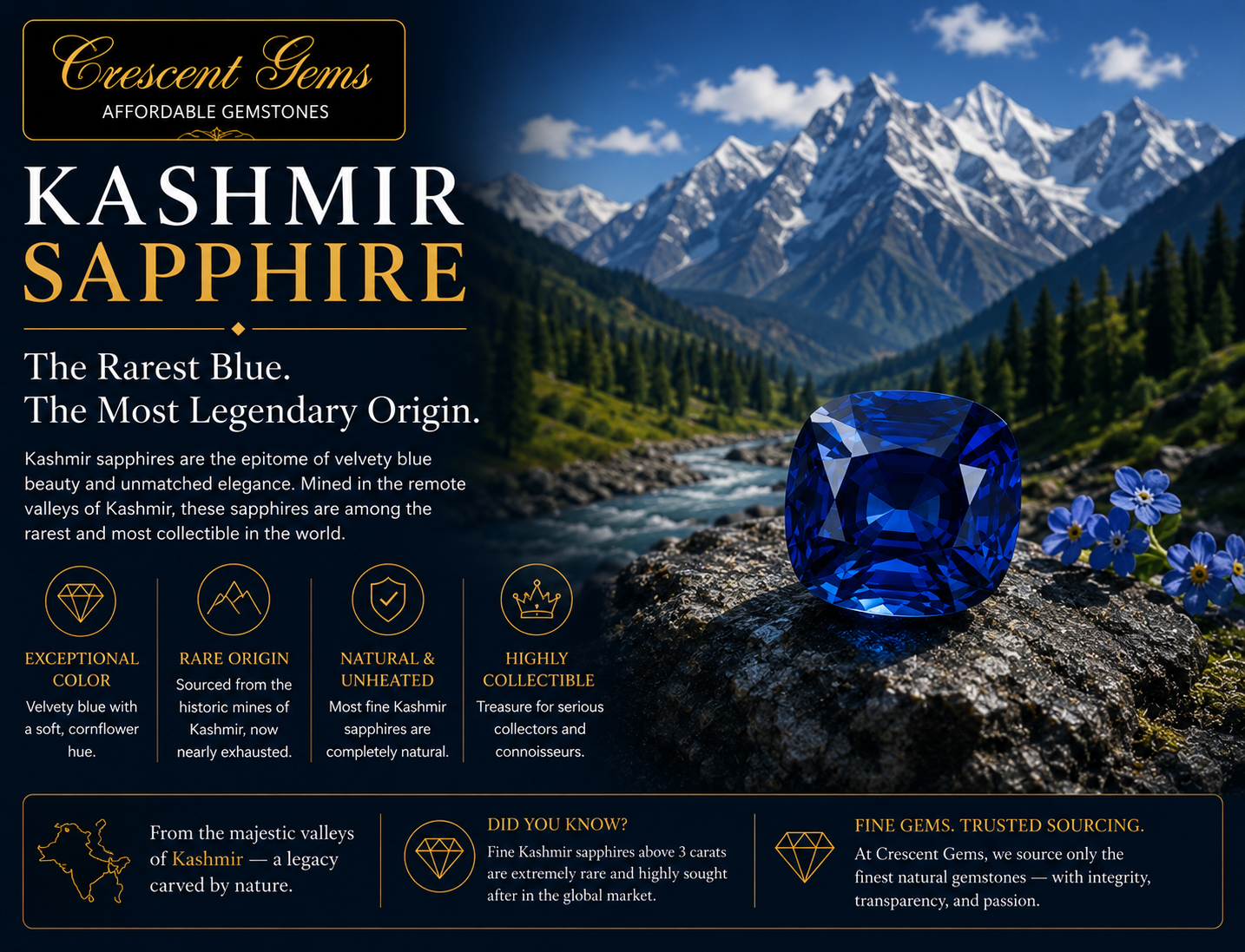
Kashmir sapphire is the most expensive colored gemstone per carat that exists. Not the most expensive sapphire — the most expensive colored gemstone of any kind. A fine Kashmir blue sapphire above 5 carats can command $200,000 to $500,000 per carat at auction, and record-breaking stones have exceeded $1 million per carat. These are numbers that rival the world's finest diamonds and surpass every other colored stone origin by a factor of three to ten.
The prices are not arbitrary. They reflect the intersection of three forces that will never reverse: a color quality that is unique in gemology, a deposit that is functionally exhausted, and a collector market that has decided Kashmir sapphire is the pinnacle of natural beauty in corundum. Understanding how these forces work — and what they mean for buyers at every level — is the purpose of this article.
The Kashmir sapphire deposit was discovered by accident in 1881, when a landslide high in the Zanskar Range of the western Himalayas exposed a pocket of vivid blue crystals at an altitude of approximately 4,500 meters (14,800 feet) in the Paddar region of what is now the Indian state of Jammu and Kashmir. Local villagers collected crystals from the exposed surface and traded them, initially without understanding their value. When the stones reached gem markets in Delhi and eventually Europe, their quality was immediately recognized as extraordinary.
The Maharaja of Kashmir dispatched guards to secure the site and organized systematic extraction. The initial surface collection from 1882 to 1887 — known as the "Old Mine" period — produced the finest Kashmir sapphires ever recovered, the stones that established the legendary reputation the origin carries today. These Old Mine stones are the benchmark against which all subsequent Kashmir production (and all other sapphire origins) are measured.
A second phase of mining occurred intermittently from the late 1880s through the early 1900s, producing additional material but generally of lower average quality than the initial Old Mine production. By the 1930s, the accessible deposit was largely exhausted. Sporadic government-sponsored mining attempts have occurred since, most recently in the 2000s, but have produced only small quantities of material, much of it below the quality threshold that commands the Kashmir premium.
The Kashmir sapphire deposit is a primary occurrence — the sapphires formed in situ within their metamorphic host rock, a geological setting called a "pegmatitic vein" intruding into crystalline limestone and schist. Unlike Sri Lanka's alluvial deposits, where gems are loose in gravel and can be extracted by washing (see Pit Mining in Sri Lanka), Kashmir sapphires must be chiseled or blasted from solid rock at extreme altitude in one of the most inaccessible mountain environments on Earth.
The deposit sits at 4,500 meters — above the tree line, above most permanent habitation, and accessible only during the brief summer months when the passes leading to the site are free of snow. The working season is approximately three to four months per year. Workers must trek for days to reach the site, carrying their supplies, tools, and fuel on foot or by pack animal. There is no road access, no electricity, no permanent shelter, and no modern infrastructure of any kind.
At this altitude, physical labor is exhausting. The air contains approximately 60% of the oxygen available at sea level. Temperatures drop below freezing at night even in summer. Weather can change rapidly and violently, with storms that make exposed rock faces dangerous. These conditions limit the number of workers who can operate effectively, the length of the working day, and the amount of rock that can be moved in a season.
The primary deposit — the pegmatitic vein that produced the original Old Mine stones — was small. It was not a extensive formation like Sri Lanka's alluvial gravel beds or Madagascar's Ilakaka deposit. It was a localized geological event: a specific vein, in a specific rock formation, at a specific point on a mountain. The finest material was concentrated in pockets within this vein, and those pockets were largely emptied during the initial extraction period of the 1880s.
Subsequent mining has explored extensions of the original vein and surrounding rock formations, occasionally finding additional sapphire-bearing zones. But the production has been sporadic, the quality inconsistent, and the volume tiny compared to the initial bonanza. The deposit is not completely exhausted in the geological sense — there may be additional sapphire-bearing rock at depth or in unexplored extensions — but the practical and political challenges of mining at this location make large-scale production effectively impossible.
The Kashmir sapphire deposit is located in one of the most geopolitically contested regions on Earth — the territory disputed between India and Pakistan since 1947. The mine falls within Indian-administered Jammu and Kashmir, in an area with restricted access for security reasons. Government permits are required for any mining activity, and those permits have been issued intermittently and unpredictably. The combination of political sensitivity, military security zones, and bureaucratic complexity makes sustained commercial mining operations impractical regardless of the geological potential.
The Kashmir sapphire premium is ultimately about one thing: the color. Specifically, a color quality that no other origin has consistently replicated.
Fine Kashmir sapphires display a quality variously described as "velvety," "sleepy," "luminous," or "glowing" — a soft, internally lit blue that appears to emanate from within the stone rather than reflecting off its surface. This quality is produced by extremely fine, evenly distributed rutile silk throughout the crystal. The silk particles are too small to reduce transparency significantly but large enough to scatter light internally, creating a soft diffusion effect that is visually unique.
This is the same rutile silk that produces the star effect in star sapphires and that dissolves during heat treatment to release titanium into the lattice. In Kashmir sapphires, the silk density hits a sweet spot: enough to create the velvety glow, not enough to cloud the stone. And because Kashmir sapphires are virtually never heated, the silk remains intact exactly as nature arranged it. See How to Read Sapphire Inclusions.
The ideal Kashmir hue is described as "cornflower blue" — a medium-toned, vivid, slightly violet-tinged blue with strong saturation and no grayish, greenish, or inky modifiers. It is neither too light (which would lack presence) nor too dark (which would lose color under indoor lighting). The combination of this specific hue with the velvety silk texture creates a visual impression that is immediately recognizable to anyone who has seen a fine Kashmir stone.
Other origins can produce cornflower blue. Fine Ceylon sapphires, Burmese sapphires, and exceptional Madagascar stones can achieve the color. What they rarely achieve is the combination of cornflower hue with the velvety silk texture. The color alone is reproducible; the combination is what makes Kashmir Kashmir.
Kashmir sapphires are virtually never heated. The natural color is already the standard by which all other blues are judged — there is nothing to improve. And heating would dissolve the rutile silk that produces the velvety quality, destroying the very characteristic that makes the stones exceptional. By nature and by market logic Kashmir sapphires are overwhelmingly unheated stones — but that is an expectation, not a certificate: SSEF, Gubelin and AGL reports state heat status for each stone, and that line is what a buyer at this level is paying to read. See What Is an Unheated Sapphire?
This is the single most important market reality for Kashmir sapphire: no new supply is entering the market in meaningful quantities.
The total production of fine Kashmir sapphires over the entire history of the deposit — from 1881 to today — is estimated at a few thousand carats of gem quality. Not thousands of stones — thousands of carats total. The number of fine Kashmir sapphires above 5 carats that exist in the world is measured in hundreds, not thousands. Above 10 carats, the number is in the dozens.
Every Kashmir sapphire sold today is a stone that was mined decades or centuries ago and is being resold from an existing collection. When a Kashmir sapphire appears at auction, it is coming out of a private collection, an estate, or a dealer's inventory. It is not a new discovery. The supply is fixed and, as stones enter permanent institutional or private collections, it is shrinking.
This supply reality is the foundation of Kashmir pricing. It is not marketing. It is not hype. It is arithmetic: finite supply, rising demand, and no possibility of new production at meaningful scale.
Kashmir sapphire pricing operates on a different scale from any other sapphire origin. These are approximate ranges for stones with Gübelin or GIA documentation confirming Kashmir origin:
| Size | Quality | Approximate $/ct | Context |
|---|---|---|---|
| 1–2ct | Fine | $15,000–$50,000 | Entry-level Kashmir |
| 3–5ct | Fine | $50,000–$150,000 | Serious collector / investment |
| 5–10ct | Fine | $100,000–$300,000 | Major auction territory |
| 10ct+ | Exceptional | $200,000–$500,000+ | World-class; museum quality |
Figures above are approximate market guidance, not fixed quotes. Actual value varies by treatment, origin, colour, cut, clarity, and certification.
For comparison, fine unheated Ceylon blue sapphire at 3–5ct trades at $4,000–$10,000 per carat. Fine Burma trades at $8,000–$25,000. Kashmir trades at 3–10× the price of the next most expensive origin for equivalent size. See Sapphire Pricing Explained for the full pricing framework.
Kashmir sapphire has been one of the strongest performing alternative investment assets over the past three decades. The investment case rests on fundamentals that are difficult to replicate in any other asset class:
Supply is fixed and declining as stones enter permanent collections. Demand is growing as wealth creation in Asia, the Middle East, and the West produces more collectors competing for fewer stones. This is the most favorable supply-demand dynamic possible for an asset: genuinely finite supply meeting structurally rising demand.
Fine Kashmir sapphires have appreciated at an estimated 8–15% per year over the past 20 years, with the most exceptional stones appreciating at 15–25% annually. A Kashmir sapphire purchased at auction for $50,000 per carat in 2005 might command $150,000–$200,000 per carat today. These are returns that most financial assets have not matched over the same period.
A Kashmir sapphire worth $1 million weighs less than a gram and fits in a coat pocket. It requires no electricity, no internet connection, no custodian, and no financial institution to hold. It does not appear on any database, registry, or public record (unless voluntarily disclosed). For high-net-worth individuals seeking portable, private, tangible wealth storage, gemstones offer characteristics that financial assets do not.
Kashmir sapphire investment carries real risks that must be acknowledged:
If you are considering a Kashmir sapphire purchase — whether for collection or investment — the non-negotiable requirements are:
| Factor | Kashmir | Ceylon |
|---|---|---|
| Color character | Velvety cornflower with silk glow | Bright, transparent, vivid |
| Supply | Functionally exhausted | Active, sustainable production |
| Availability | Secondary market only | Readily available new production |
| Price (fine, 3ct) | $50,000–$150,000/ct | $4,000–$10,000/ct |
| Treatment | Virtually never heated | Both heated and unheated |
| Color range | Blue only | Every sapphire color |
| Investment profile | Strong appreciation; thin liquidity | Moderate appreciation; good liquidity |
| Accessible to most buyers? | No — ultra-high-net-worth only | Yes — available at every budget |
Figures above are approximate market guidance, not fixed quotes. Actual value varies by treatment, origin, colour, cut, clarity, and certification.
For the vast majority of sapphire buyers — those purchasing for engagement rings, personal jewelry, or moderate collection — Ceylon sapphire offers the best combination of beauty, availability, value, and investment potential. Kashmir is for buyers operating at a fundamentally different price tier, where the purchase is as much about asset allocation as it is about the gemstone.
Read the full origin guides: Ceylon Sapphire Complete Guide and Montana vs. Ceylon Sapphire.
The market for Kashmir sapphires has created a secondary market for stones from other origins that display the "Kashmir look" — the velvety, silky blue quality associated with Kashmir. Fine unheated Ceylon sapphires with dense silk occasionally achieve a similar visual effect, as do exceptional stones from Burma and (rarely) Madagascar. These stones carry a premium within their own origin category but cost a fraction of genuine Kashmir.
The distinction is important: a fine unheated Ceylon sapphire with velvety quality is a beautiful and valuable stone. But it is a Ceylon sapphire with Kashmir-like characteristics, not a Kashmir sapphire. The laboratory report determines the origin, and the origin determines the price tier. No matter how closely a Ceylon stone resembles Kashmir visually, it trades at Ceylon prices — which, for fine unheated blue above 3ct, still means $4,000–$10,000 per carat. That is not a consolation prize; it is an exceptional gemstone at a fraction of Kashmir pricing.
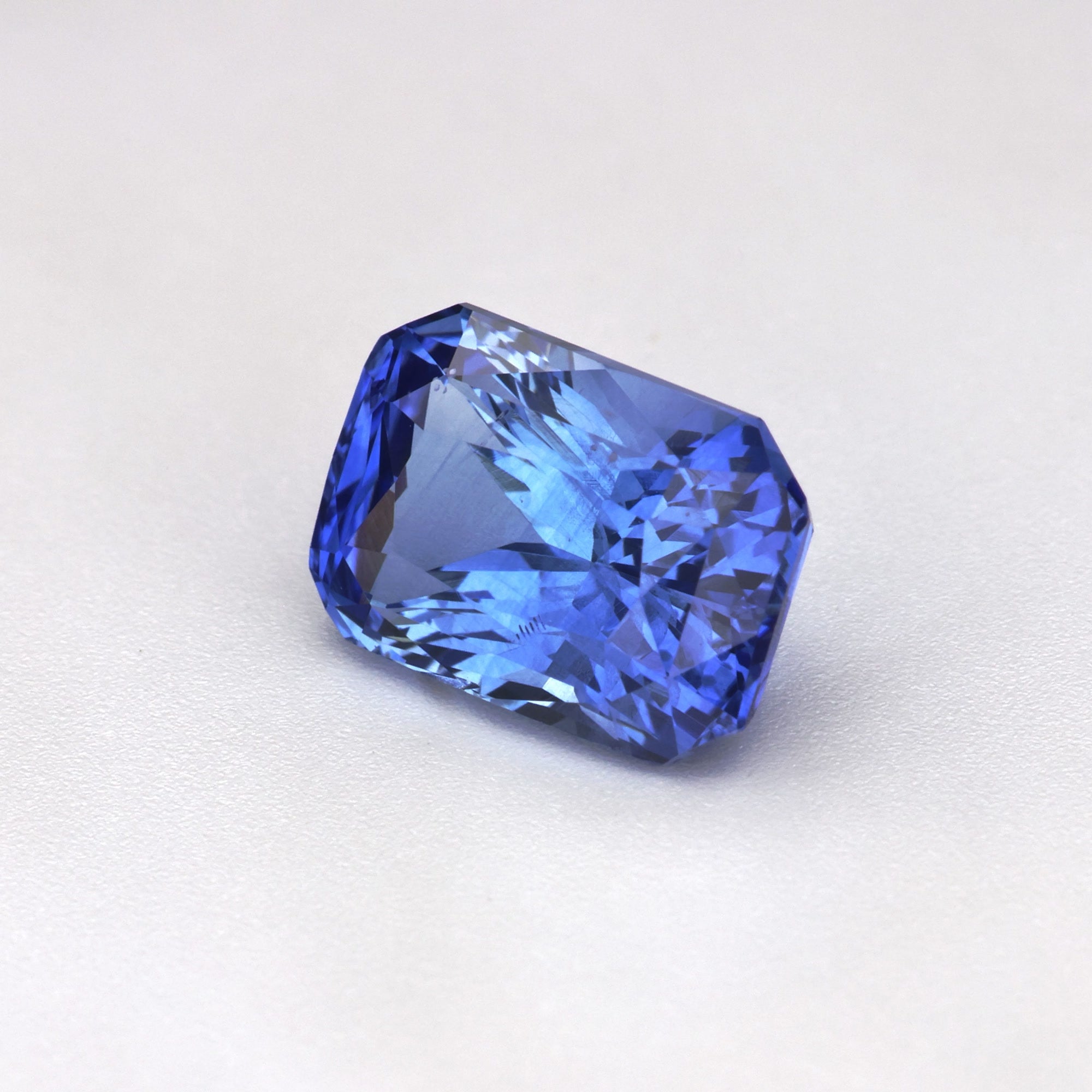
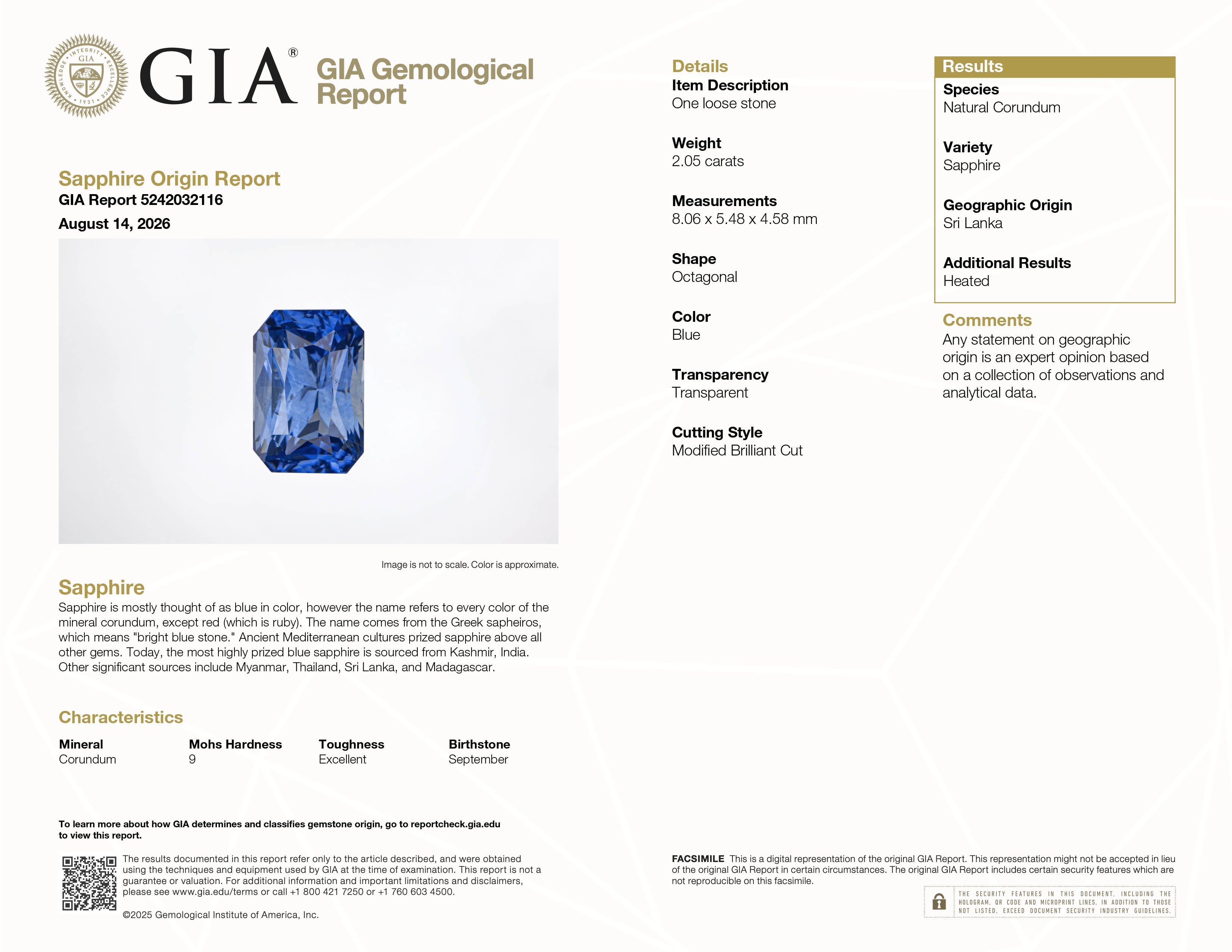
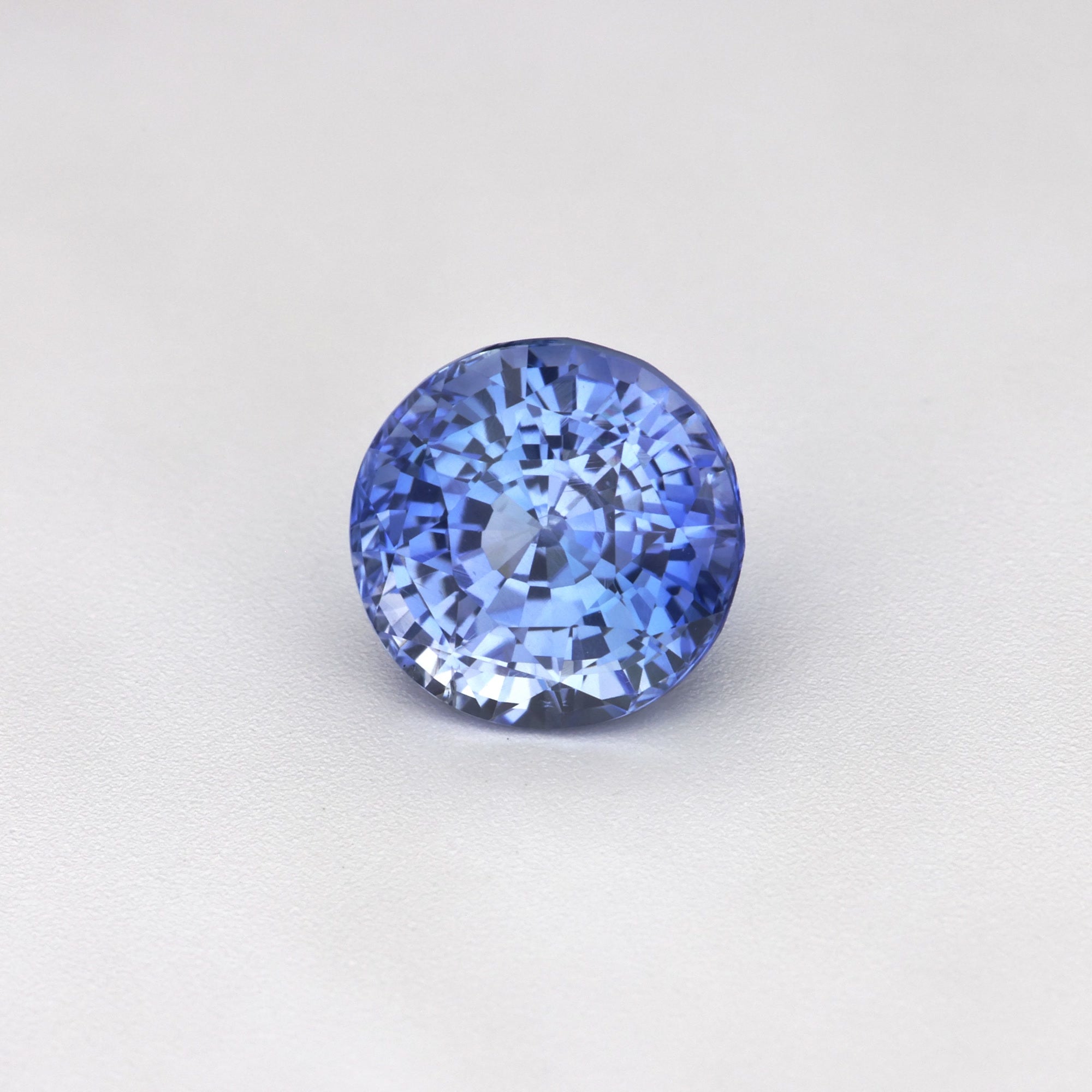
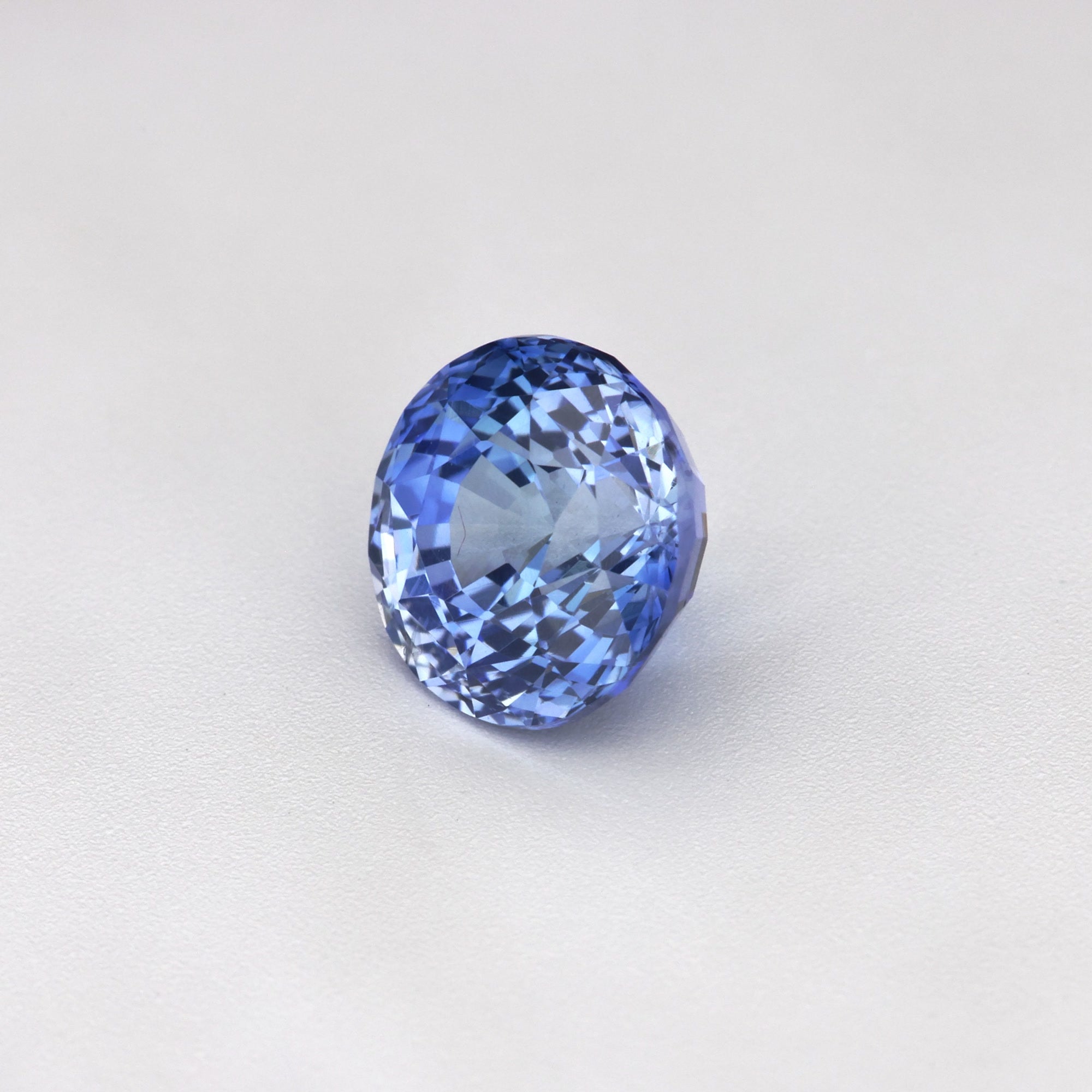
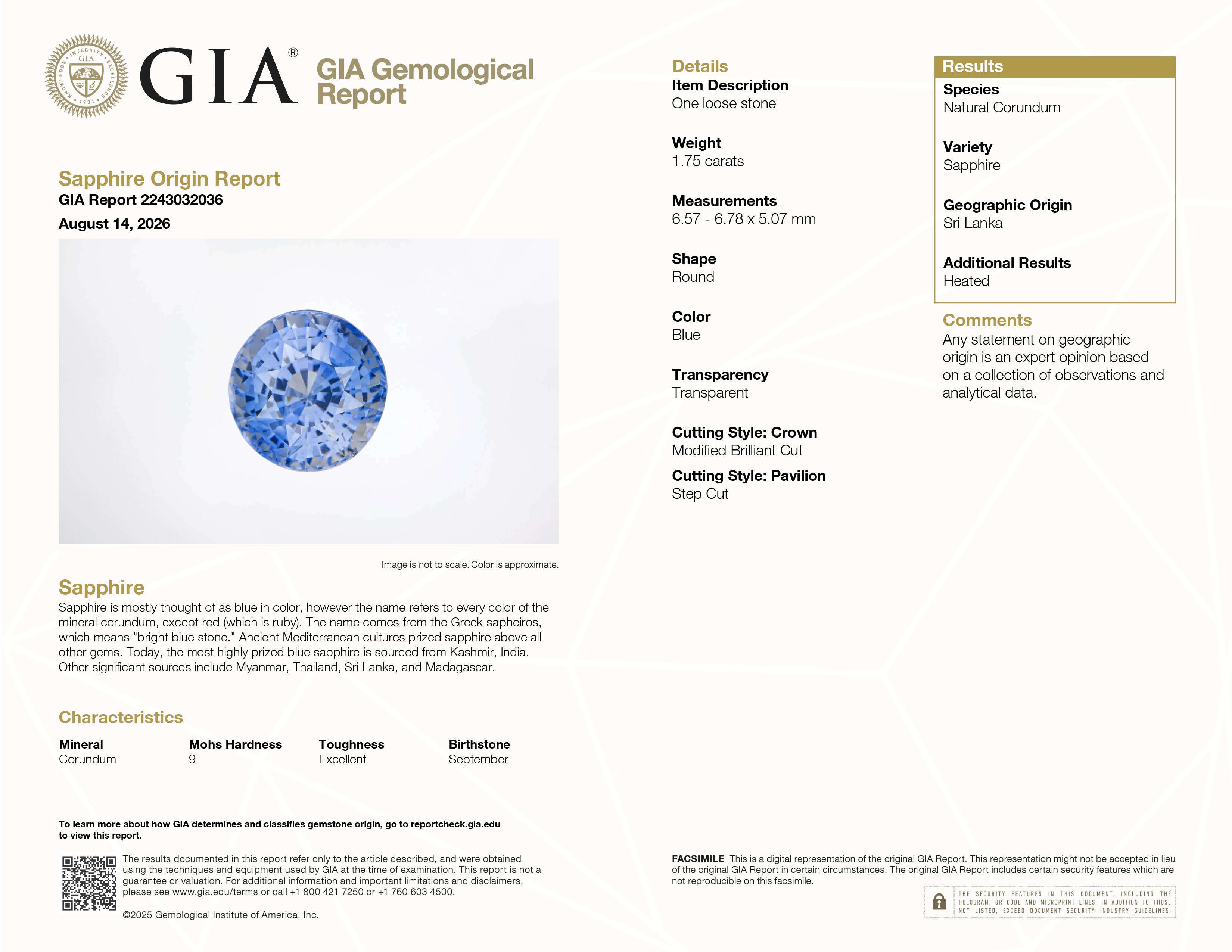
Kashmir sapphire is beyond the price range of our catalog, but fine unheated Ceylon blue sapphire — the origin most often compared to Kashmir for brightness and quality — is our specialty. Browse the full Ceylon sapphire catalog or email crescentgems@gmail.com with your specifications. We respond within one business day.

CG8465
CG8460
CG8456


Blue Star Sapphire Price Guide — What They Cost and Why
Read moreabout Blue Star Sapphire Price Guide — What They Cost and Why
Tsavorite Garnet Price Guide — What They Cost and Why
Read moreabout Tsavorite Garnet Price Guide — What They Cost and Why
Color-Change Sapphire Price Guide — What They Cost and Why
Read moreabout Color-Change Sapphire Price Guide — What They Cost and Why
Is Cat's-Eye Chrysoberyl Good for an Engagement Ring?
Read moreabout Is Cat's-Eye Chrysoberyl Good for an Engagement Ring?
Cat's Eye Chrysoberyl Price Guide — What They Cost and Why
Read moreabout Cat's Eye Chrysoberyl Price Guide — What They Cost and Why















Share: