- by Ahmed Shareek
How to Tell If a Star Sapphire Is Natural: A Complete Identification Guide
- by Ahmed Shareek
We are a supplier from the source in Sri Lanka, so our star sapphires reach you direct, without the intermediaries most sellers buy through.
New to buying sapphires? Start with our Ultimate Sapphire Buying Guide — the complete resource for colour, origin, treatment, and pricing.
Star sapphire is one of the most visually dramatic gemstones in existence — a natural corundum that produces a sharp, six-rayed star of reflected light across its domed surface when illuminated by a single light source. It is also one of the most commonly imitated. Synthetic star sapphires have been manufactured since the 1940s. Glass star sapphires have been sold alongside natural stones for decades. Composite stones, coated stones, and surface-diffusion treated stones all exist in the market alongside the real thing, some convincingly. Knowing how to distinguish a natural star sapphire from an imitation is not a trivial skill — it requires understanding what asterism actually is, how it forms, and what signatures each type of stone leaves behind for an informed observer.
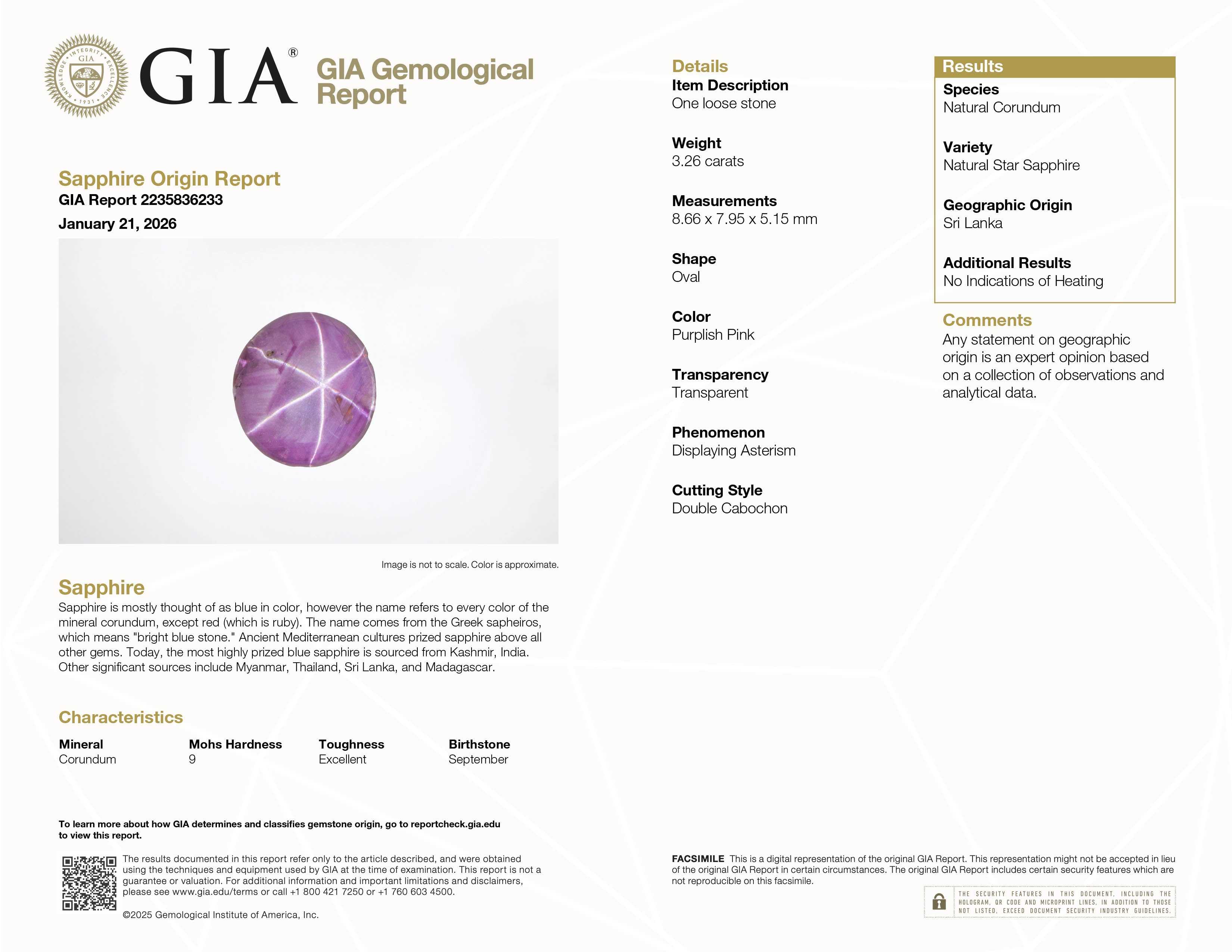
At Crescent Gems, we source natural star sapphires directly from Sri Lanka and document their treatment status on every product page. Several of our star sapphires carry GIA reports that record the phenomenon, the unheated status, and a Sri Lankan origin opinion. Ceylon is the trade name; the factual statement of origin is Sri Lanka, and that is what a report prints. This guide shares what we know about identification — the visual tests, the structural differences, and the laboratory methods that settle the question as far as it can be settled.
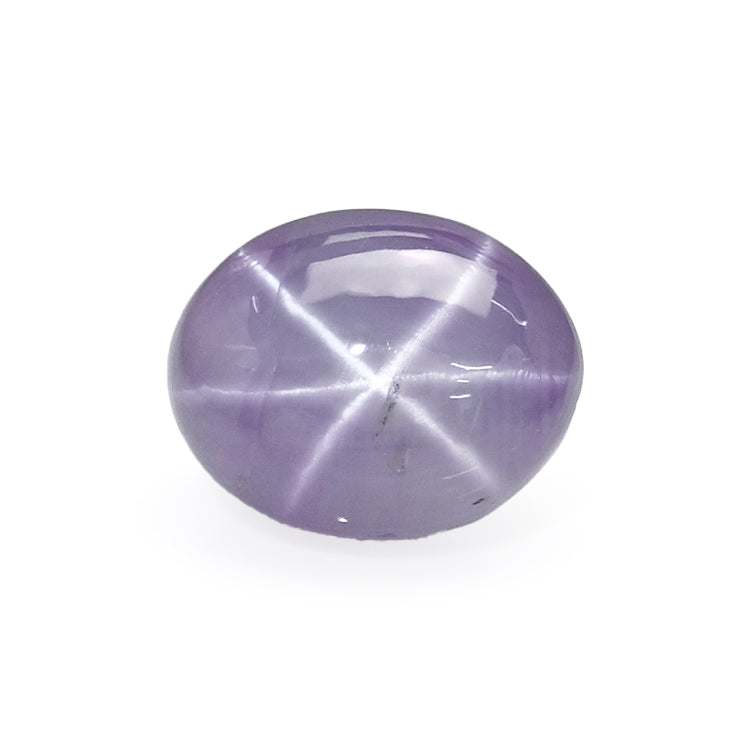
Asterism is a phenomenon caused by the reflection of light off microscopic needle-like inclusions aligned within the crystal structure of the sapphire. In natural star sapphire, these needles are rutile — titanium dioxide — that exsolved from the corundum crystal as it cooled over millions of years. The rutile needles align in three directions, each 60 degrees apart, following the hexagonal crystal symmetry of corundum. When the stone is cut as a cabochon with the dome oriented perpendicular to the crystal's c-axis, light reflecting off all three sets of aligned needles produces a six-armed star that appears to float across the surface of the stone.
The key word is exsolved. Natural rutile silk in star sapphire is not introduced from outside the crystal — it forms inside the crystal as titanium atoms migrate within the corundum structure over geological time. This process leaves structural evidence that synthetic and imitation stars cannot replicate: the needles are genuinely within the crystal lattice, they extend through the depth of the stone, and they occur alongside other natural inclusion types that form in the same geological conditions. Understanding this is the foundation of identification — a synthetic star does not have the same internal structure, and a glass or coated stone has no internal structure at all.
Before getting to identification tests, it helps to know exactly what you might be looking at.
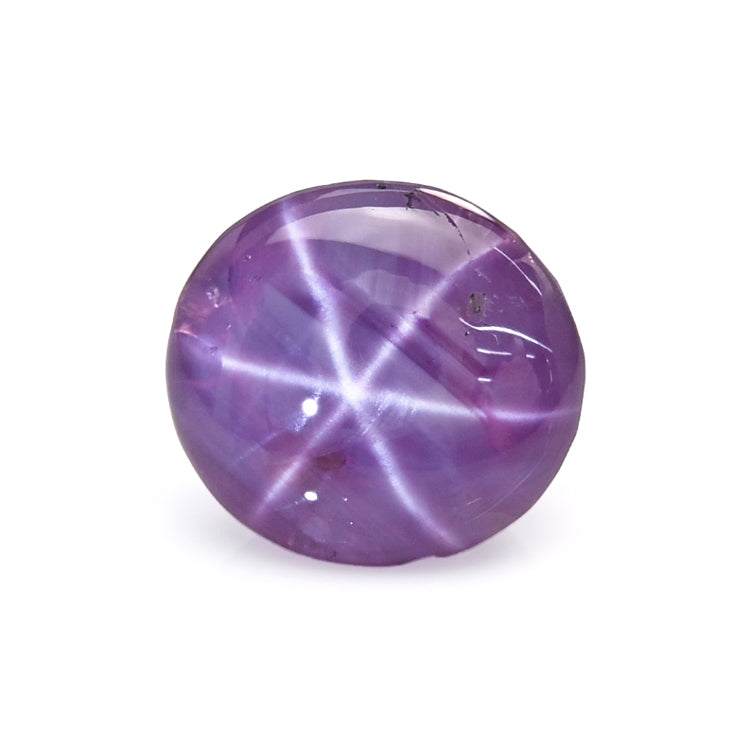
Genuine corundum with rutile silk aligned in three directions, cut en cabochon with the dome oriented to show the star. The body color can be blue, gray, black, purple, pink, or rarely other colors. The asterism phenomenon is entirely natural — the stone was not treated to create the star. Unheated natural star sapphires, which retain their original rutile silk, are what the trade prices highest. Heat treatment can destroy the rutile silk, which is one reason fine natural star sapphires are almost always unheated.
Laboratory-grown corundum produced using the Verneuil flame-fusion process, with titanium introduced deliberately during growth to produce rutile silk. Synthetic star sapphires have been commercially available since the 1940s under the Linde brand and are still widely sold today. They are chemically identical to natural corundum (aluminum oxide) but formed in hours rather than millions of years, and their internal structure is fundamentally different from natural material. They can be visually convincing to an untrained eye but have specific identifying signatures discussed below.
Colored glass cut as a cabochon with a surface-painted or foil-backed star, or with sub-surface inclusions arranged to simulate asterism. These are the least convincing imitations to anyone who has handled a natural star sapphire, but they are sometimes sold at tourist markets and online. The star in glass imitations typically looks flat, painted, or does not move correctly under changing light.
Natural or synthetic corundum treated with titanium diffusion at high temperatures to induce a surface layer of asterism. The star in diffusion-treated stones is extremely sharp and perfect — suspiciously so — and sits only on the surface of the stone. A nick or surface chip can destroy the star entirely because the effect does not penetrate the depth of the material. GIA and other major laboratories can detect this treatment and will note it on the report.
A composite stone using a crown of natural sapphire over a glass or synthetic base, or the reverse. Rare in the star sapphire market but worth being aware of for any large stone at a suspiciously low price.
Black star sapphire produces its star from hematite inclusions rather than rutile, creating a golden or coppery star rather than a silver-white one. This is a natural phenomenon distinct from blue or gray star sapphire and is worth knowing about separately: black star sapphires from Thailand and other sources are natural but produce a different optical effect.
These tests do not require any gemological equipment. They will not definitively identify or exclude every type of imitation, but together they narrow the field significantly.
This is the most basic test, and it eliminates most glass fakes immediately. A genuine star sapphire — natural or synthetic — only shows its star under a single, directional light source: direct sunlight, a flashlight beam, a spotlight, or the sun. Under diffuse room lighting, the star disappears or becomes vague. Glass fakes with painted or foil-backed stars often show the star under ambient room lighting, because the effect is created on or near the surface rather than through the optical depth of the stone.
Take the stone into a dark room and illuminate it with a single flashlight beam pointed directly at the apex of the dome. A genuine asterism (natural or synthetic) will show a sharp, well-defined star. Move the light source slowly — the star should move across the dome in response to the changing angle of the light. If the star is fixed in place regardless of how you move the light, the effect is not genuine asterism.
Natural star sapphires have stars that vary in sharpness. Very fine natural stars are sharp and clearly defined; lower-quality natural stars can be slightly diffuse or have uneven arm lengths. Synthetic (Linde) star sapphires typically show a very sharp, very even, very perfect star — more perfect than most natural material produces. If the star looks too perfect — every arm exactly the same length, perfectly sharp with no variation — that perfection is actually a red flag pointing toward synthetic origin.
The practical rule: natural stars are beautiful but not flawless. A star that looks machine-perfect is almost certainly synthetic.
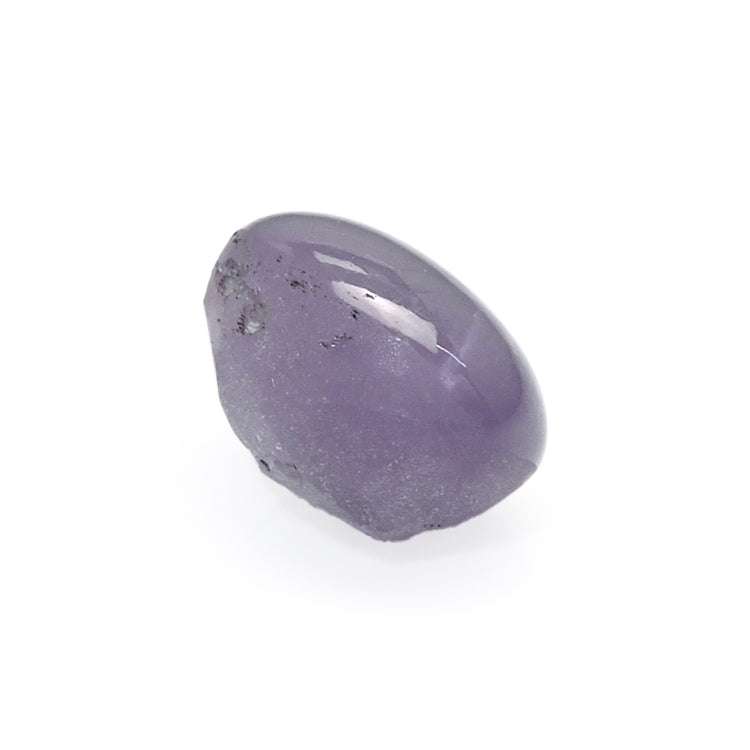
Natural star sapphires contain enough rutile silk to produce the star, which means they are typically translucent rather than transparent — the silk scatters light within the stone, giving it a slightly milky, glowing quality rather than the water-clear transparency of a fine faceted blue sapphire. This translucency is characteristic: hold the stone up to a light source (not a flashlight — just a lamp or window) and look through the dome. You should see a milky, softly lit interior rather than a clear, see-through stone.
Very transparent star sapphires do exist (the star can appear in relatively clean material with finer silk), but they are less common than translucent stones. If a stone claiming to be a natural star sapphire is glass-clear, that is a point worth investigating further.
Corundum (sapphire) has a specific gravity of approximately 4.0 — meaningfully denser than glass (2.5) and some synthetic materials. A genuine sapphire cabochon of a given size will feel noticeably heavier than a glass or low-density synthetic substitute of the same visual size. This test requires familiarity with the heft of sapphire — if you have handled genuine natural sapphire before, you will notice the difference. If you have not, this test is less useful in isolation, but it adds to the picture when combined with others.
Genuine corundum feels cold to the touch and warms slowly in the hand — it conducts heat away from your fingertips. Glass retains warmth more quickly and does not feel as cold initially. This is a rough test and is not definitive, but it provides one more data point: a stone that feels room-temperature immediately when you pick it up is more likely to be glass than sapphire.
A well-cut natural star sapphire is oriented so that the star sits at the apex of the dome when the stone is viewed face-up under a single light source. If the star is significantly off-center — closer to one side of the dome than the other — either the cutting was poor (which occurs in commercial-grade natural material) or the stone was not oriented correctly during cutting. Poor centering is common in natural material cut for weight retention from irregularly shaped rough. It is less common in synthetic material, where cutting precision is easier to achieve. An off-center star is therefore a mild indicator of natural origin, not a disqualifier.
A hydrostatic specific gravity measurement (weighing the stone in air and in water) will give you a number that identifies the material with reasonable accuracy. Natural and synthetic corundum both produce specific gravity readings around 3.99–4.01. Glass typically reads 2.40–2.70 depending on composition. A reading outside the corundum range rules out a genuine sapphire (natural or synthetic). A reading within the corundum range confirms you have corundum but does not distinguish natural from synthetic — that requires additional investigation.
A refractometer measures how much the stone bends light passing through it. Corundum has a characteristic refractive index range of 1.762–1.770 (birefringence 0.008). Glass has a single refractive index that varies by composition, typically 1.50–1.70. A refractometer reading in the corundum range confirms the material is corundum; a reading outside it points to glass or a non-sapphire material. Cabochon-cut stones can be measured on the refractometer on their flat base, so the domed shape is not a barrier to this test.
Under long-wave ultraviolet light, some natural sapphires from Sri Lanka fluoresce a reddish-orange (caused by trace chromium). This is not universal — not all natural star sapphires fluoresce — but when present, reddish-orange UV fluorescence is a meaningful indicator of natural origin because synthetic Verneuil corundum typically shows a chalky white or inert fluorescence response rather than the chromium-driven red. This test is directional rather than definitive: the presence of reddish fluorescence supports natural origin; the absence does not rule it out.
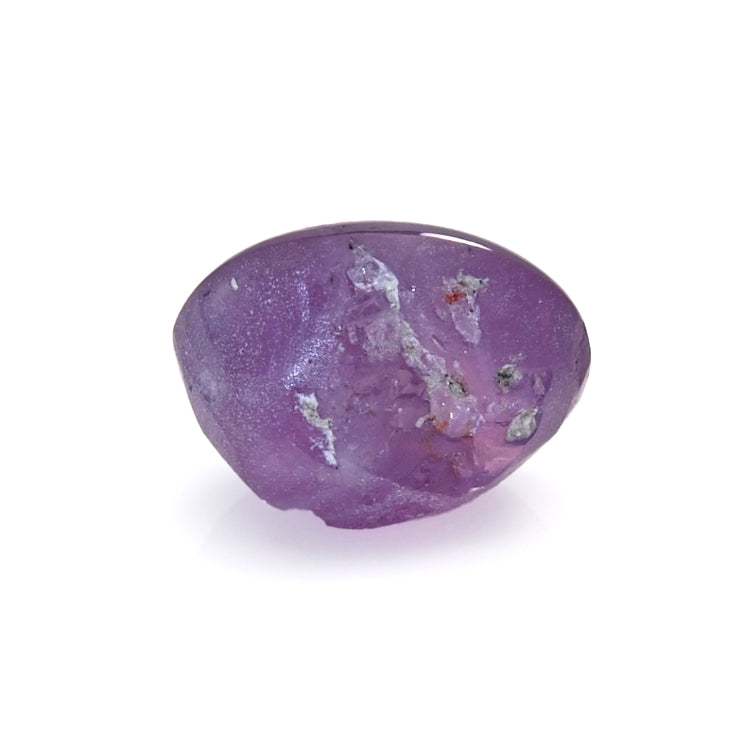
Under 10x magnification, natural star sapphires show characteristic internal features that synthetic material does not replicate. The most important things to look for:
Summarizing the most reliable visual and equipment-based distinctions between natural star sapphire and synthetic (Verneuil) star sapphire:
Surface-diffusion treated star sapphires are natural corundum (or synthetic corundum) that have been coated with titanium and heated at very high temperatures, causing titanium to diffuse into the surface layer of the stone and form rutile silk there. The star produced by diffusion treatment is extremely sharp and perfect — often more perfect than any natural star. The key identifying characteristic of diffusion treatment is that the star exists only in the surface layer of the stone.
To test for surface diffusion: immerse the stone in a heavy liquid such as methylene iodide (di-iodomethane) and examine the surface. Diffusion-treated stones show the silk concentrated in a thin surface layer rather than throughout the body of the stone. Alternatively, examine a nick or chip on the surface of the stone — if the star disappears or weakens at the damaged area, diffusion treatment is indicated. Major gemological laboratories (GIA, Gübelin, SSEF) use spectroscopic analysis to look for diffusion treatment, and where they find it they say so explicitly on the report.
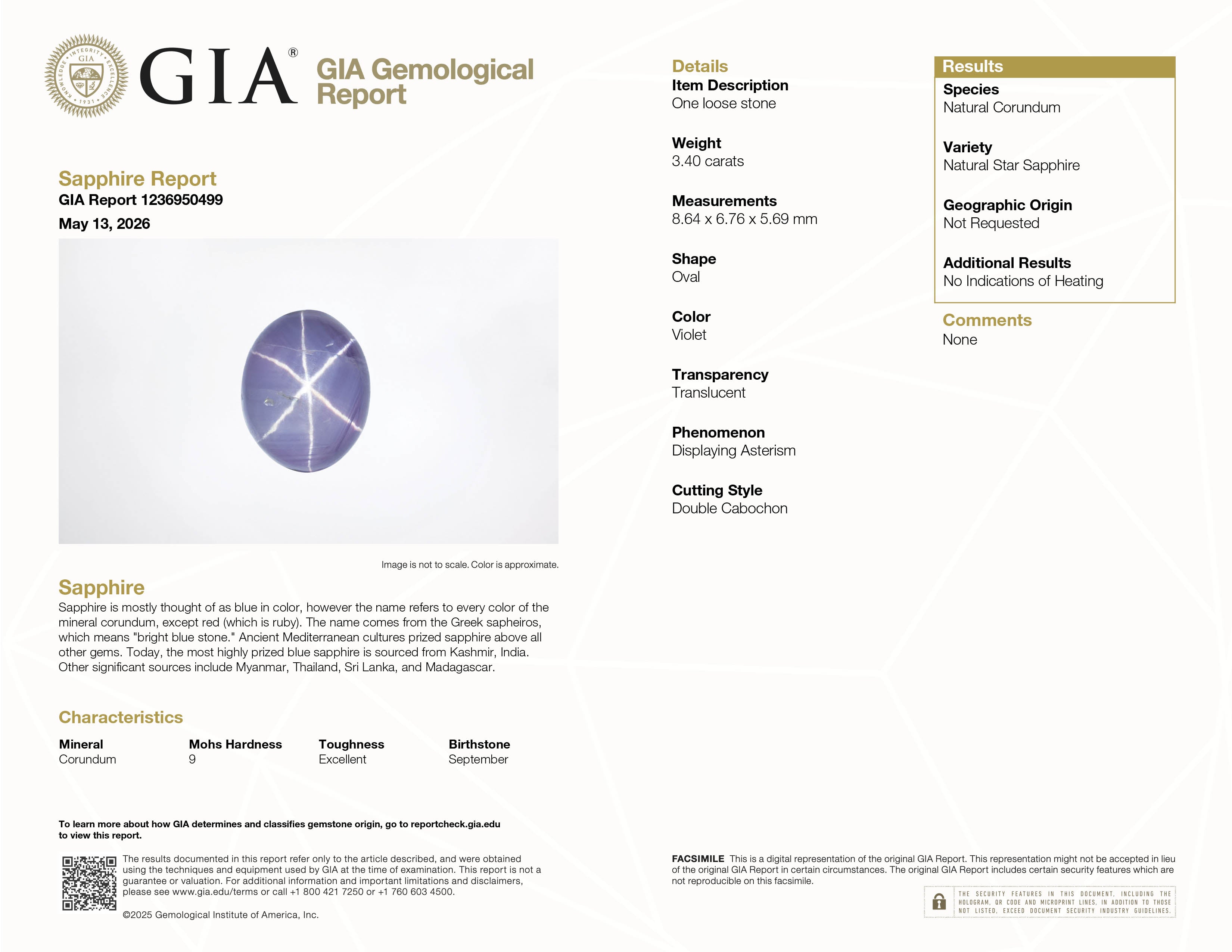
For any star sapphire of significant value, a report from GIA, Gübelin, SSEF, or Lotus is the most authoritative document you can put beside the stone. These laboratories use a combination of standard gemological testing, spectroscopy (FTIR, UV-Vis, photoluminescence), and microscopic examination, and the report records what they observed on these points:
A GIA report on a star sapphire notes the phenomenon (asterism), states the species (natural corundum), and records whether there are indications of heating. An unheated natural star sapphire with a GIA report that records no indications of heating, natural asterism, and a Sri Lankan origin opinion is the most completely documented stone in the category.
What a report is, in the laboratories' own words, is an opinion rather than a confirmation. The Laboratory Manual Harmonisation Committee, whose information sheets standardize report wording across the major laboratories, puts it plainly: “All findings described in the report are opinions expressed by the laboratory.” GIA prints its own reservation beside a geographic origin finding: “Any statement on geographic origin is an expert opinion based on a collection of observations and analytical data.” A GIA origin report also prints, on its face, that it “is not a guarantee or valuation.” None of that makes a report less useful — it is still the most independent evidence anyone can put beside a stone. It does mean that a report records, states and describes. It does not certify, and it cannot be produced as proof of anything it does not actually say.
At Crescent Gems, several of our star sapphires are accompanied by GIA reports or have reports in progress. We disclose this on every product page, including a note where stones are currently at the GIA laboratory awaiting their reports. Our natural star sapphire collection lists treatment status, origin, and certification status for every stone individually.
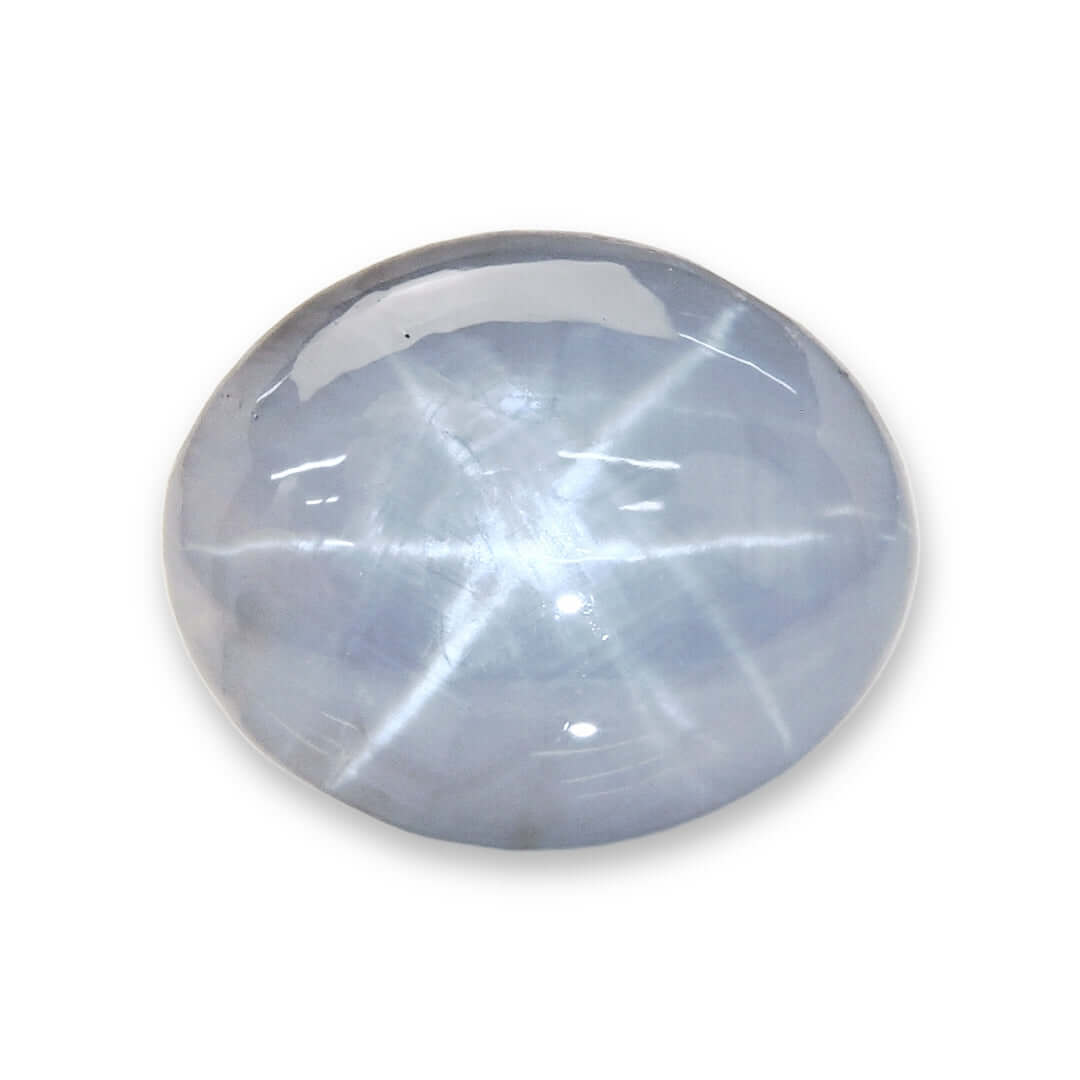
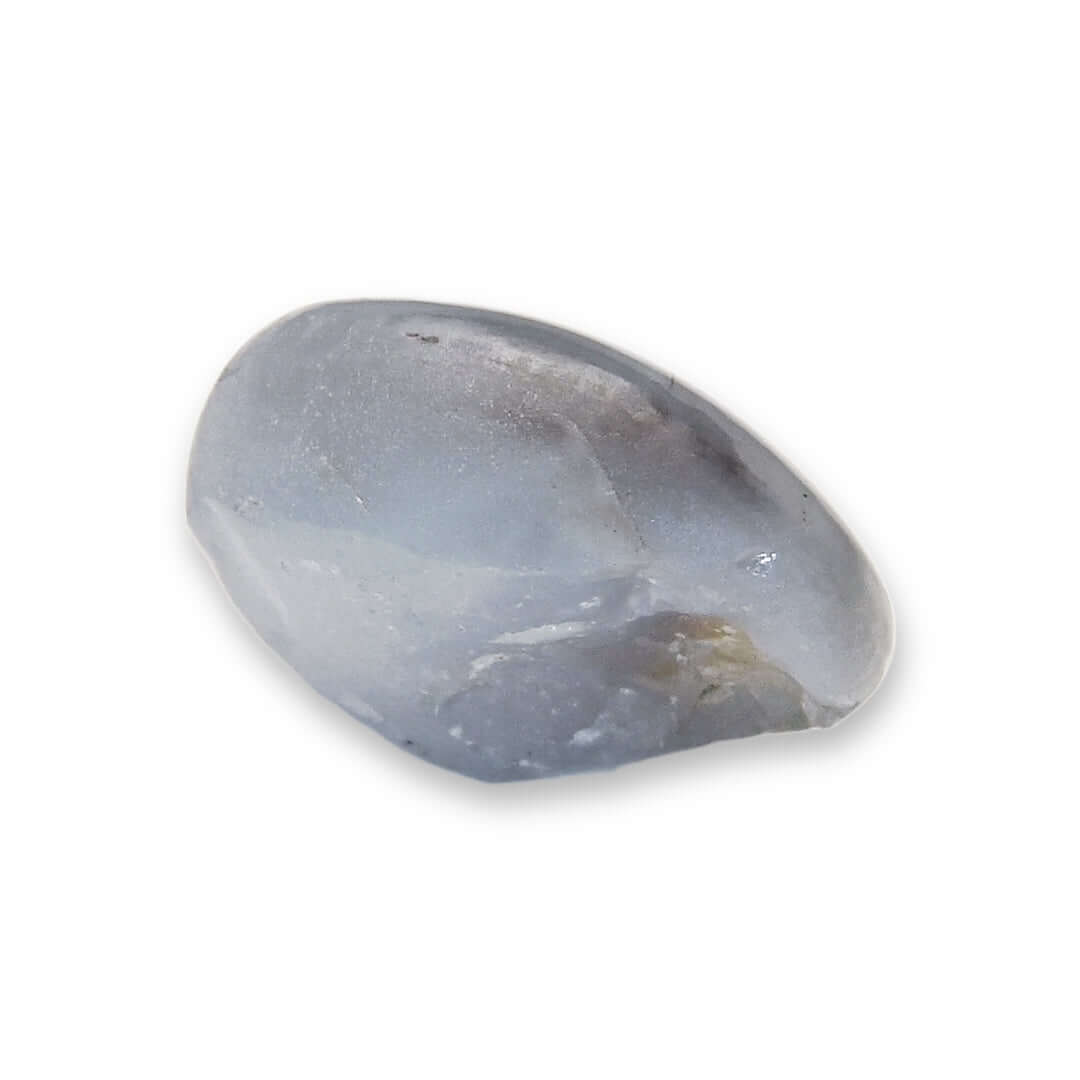
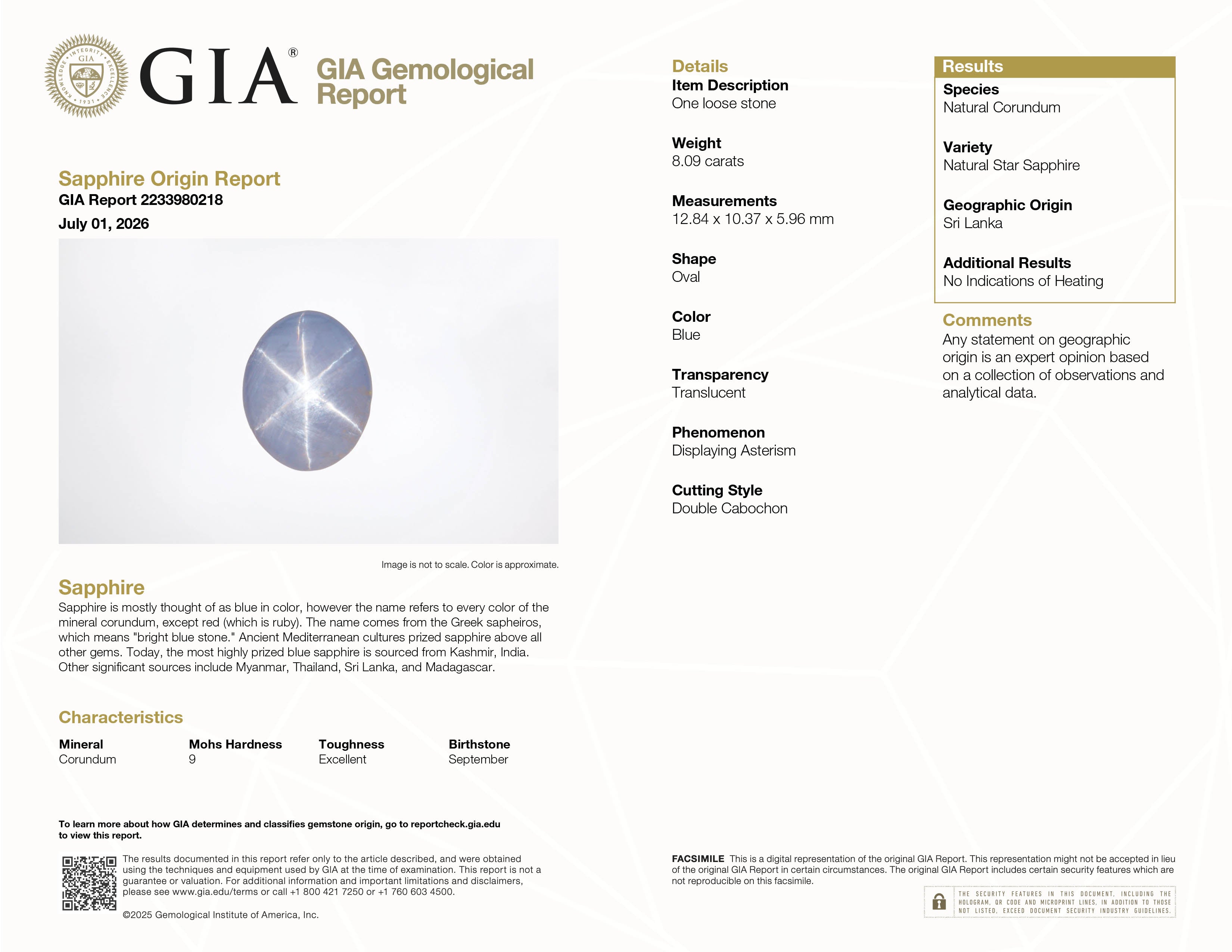
When we source star sapphires for the Crescent Gems catalog, we look at them against the same material discussed in this guide. How a particular star looks to us is our own opinion, and we would rather say so than dress it as a grade: no published laboratory grades this phenomenon, and GIA states that it “doesn’t grade or provide quality analysis for sapphire or other colored stones.” What we can put in writing is what a report or an invoice actually records — the species, the treatment status, the body color as the laboratory printed it, the weight, and the documentation that comes with the stone. That is what every listing carries, and for everything else we send a video of the stone rather than an adjective. Our current in-stock star sapphires are documented on exactly that basis: the 8.09 ct unheated blue star sapphire from Sri Lanka — priced at $4,040 — carries a completed GIA report (#2233980218) recording natural corundum, no indications of heating, a Sri Lankan origin opinion, and six-ray asterism.
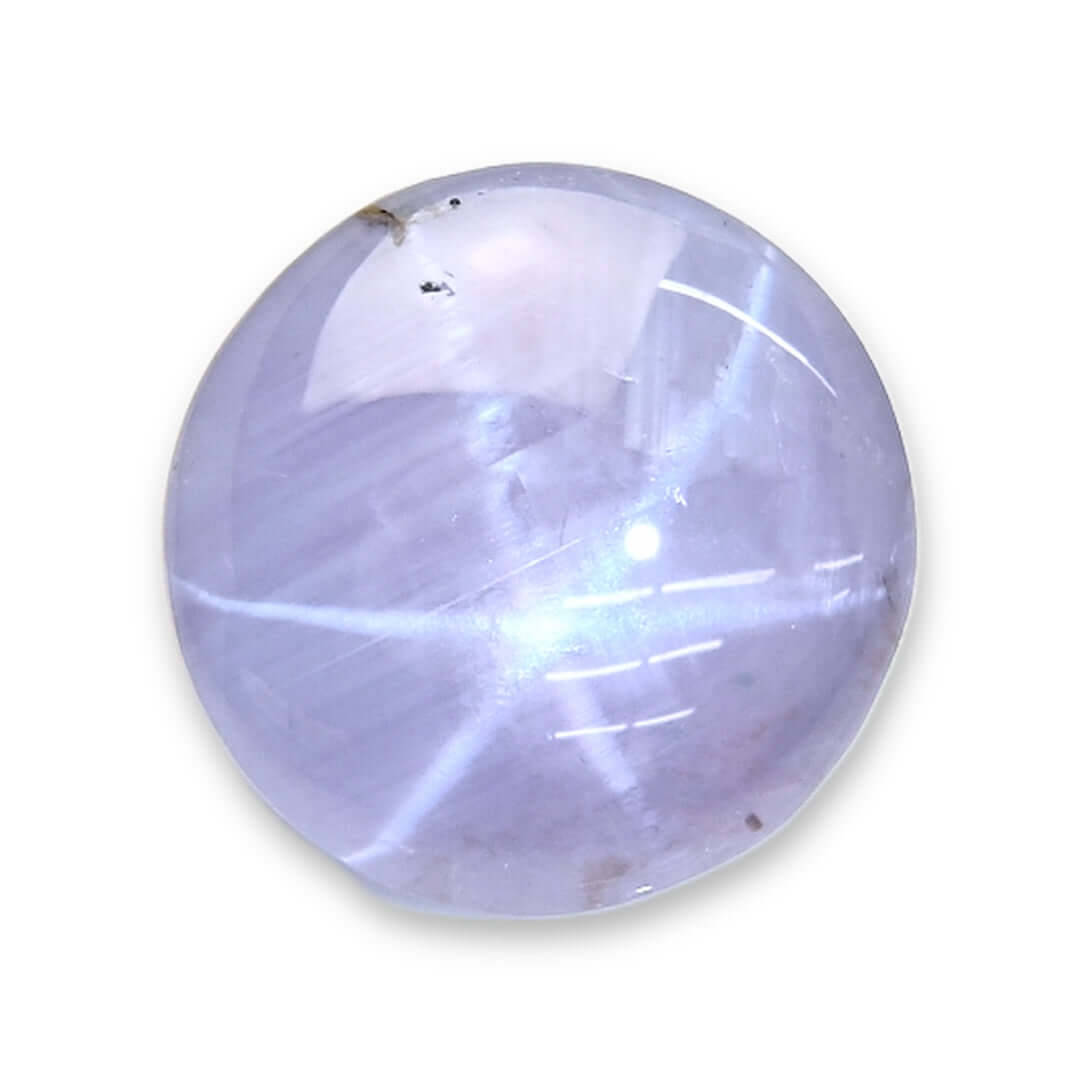
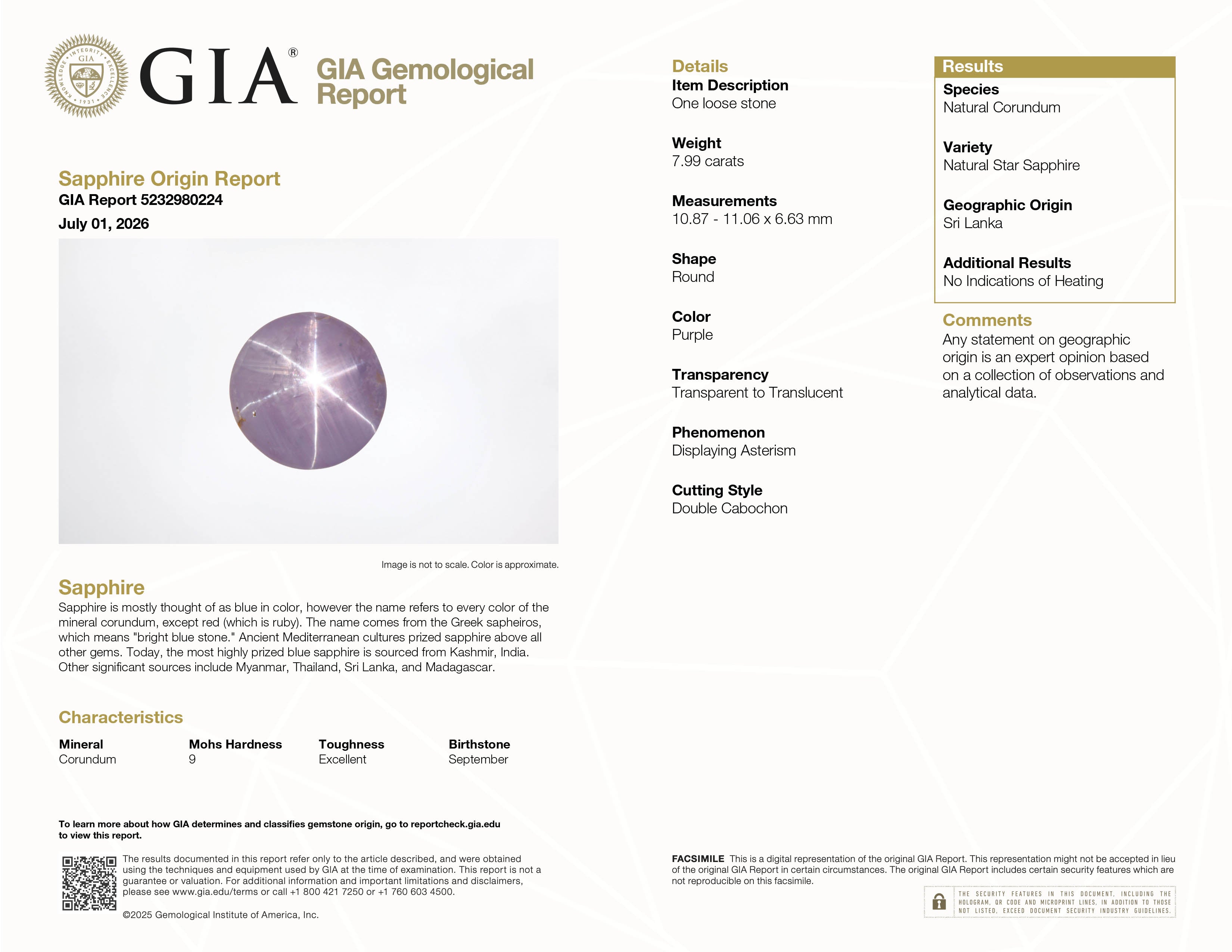
The 7.99 ct unheated round purple star sapphire from Sri Lanka (priced at $3,990) carries its own completed GIA report (#5232980224), which prints Color: Purple and records no indications of heating, a Sri Lankan origin opinion, and six-ray asterism. Our own listing describes that body color more fully as grayish purple; the report prints the shorter value. Where a seller’s adjective and a report’s printed value differ, read the report. Neither of these two stones was picked by a score for its star, because there is no score to pick by — we picked them, and we will send you a video so you can judge the star yourself.
If you are considering a star sapphire purchase, run through this checklist before committing:
No guide fully substitutes for the experience of holding and examining a genuine natural star sapphire. If you have the opportunity to examine one in person — ideally one with a laboratory report recording its status — pay attention to these qualities:
The star in a fine natural star sapphire has a three-dimensional quality: it appears to float above the surface of the stone rather than sitting painted on it. This is the optical depth created by the silk needles extending through the body of the stone — the star is reflecting off inclusions at multiple depths, not just at the surface. The body of the stone has a translucent, milky glow when light enters it — the silk that creates the star also scatters light within the stone, giving it that characteristic soft luminosity that solid-color transparent sapphire does not have.
Under a flashlight in a dim room, moving the light slowly across the dome, you will see the star track the light with a smooth, fluid motion — the arms of the star intersecting at the point directly above your light source. This motion is different from any surface-painted effect: it has depth and fluidity that come from genuine optical physics operating within the crystal.
The star in a fine natural example shows a silver-white color against the body color of the stone: blue, gray, purple, or black. Whether one such stone strikes you as finer than another is a judgement, and it is yours to make. Ours would only be an opinion too, and no report will settle it for either of us — which is why we photograph and film every stone and send the footage on request, instead of attaching an adjective to it.
Natural star sapphire is one of the gemstone world's most compelling phenomenon stones — a mineral that produces a genuine optical miracle through millions of years of crystal growth. That rarity and beauty have made it a target for imitation since the first synthetic stones came to market in the mid-twentieth century. But with the right knowledge, most imitations are detectable through straightforward visual and basic gemological tests. The curved striae of Verneuil synthetic corundum, the flat star of glass imitations, the surface-only effect of diffusion-treated stones — each leaves its own signature for an informed observer.
For a natural star sapphire of any real value, a GIA report is the best document you can have: it sets an independent laboratory’s record of the material, the phenomenon and the treatment status beside your own impression of the stone. At Crescent Gems we apply that standard to our own catalog — where a stone is listed with GIA documentation, the material and treatment findings are the laboratory’s, stated in its own report, and not ours.
Browse our current selection of natural star sapphires, with treatment status, origin, and certification disclosed on every product page. Questions about a specific stone or its documentation? Email crescentgems@gmail.com — we respond personally within one business day.

Prices are shown in your local currency and may change.
CG8293


Blue Star Sapphire Price Guide — What They Cost and Why
Read moreabout Blue Star Sapphire Price Guide — What They Cost and Why
Tsavorite Garnet Price Guide — What They Cost and Why
Read moreabout Tsavorite Garnet Price Guide — What They Cost and Why
Color-Change Sapphire Price Guide — What They Cost and Why
Read moreabout Color-Change Sapphire Price Guide — What They Cost and Why
Is Cat's-Eye Chrysoberyl Good for an Engagement Ring?
Read moreabout Is Cat's-Eye Chrysoberyl Good for an Engagement Ring?
Cat's Eye Chrysoberyl Price Guide — What They Cost and Why
Read moreabout Cat's Eye Chrysoberyl Price Guide — What They Cost and Why