

- by Ahmed Shareek
Sapphire, Moissanite and Lab-Grown Diamond: What Each Report Records
- by Ahmed Shareek
This guide does not end in a verdict about which of the three materials to buy. What a buyer can actually check before paying is narrower and more useful than a verdict: what document comes with each material, what that document records, and what it does not record. On that question the three are not variations on a theme. They sit under three different regimes, and one of those regimes changed in 2025.
A disclosure first. We sell sapphire. We hold no laboratory-grown diamond and no moissanite. So there is no price for either on this page, no judgement of either, and no claim about either one's market. What follows is what the laboratories publish, quoted, and what we hold in colourless sapphire, measured.
As of 1 October 2025, GIA stopped describing laboratory-grown diamonds with the grades it developed for mined ones. In its own words: "As of October 1, 2025, GIA began providing an overall quality evaluation for laboratory-grown diamonds, classifying each stone as either Premium or Standard."
The service is the GIA Laboratory-Grown Diamond Quality Assessment, and what it produces is one of two words. The classification "is based on a combination of clarity, color, polish, symmetry, and cut," and the bar for the upper tier is all-or-nothing: "To qualify as Premium, a diamond must meet the Premium criteria across all five assessment criteria." Any mixture of the two, or all five at the lower tier, comes out as Standard.
And below that there is nothing at all. "A diamond with any criteria outside of the Premium or Standard rating will not be provided a GIA Laboratory-Grown Diamond Quality Assessment." GIA put the same point more plainly when it announced the change: "If the man-made diamond fails to achieve the minimum standard for quality, it will not receive a designation from GIA."
GIA's stated reason, from the June 2025 announcement: "it is no longer relevant for GIA to describe man-made diamonds using the nomenclature created for the continuum of color and clarity of natural diamonds," and it "will no longer use the color and clarity nomenclature that GIA developed for natural diamonds."
Two further facts worth having. The stone itself carries the result: the girdle is "laser inscribed with the term 'Laboratory-Grown' and its GIA quality assessment number." And older paperwork did not become waste paper — "Existing GIA reports for laboratory-grown diamonds remain valid." So a buyer may quite properly be handed either kind of document, and the two do not say the same sort of thing.
One tension in GIA's own material, which we will state and not resolve, because resolving it would mean inventing something. GIA says it will no longer use natural-diamond colour and clarity nomenclature for laboratory-grown stones — yet its published criteria for the two tiers are expressed in exactly those terms, with clarity given as Very Very Slightly Included and higher for Premium and Very Slightly Included for Standard, and colour as D for Premium and E-to-J for Standard. GIA's own published material does not reconcile the two statements. Both are published. Read the document you are actually given.
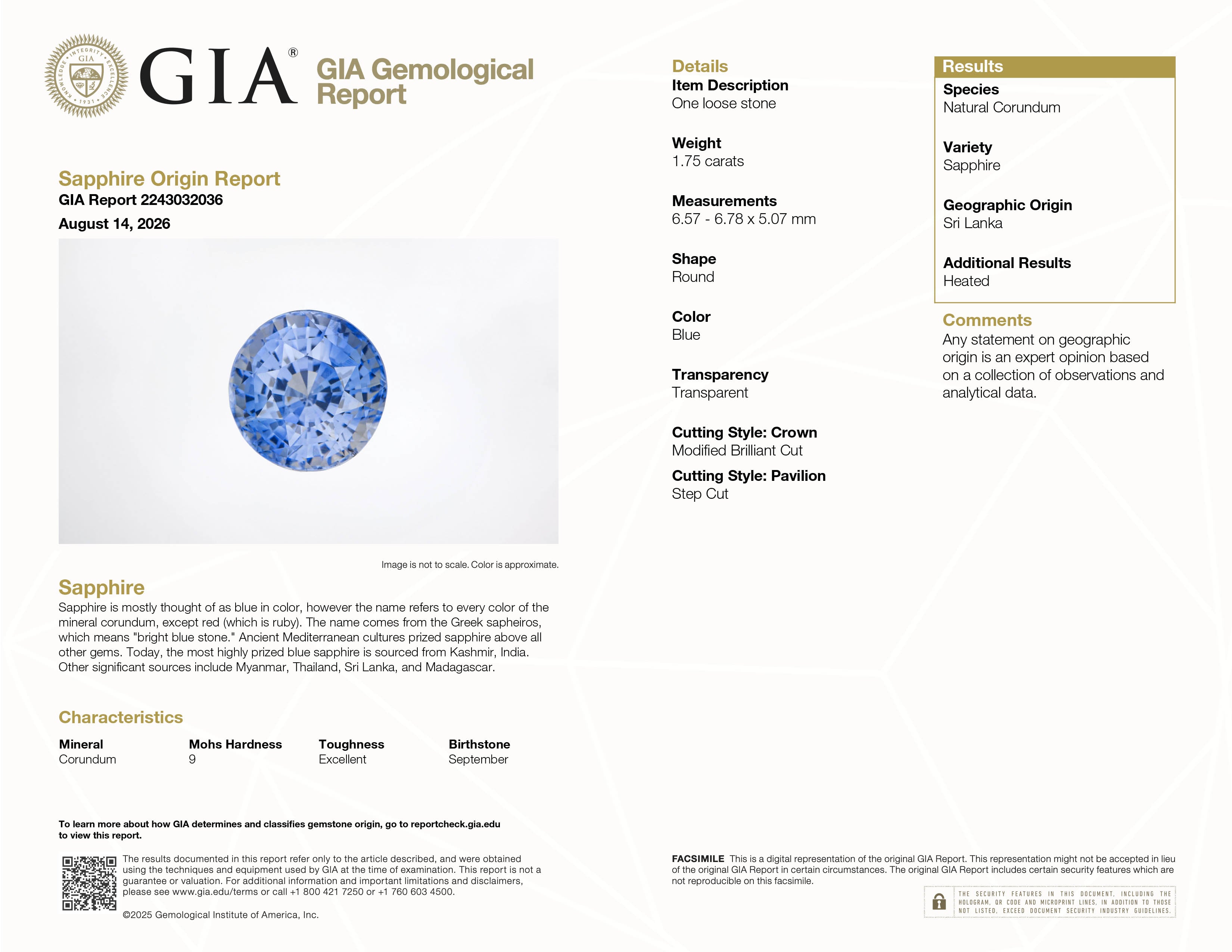
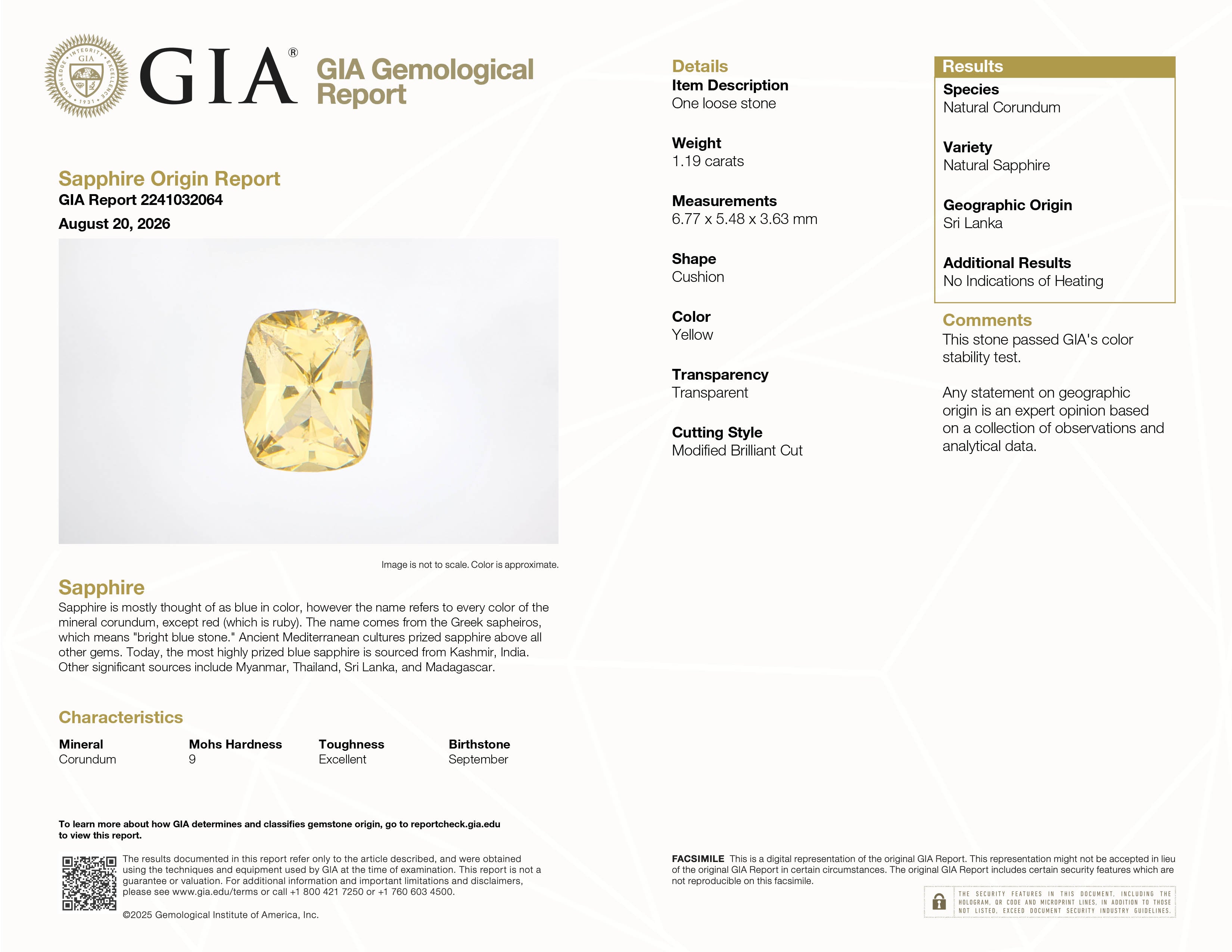
On coloured stone GIA's position is a flat refusal: it "doesn't grade or provide quality analysis for sapphire or other colored stones." There is no sapphire counterpart to Premium and Standard, and no sapphire counterpart to a clarity grade, because there is no scale to place a sapphire on.
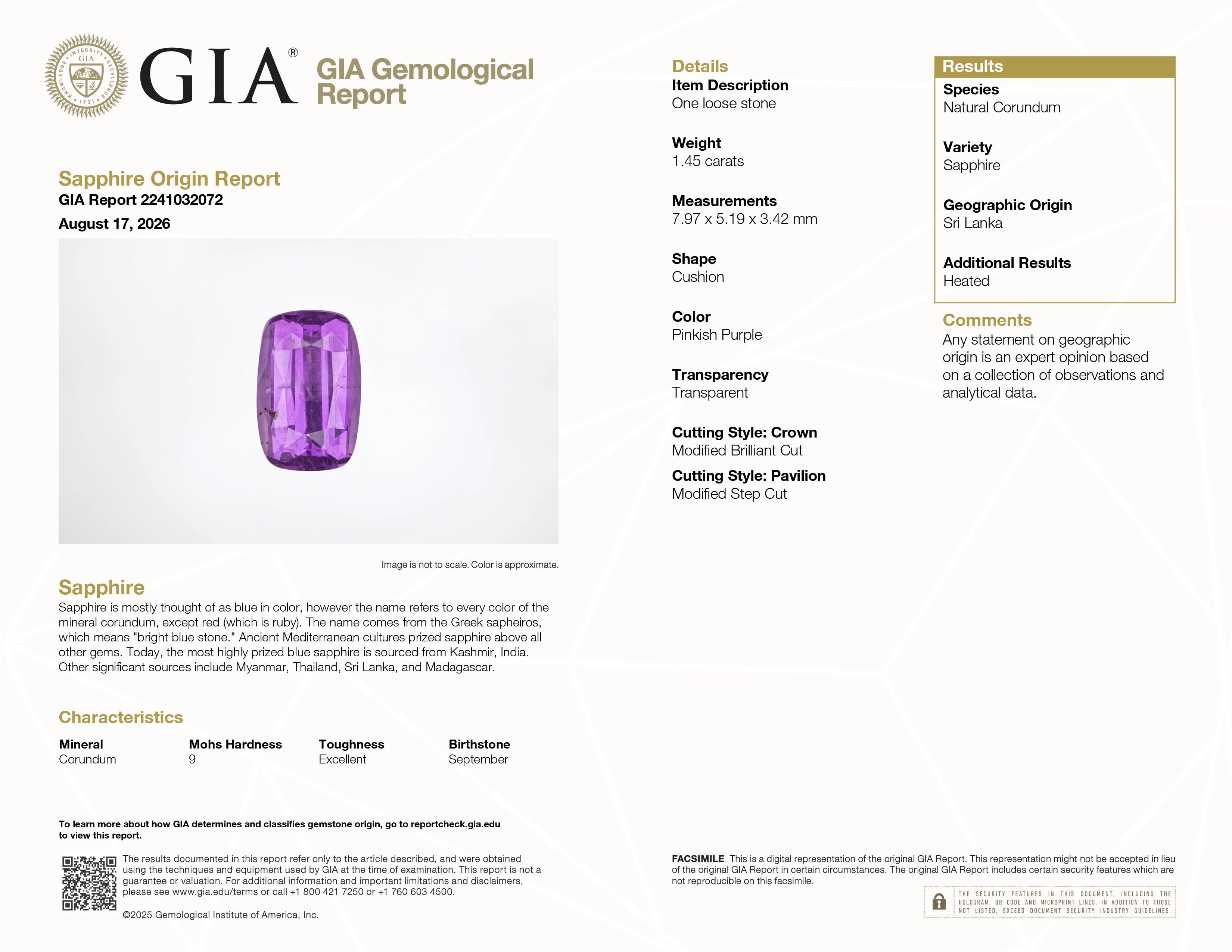
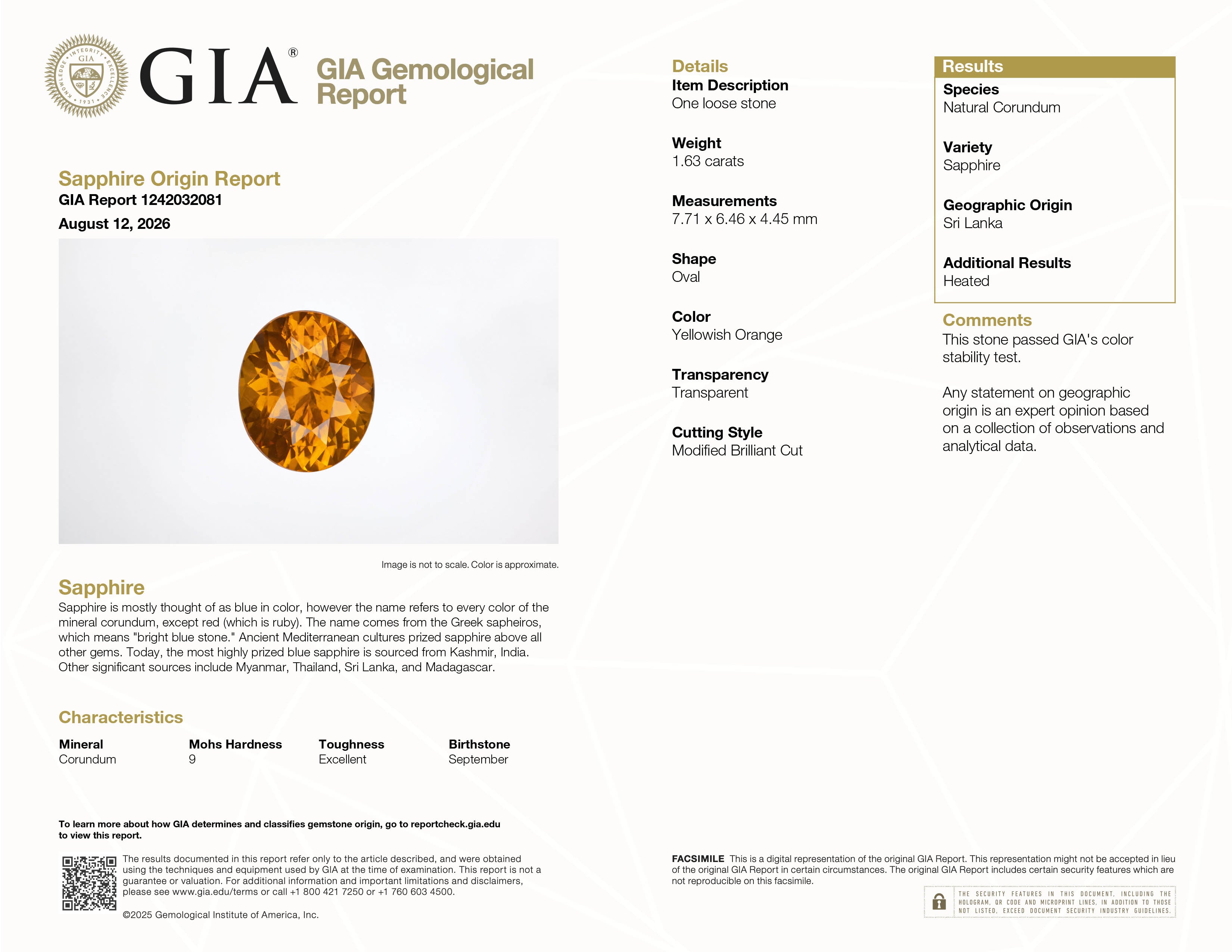
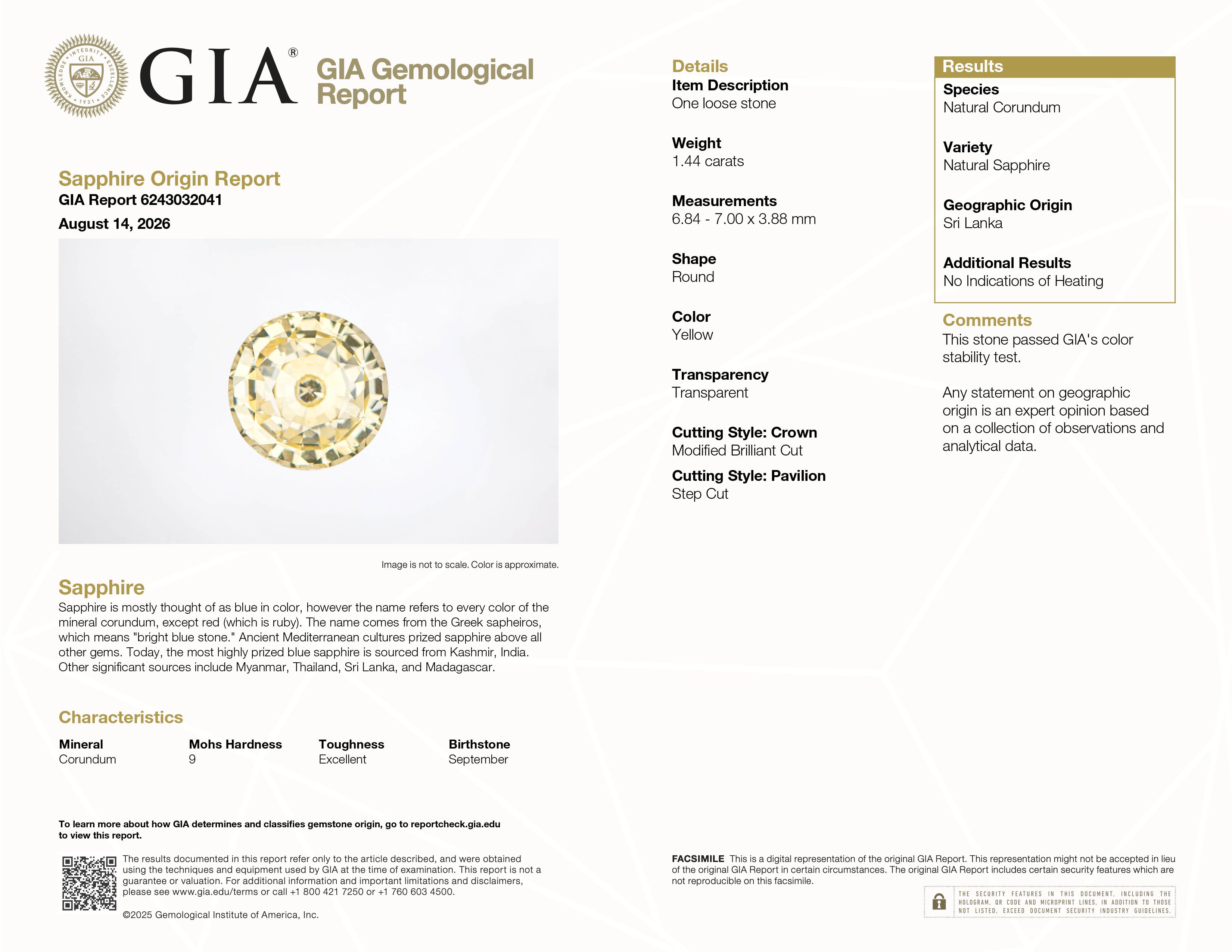
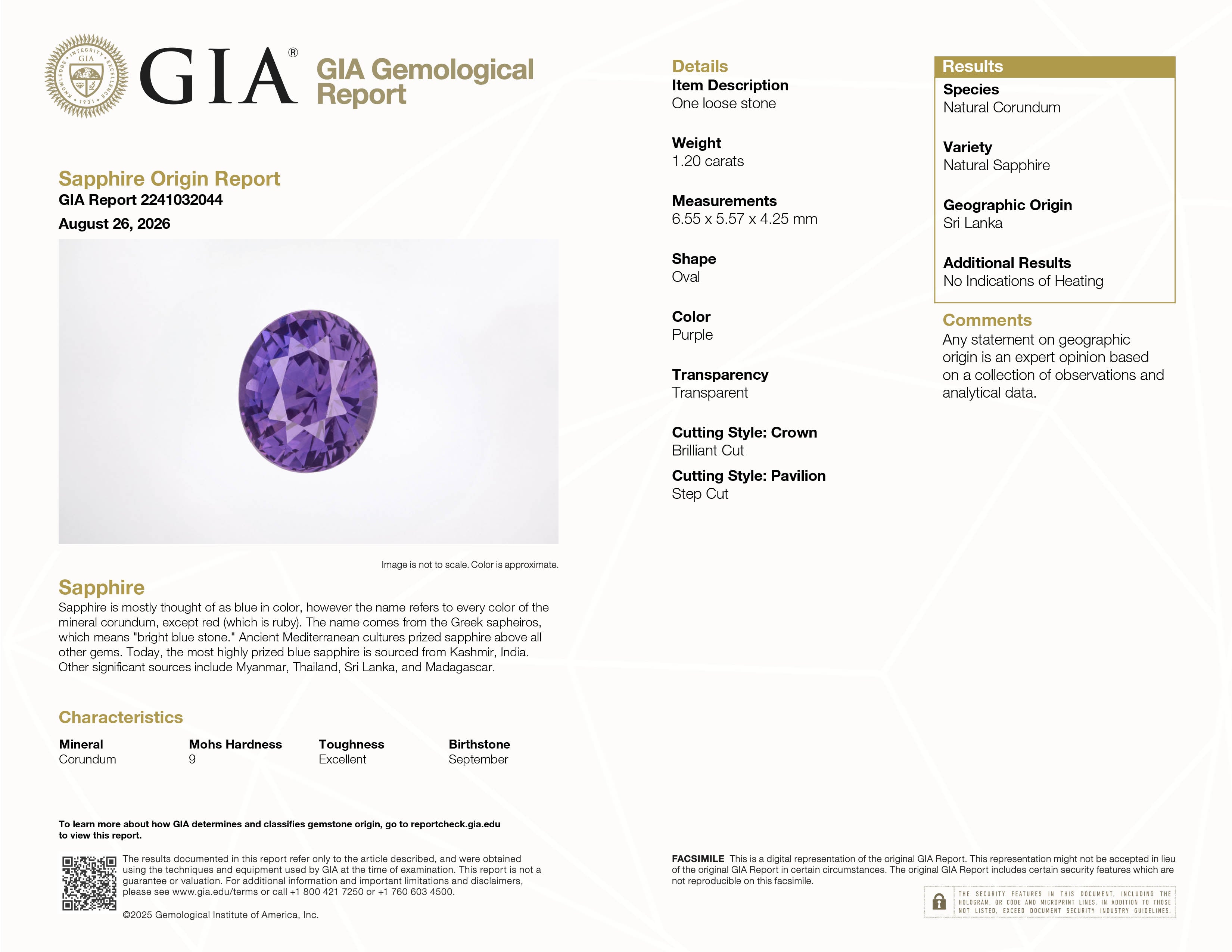
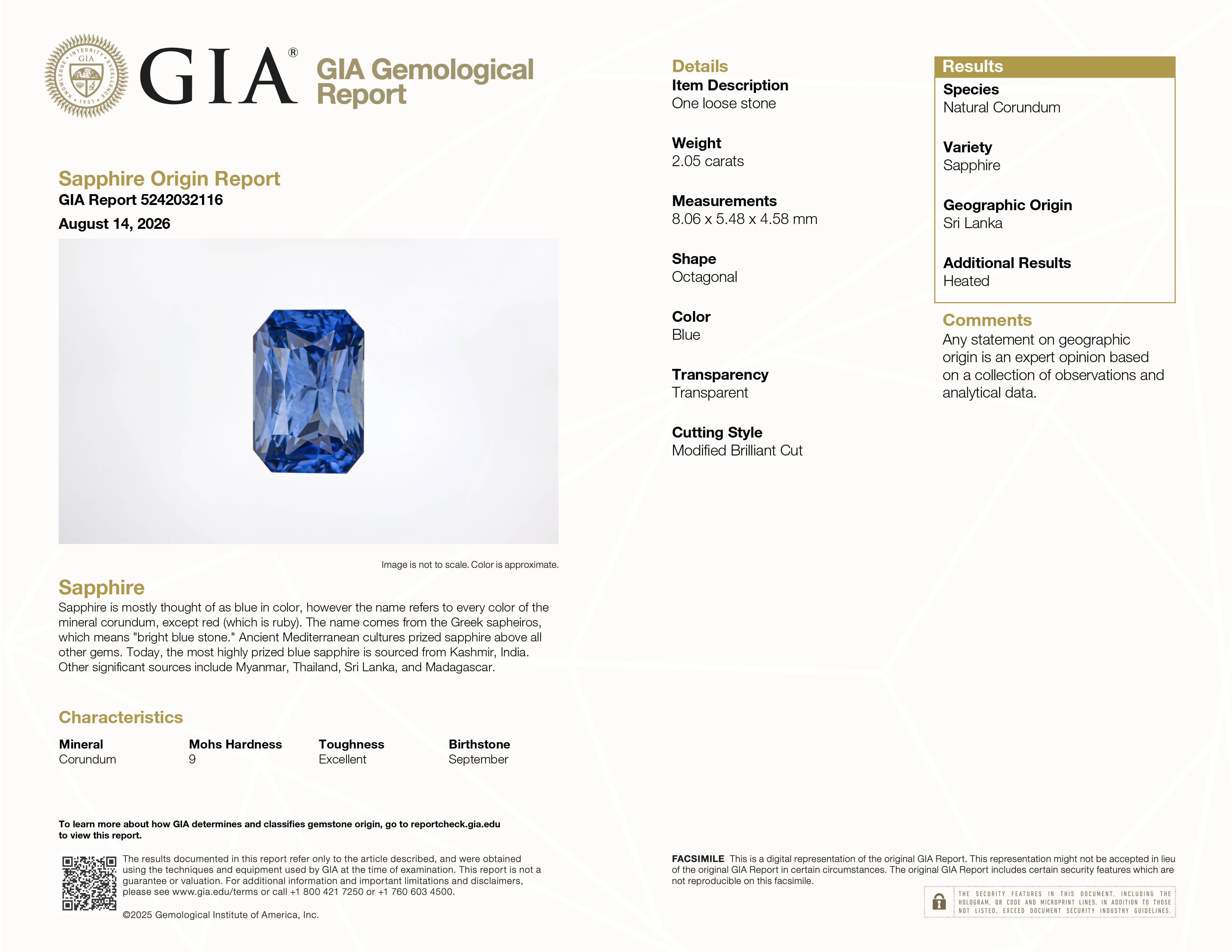
What a sapphire report does carry is a treatment finding, worded to a published standard: the Laboratory Manual Harmonisation Committee's Information Sheet #7, "Corundum – No indications of heating and Indications of heating", version 6, February 2023. That is where the wording on our own listings comes from. Where a report reads No Indications of Heating, the word we use is unheated, for that finding and no further. We do not write untreated, which is a larger claim about the whole history of a stone and is not ours to make.
Geographic origin is a separate service, separately requested, and where an opinion is given GIA prints its own reservation beside it, which we would rather quote than paraphrase: "Any statement on geographic origin is an expert opinion based on a collection of observations and analytical data." The committee makes the same general point about reports: "All findings described in the report are opinions expressed by the laboratory." Those are opinions reached by qualified examiners, and that is exactly how we present them.
Here the honest answer is an absence. GIA publishes no grading, assessment or report service for moissanite that we can point you to. What it publishes is the general rule: "GIA does not issue grading reports for gemstones other than diamond; these gems receive identification reports instead."
So a moissanite does not arrive with a Premium or a Standard, and it does not arrive with a sapphire-style treatment finding either. An identification report answers what the material is. Whatever else comes in the box — a warranty, a seller's own card, a certificate of authenticity — is that issuer's document, and it is worth reading whose name is on it and what it actually asserts.
This is not a hypothetical. GIA has published the cases.
In Gems & Gemology, Fall 2020, GIA's Johannesburg laboratory reported that it "recently received a 1.02 ct round brilliant for a Diamond Grading report." It was not a diamond: "Standard testing showed it was not a diamond, and subsequent spectroscopic and gemological analysis proved it to be synthetic moissanite." What made the case worth publishing was the paperwork — "This near-colorless synthetic moissanite was noteworthy because it had a fraudulent GIA inscription," and the number on the girdle was real but belonged to something else: "The report number does belong to an E-color natural diamond graded in 2019 with the same weight."
It was caught because the laboratory checks: "GIA checks all stones with a preexisting inscription, and this one was obviously not inscribed by GIA" — the font was "distinctly different from GIA's standard inscription font". GIA's own conclusion was that "careful examination protected the consumer against such attempted fraud."
It was not the only one. The same note records that Johannesburg "has received and identified two more synthetic moissanites with fraudulent GIA inscriptions", and in Fall 2022 the Mumbai laboratory reported a 1.71 ct square modified brilliant whose "girdle was inscribed with 'GIA' and a number matching an existent report, although the font was different from that of an actual GIA inscription". Again the number was real and belonged elsewhere: it "matched one for a natural diamond, a 1.71 ct square modified brilliant cut".
What to take from it, and what not to. These are individual published cases, and we are not going to tell you how common forged inscriptions are, because we have no figure for it and GIA publishes none. What the cases do establish is narrower and sturdier: an inscription and a report number are not self-verifying. A number can be genuine and still belong to a different stone. The check that works is the one the laboratory itself performed — ask the issuing laboratory what that number describes, and compare it to the stone in front of you.
On moissanite, GIA publishes this much: it is "another popular diamond simulant", it is silicon carbide, and it has "a hardness of 9 ¼ and excellent toughness". On colour it notes a direction rather than a grade: "Unlike a natural diamond, where its color can have a slightly yellowish hue, synthetic moissanite can have a slightly greenish or greyish hue." We print GIA's "9 ¼" as GIA writes it.
In the Fall 2020 lab note, the two specific gravities appear together — 3.52 for diamond and 3.22 for moissanite — and the moissanite "did show obvious double refraction in the microscope". GIA describes moissanite as having "a much higher dispersion (leading to more obvious fire) and double refraction", and that is as far as the published wording goes.
So we will not print a refractive index or a dispersion figure for moissanite. We have no source for either that we are willing to cite, and a figure we cannot attribute is a figure we should not publish. The same discipline applies to corundum, where the constants we do publish are Mohs 9, a refractive index of 1.762–1.770 and a specific gravity of 3.99–4.10 — the values this store has used in its own product data throughout.
Those figures identify. A specific-gravity measurement separates moissanite from diamond because 3.22 and 3.52 are not the same number, and double refraction is visible under a microscope to someone who knows to look for it. That is what the constants are for. They are not a score, and we are not going to arrange the three materials in an order with them.
Its absence here is deliberate, so it should be explained rather than left as a gap.
We publish no resale figure, no appreciation claim and no depreciation claim for any of the three materials. Not for sapphire, not for laboratory-grown diamond, not for moissanite. We have no measurement of our own and no source we can name, and a gemmological report does not record what a stone will later be worth — it records what the material is, what was done to it, and in some cases where the laboratory believes it formed. A price history is a different kind of claim, needing a different kind of evidence, and we do not have it.
That cuts in the direction least convenient for us, since we are the ones selling the natural stone. We would rather say nothing than put a number on it that we cannot stand behind. If resale matters to your decision, it is worth asking an independent valuer rather than any seller, including us.
Colourless sapphire is the stone on our side of this comparison, so here is ours, read from our own listings on 17 November 2026. Ten listings were visible and in stock, holding eleven stones, because one listing is a matched pair.
| Stone | Carat | Listed price | Per carat | What the listing names |
|---|---|---|---|---|
| Princess cut, unheated | 0.33 | $165 | $500.00 | AGCL report |
| Princess cut, unheated | 0.61 | $305 | $500.00 | AGCL report |
| Round, calibrated 5 mm, heated | 0.68 | $120 | $176.47 | No laboratory named |
| Oval, calibrated 7 × 5 mm, heated | 0.95 | $400 | $421.05 | No laboratory named |
| Radiant cut, unheated | 1.06 | $636 | $600.00 | No laboratory named |
| Radiant cut, unheated | 1.13 | $678 | $600.00 | AGCL report |
| Baguette cut, unheated | 1.20 | $720 | $600.00 | AGCL report |
| Round cut, unheated | 1.42 | $725 | $510.56 | No laboratory named |
| Radiant cut, unheated | 1.73 | $1,211 | $700.00 | No laboratory named |
| Matched pair, unheated — two stones | 0.93 total | $232.50 | $250.00, across both stones | AGCL report |
Eleven stones in ten listings, and that is not a price range — we have not presented it as one. Per-carat figures are the listed price divided by the listed carat weight, rounded to the nearest cent, and that is the only rounding on this page. The matched pair is one listing that buys two stones, so its figure is the total over the two stones' combined weight and is not comparable with a single stone's; it sits outside the single-stone spread below. Two of the ten are calibrated lines we stock in multiples rather than one-offs, and both of those are heated; the other eight single stones are unheated. Five of the ten listings name a laboratory and five do not. Prices move with stock — each stone's own product page is the current figure.
Across the nine single stones the per-carat figures run from $176.47 to $700.00, and the two ends of that are the two calibrated heated lines at the bottom and a 1.73 ct unheated radiant at the top. We publish no band wider than what we hold, and no figure at all for a stone we do not have.
The habit is the same across all three materials: read the fields, notice which fields are absent, and check the document against the issuer.
Not since 1 October 2025. GIA now gives an overall quality evaluation classifying each stone as Premium or Standard, based on a combination of clarity, colour, polish, symmetry and cut, and it says it "will no longer use the color and clarity nomenclature that GIA developed for natural diamonds." To qualify as Premium a stone must meet the Premium criteria on all five. Anything outside either tier receives no GIA assessment at all. Reports issued before the change remain valid, so you may be handed either kind of document.
No. GIA "doesn't grade or provide quality analysis for sapphire or other colored stones," so there is no tier, no clarity grade and no quality verdict on a sapphire report. What it carries is an identification, a treatment finding worded to the Laboratory Manual Harmonisation Committee's standard, and an origin opinion where that separate service was requested. Any description of how a sapphire looks is the seller's own opinion, ours included, which is why we would rather send you video of the stone than hand you an adjective.
Not a GIA grading or assessment. GIA's published position is that it "does not issue grading reports for gemstones other than diamond; these gems receive identification reports instead." Anything else supplied with a moissanite is its own issuer's document, so the useful questions are whose name is on it and what it actually asserts.
Not on its own. GIA has published two cases in which synthetic moissanite arrived carrying a fraudulent GIA inscription, and in both the report number was genuine but belonged to a different stone — a 1.02 ct round brilliant in 2020 whose number belonged to an E-colour natural diamond graded in 2019, and a 1.71 ct square modified brilliant in 2022 whose number matched a natural diamond report. Both were caught because the laboratory checks every stone that arrives already inscribed, and in both the font was wrong. We have no figure for how often this happens and we are not going to invent one. Ask the issuing laboratory what the number describes.
We do not publish an answer to that, for any of the three. We have no measurement of our own and no source we can name, and a gemmological report records what a material is and what was done to it, not what it will later be worth. That is the least convenient answer for us to give, since we sell the natural stone. If resale matters to your decision, ask an independent valuer rather than a seller.
Our colourless sapphire collection holds the ten listings above, each with its own documentation, or its absence, stated on its own page. We can send video of any of them before you buy.
Have a question about a particular colourless sapphire, or want video of one before deciding? Email crescentgems@gmail.com — we respond within one business day. Shipping is free at any order value to the United States, Canada, China, Japan, Australia, New Zealand, Germany and Austria, and Canadian orders ship with duties included; to the other countries we ship to, it is $60 up to $499 and free above that. Import duty and tax, where the destination charges them, are paid by the recipient on delivery. 14-day returns on every order.

CG8454
CG8465
1.86 ct Natural Tsavorite Garnet, Cushion Shape | GIA Report #1242032119
CG8464
CG8463
CG8460
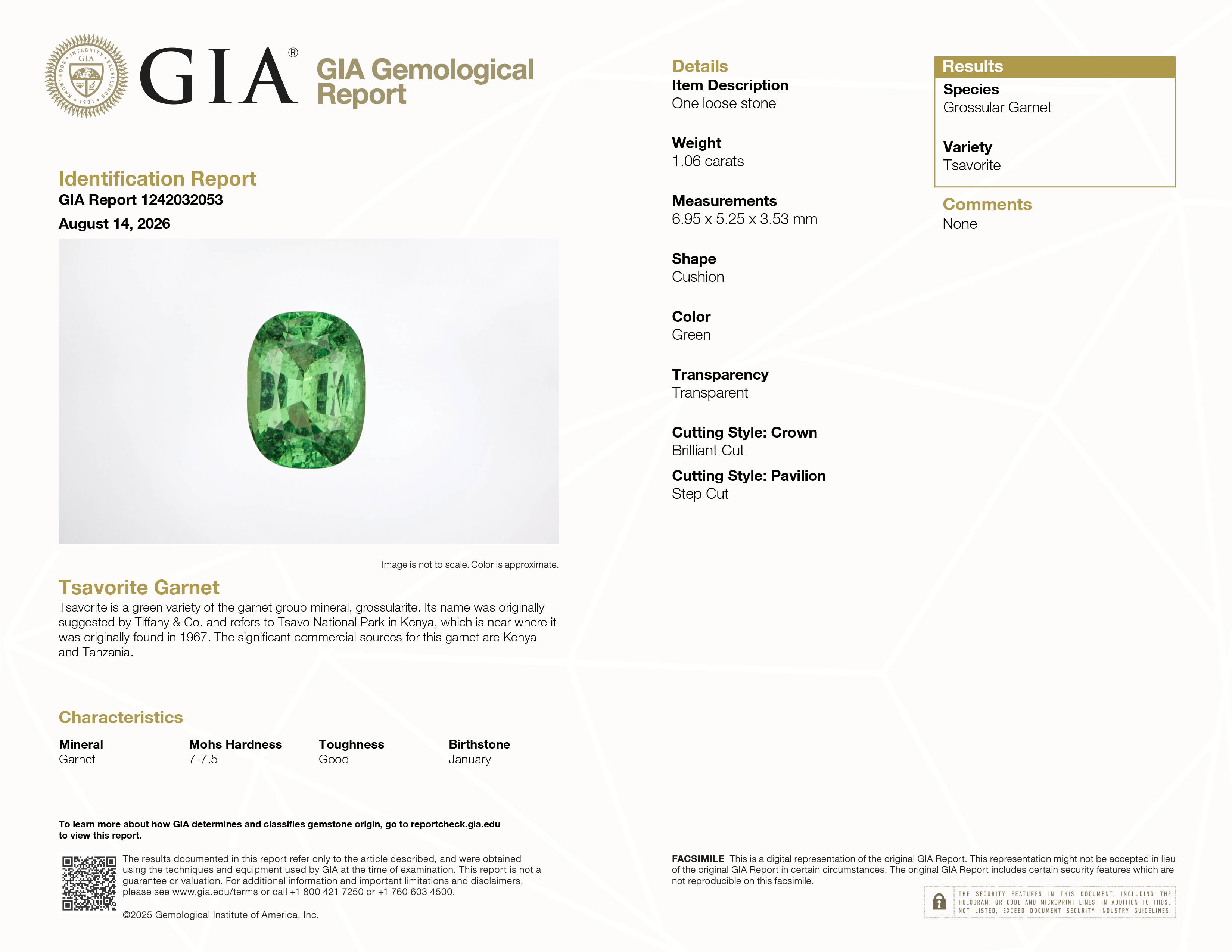
1.06 ct Natural Tsavorite Garnet, Cushion Shape | GIA Report #1242032053
CG8459
CG8458
CG8457
CG8456
1.65 ct Natural Unheated Ruby – Oval Cut | GIA Report | Madagascar
CG8453


Blue Star Sapphire Price Guide — What They Cost and Why
Read moreabout Blue Star Sapphire Price Guide — What They Cost and Why
Tsavorite Garnet Price Guide — What They Cost and Why
Read moreabout Tsavorite Garnet Price Guide — What They Cost and Why
Color-Change Sapphire Price Guide — What They Cost and Why
Read moreabout Color-Change Sapphire Price Guide — What They Cost and Why
Is Cat's-Eye Chrysoberyl Good for an Engagement Ring?
Read moreabout Is Cat's-Eye Chrysoberyl Good for an Engagement Ring?
Cat's Eye Chrysoberyl Price Guide — What They Cost and Why
Read moreabout Cat's Eye Chrysoberyl Price Guide — What They Cost and Why















Share: