- by Ahmed Shareek
Is Tsavorite Good for an Engagement Ring? Durability, Color, and What Buyers Need to Know
- by Ahmed Shareek
Considering a green gemstone ring? Read our Complete Tsavorite Buyer's Guide. For how this material is mined: Tsavorite Mining in Kenya and Tanzania. For ring design: How to Commission a Custom Ring.
Tsavorite garnet gets considered for engagement rings a great deal less often than it could be, and the reason is almost always a single number: its hardness. This page answers the question in the title directly, and then shows the working — what a laboratory report actually records about this material, where the real vulnerabilities lie, and what a setting and a cleaning routine have to do to accommodate them.
The short answer is yes, with a setting that covers the edges and one real precaution — and the reason is toughness rather than hardness. At Mohs 7-7.5 tsavorite resists everyday scratching and abrasion well, and it is softer than sapphire, which is Mohs 9. Mohs measures resistance to scratching and abrasion only. More useful than the hardness number is this: grossular garnet has no cleavage, so there is no plane along which a knock can split it, and GIA gives garnet "fair to good toughness". What tsavorite does not tolerate is a sharp impact on an exposed corner or girdle, or a sudden change in temperature. Inclusions and growth tubes affect how tough an individual stone is, so past that point the answer is per-stone rather than per-species — and the stone's own listing is where it gets answered.
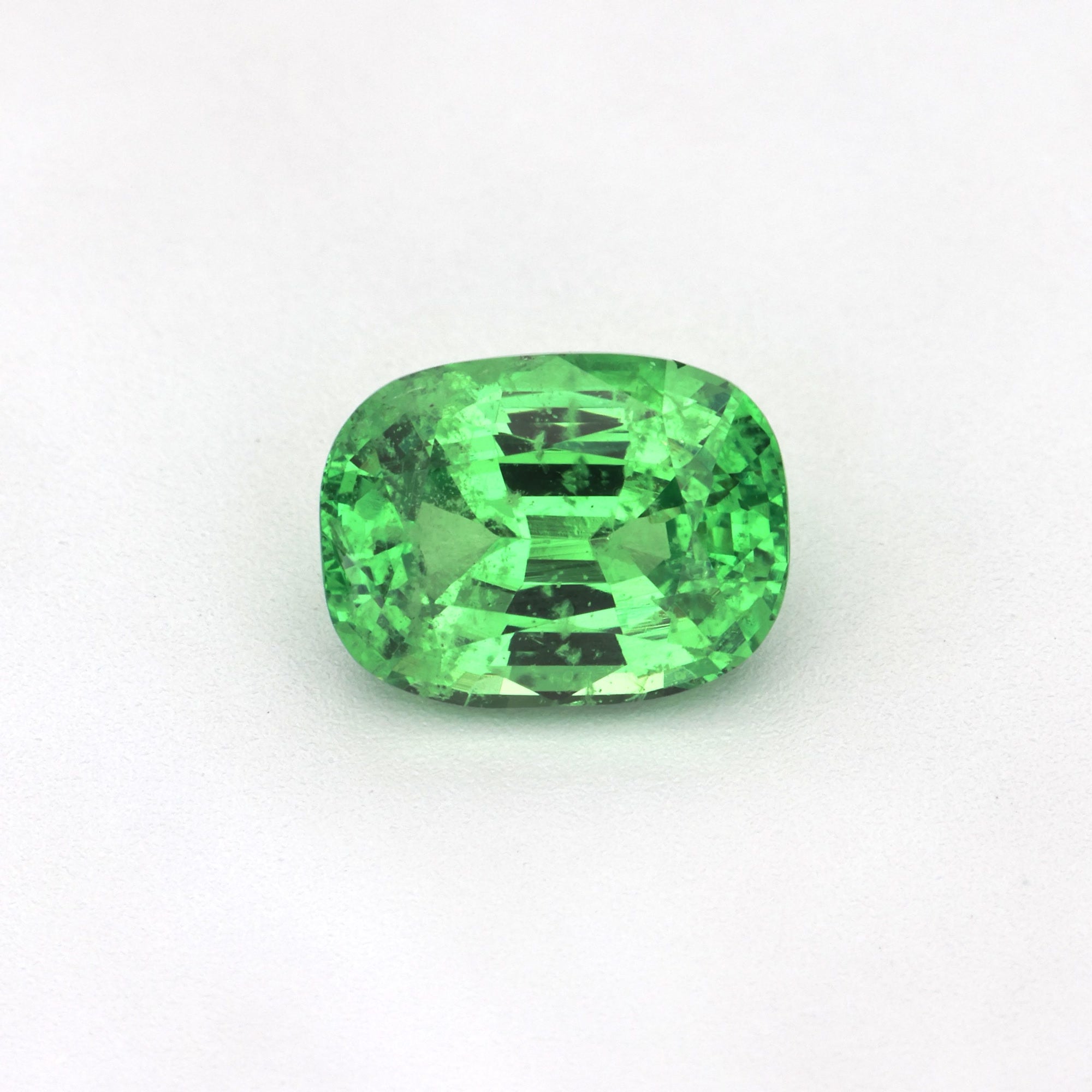
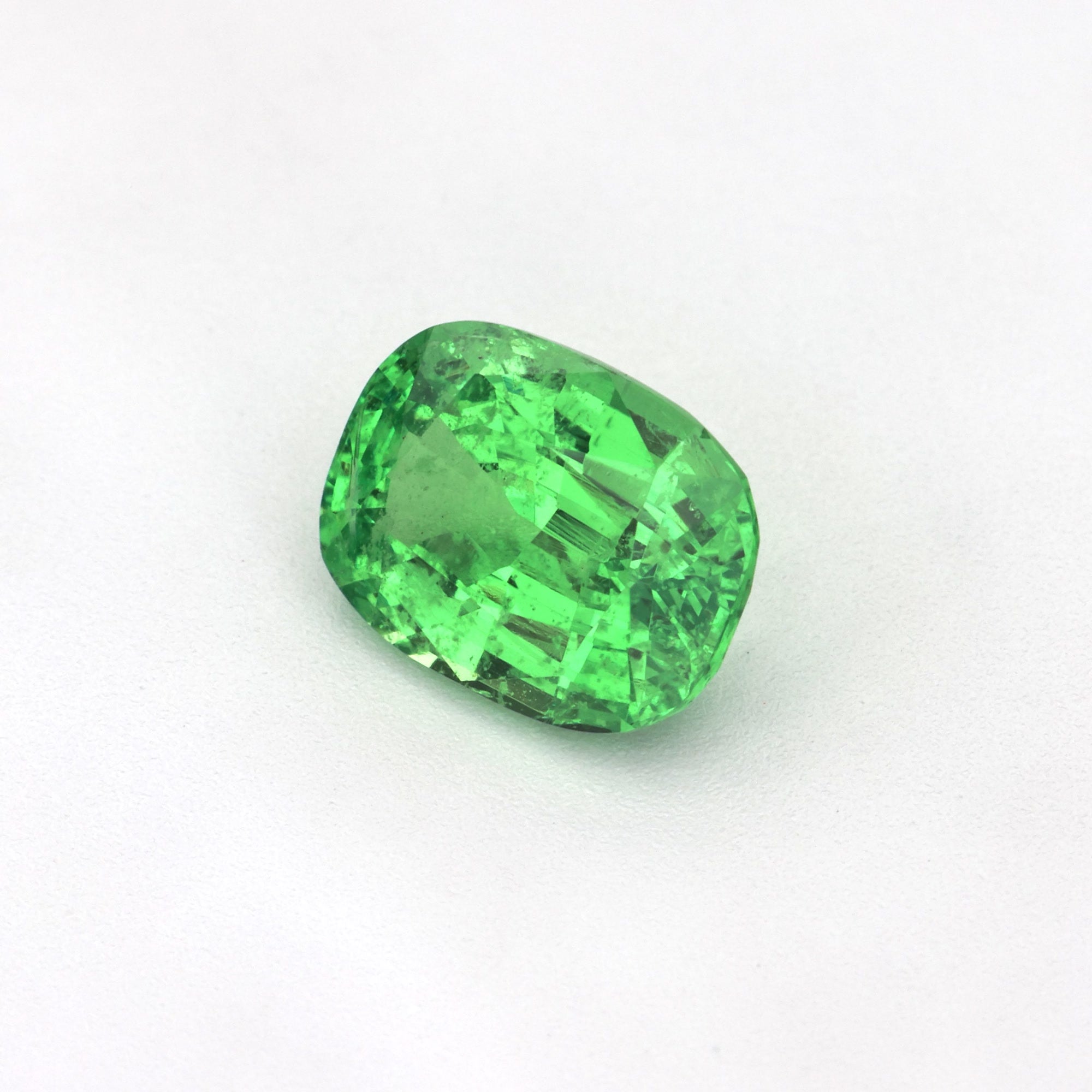
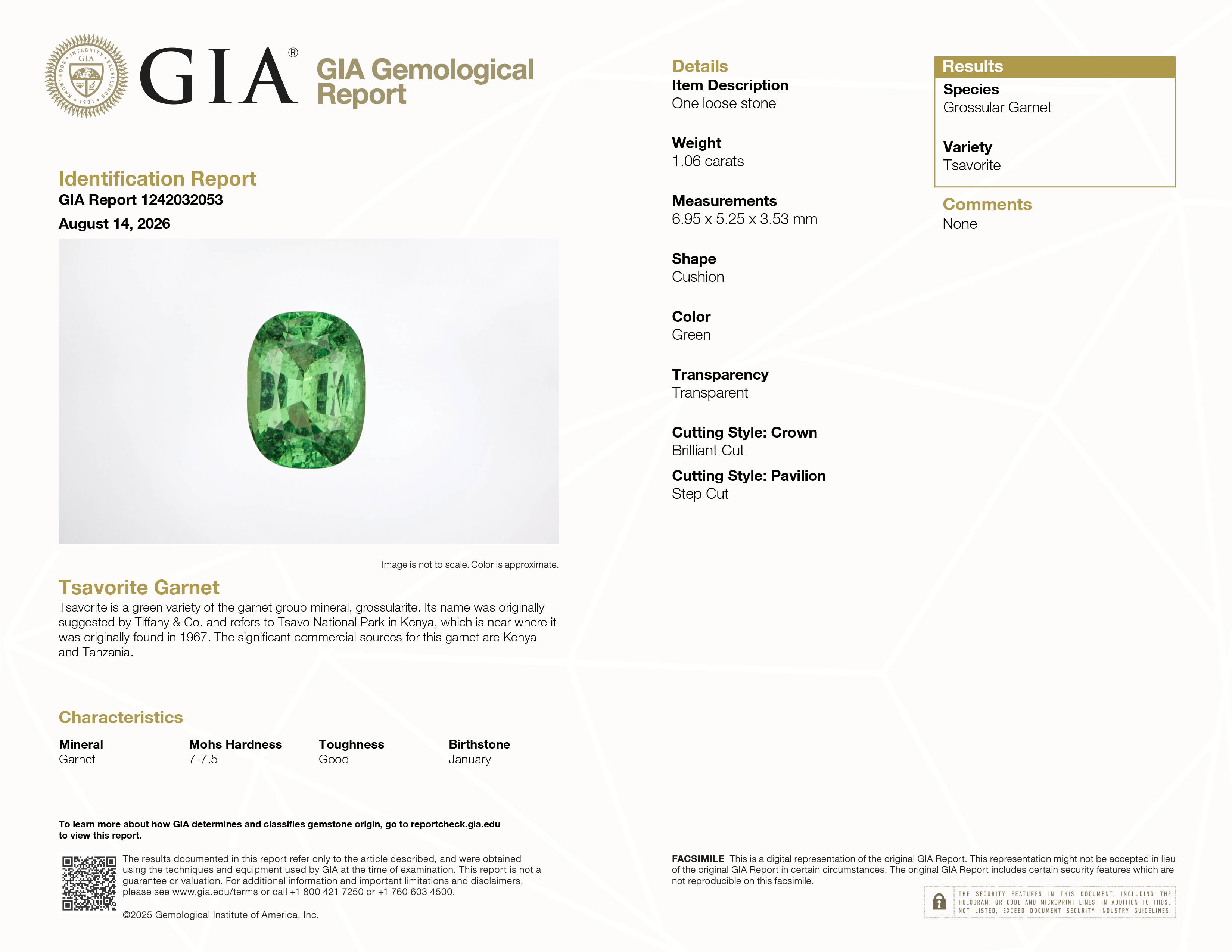
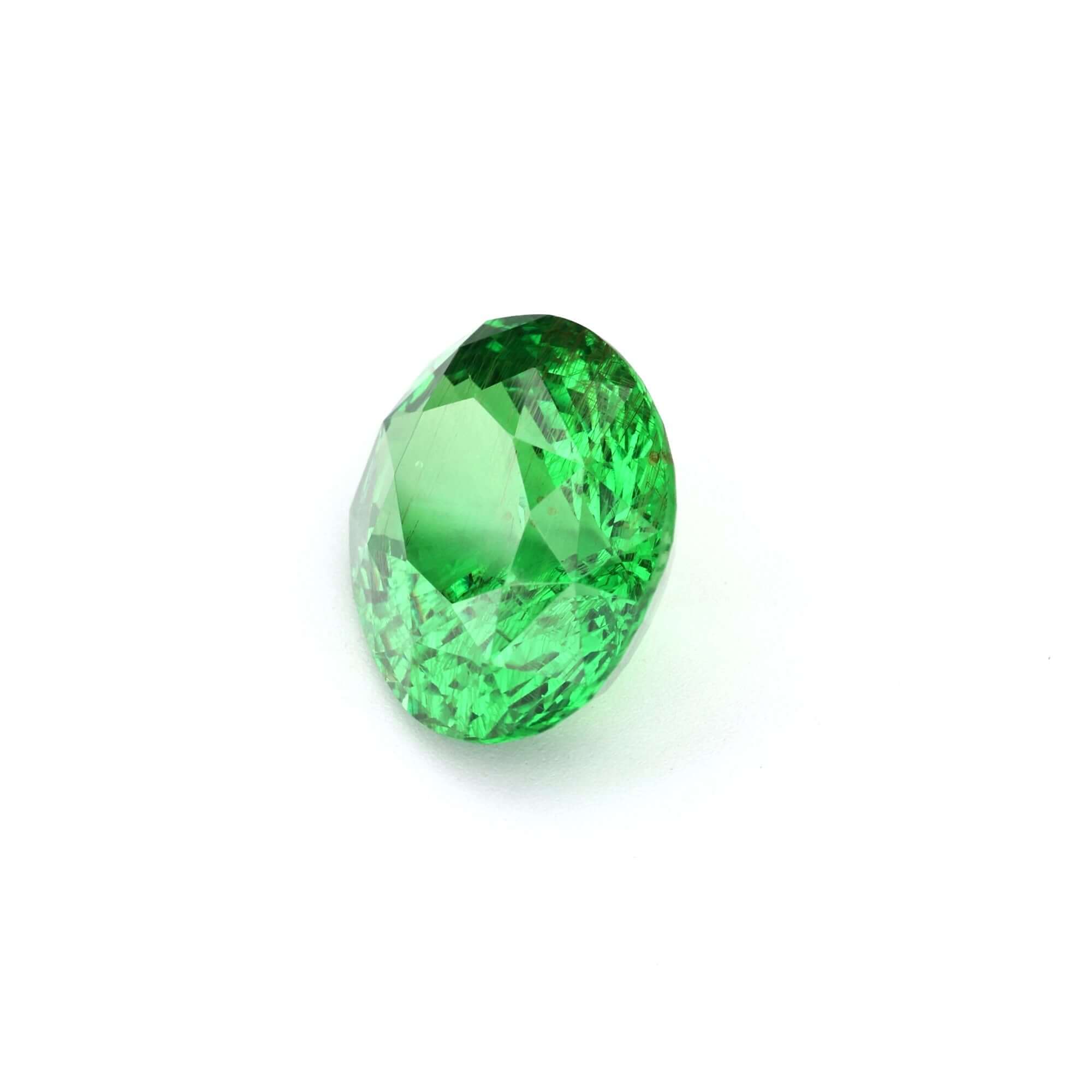
Tsavorite is the variety. The species is grossular garnet, a calcium aluminum silicate, colored green by vanadium and chromium. The pair is not interchangeable and a report keeps them in separate fields: grossular is the species finding, and it is what rules out the other green garnets; tsavorite is the variety the report names on top of it. On commercial sources GIA writes that "the significant commercial sources for this garnet are Kenya and Tanzania". Our tsavorite is Kenyan, and every listing states the stone's origin.
| Property | Tsavorite Garnet | What it means in practice |
|---|---|---|
| Mineral species | Grossular garnet (Ca₃Al₂Si₃O₁₂) | A distinct species from the pyrope, almandine and spessartine garnets |
| Variety | Tsavorite | The variety name the report prints on top of the species finding |
| Mohs hardness | 7-7.5 | Sapphire is Mohs 9. Mohs measures resistance to scratching and abrasion only, and says nothing about how a stone behaves when it is struck |
| Cleavage | None | There is no plane along which a knock can split the stone |
| Toughness | GIA: "fair to good" | GIA gives garnet "fair to good toughness" and says it "should not be subjected to any hard blows or rough wear". Toughness, not hardness, is what governs chipping |
| Refractive index | 1.730-1.760 | The sourced range for grossular; GIA's own specimen reads 1.741 |
| Cause of color | Vanadium (V) and chromium (Cr) | The green is a property of the crystal's own chemistry |
| Treatment | Stated on every listing | AGTA's Gemstone Information Manual assigns tsavorite code N, "Natural: No modification (or currently has no known modification process)." Where a stone has had something done to it, its own listing says so |
| Commercial sources | Kenya and Tanzania | GIA: "the significant commercial sources for this garnet are Kenya and Tanzania". Ours are Kenyan |
Mineral species, hardness, toughness and refractive index are not findings about any particular stone. They describe grossular garnet as a material, and they would read the same on a report for a stone we have never seen. They are here as background, not as a measurement of the stone in front of you. The no-cleavage point is sourceable from the mineralogical literature rather than from GIA, which publishes cleavage for corundum and not for this species.
Mohs 7-7.5 is the figure that worries buyers, and on its own it is the wrong thing to worry about. Mohs measures resistance to scratching and abrasion only. It is an ordinal scale of what will mark what, and it is silent on the question an engagement ring actually poses, which is what happens when the stone is knocked.
Hardness governs the slow stuff: the gradual loss of polish from grit, from surfaces, from the inside of a bag. A tsavorite handles that well. Over many years of daily wear, fine surface wear is possible on a stone of this hardness, and a repolish deals with it if it ever becomes visible.
Resistance to chipping and fracture is toughness, which is a separate property from hardness and is not measured by the Mohs scale at all. GIA gives garnet "fair to good toughness" and says it "should not be subjected to any hard blows or rough wear". Alongside that, grossular garnet has no cleavage — no plane of weakness along which a single unlucky knock can split it. Those two facts together are the honest basis for saying a tsavorite is a realistic engagement ring stone, and neither of them is a hardness argument.
Beyond those two, the answer stops being a species answer. Inclusions and growth tubes bear on how tough an individual stone is, and no general statement about tsavorite can tell you about the one you are looking at. That is not evasion — it is the reason each of our listings carries the stone's weight, color, origin and treatment, and names the laboratory and report number where a report exists. For a particular stone, the listing is the answer and this page is only the background.
Buyers looking at a green stone usually ask about oiling and resin filling, because those are part of the conversation around emerald. On tsavorite the answer is in the treatment section below: AGTA's own code for this material records no known modification process for it, and where a stone of ours has had anything done to it, that stone's listing says so. We draw no ranking between species. No laboratory publishes one.
Tsavorite occurs across a range from pale mint through mid-green to a deep, almost forest green. Before any of that is useful, one thing has to be said about the vocabulary.
Nearly everything written about grading a colored stone is diamond text with the stone's name swapped in. For a diamond there is a published scale. What does not exist, for the color of a tsavorite, is any published laboratory grading of it. GIA states that it "doesn't grade or provide quality analysis for sapphire or other colored stones", and that sentence covers garnet. CIBJO defines the category and stops there. A report records that a stone is green; it does not score the green. "Vivid" is not a graded value; it is an adjective.
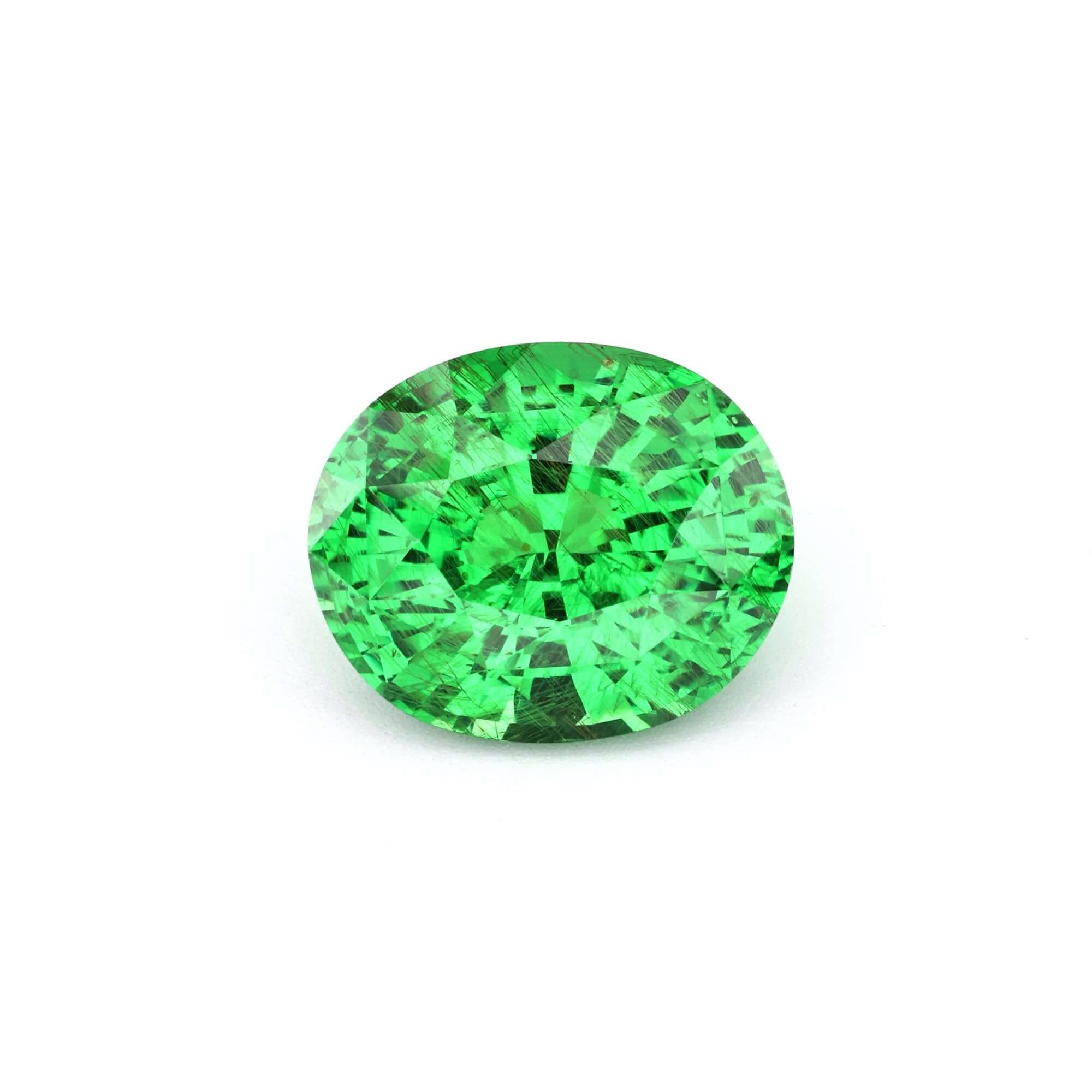
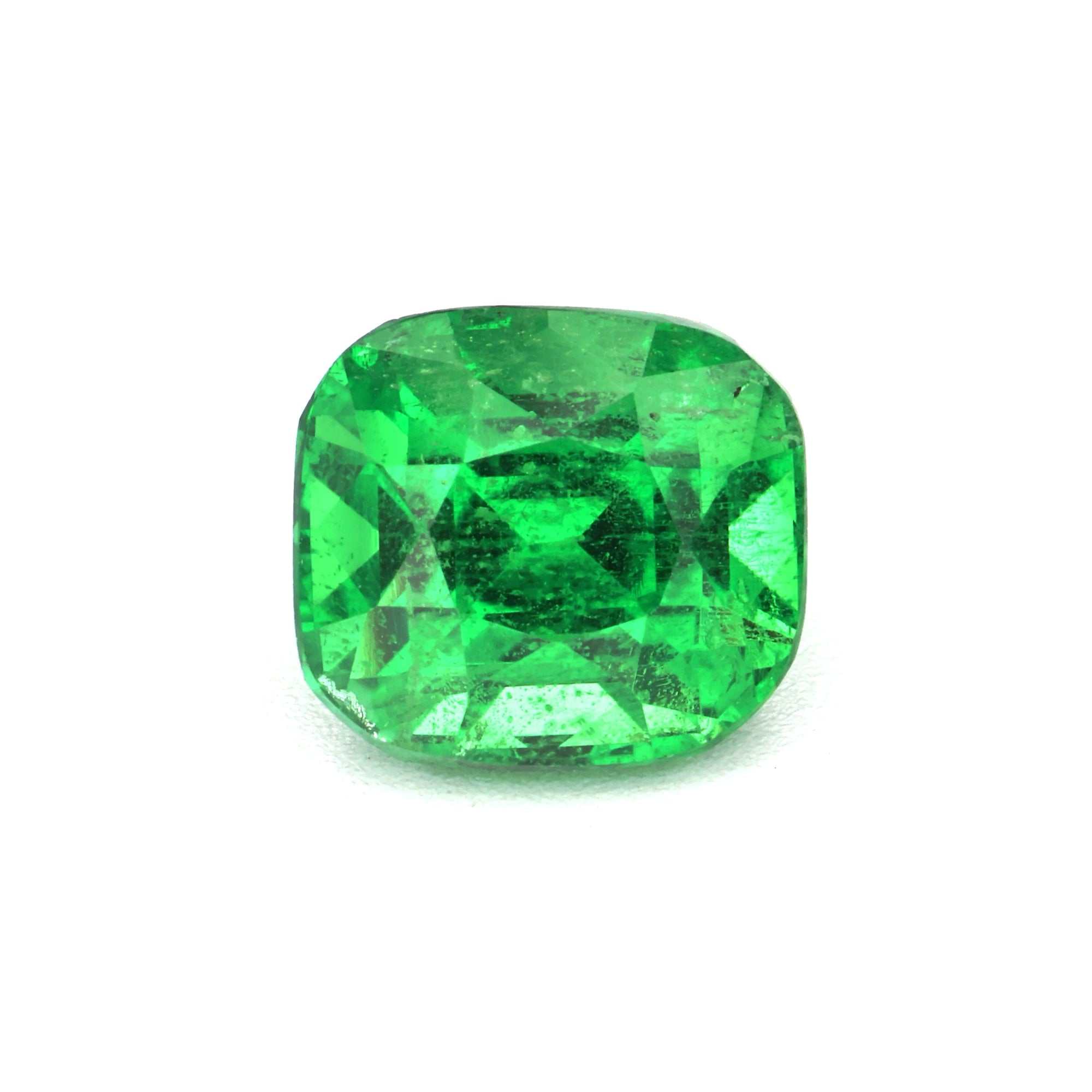
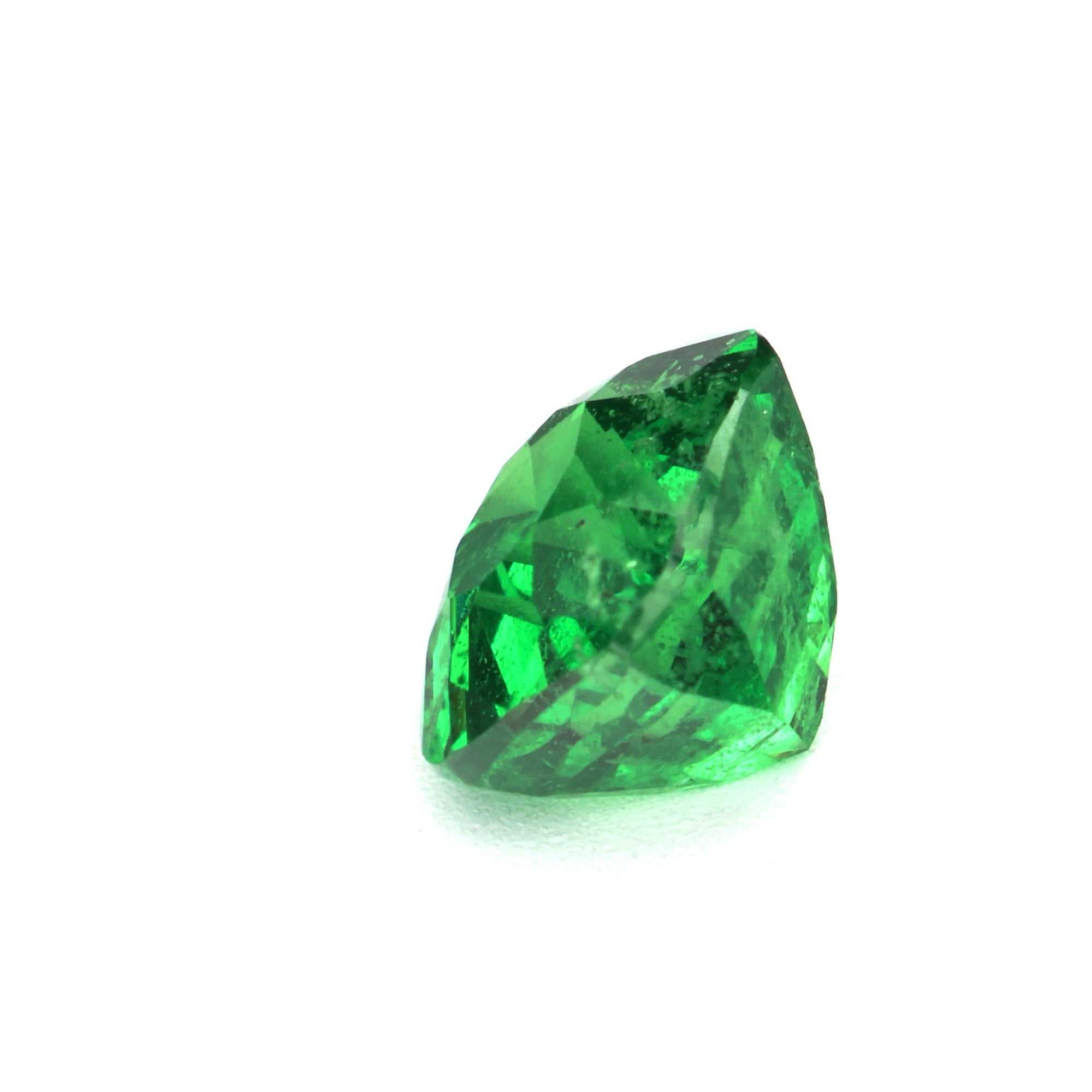
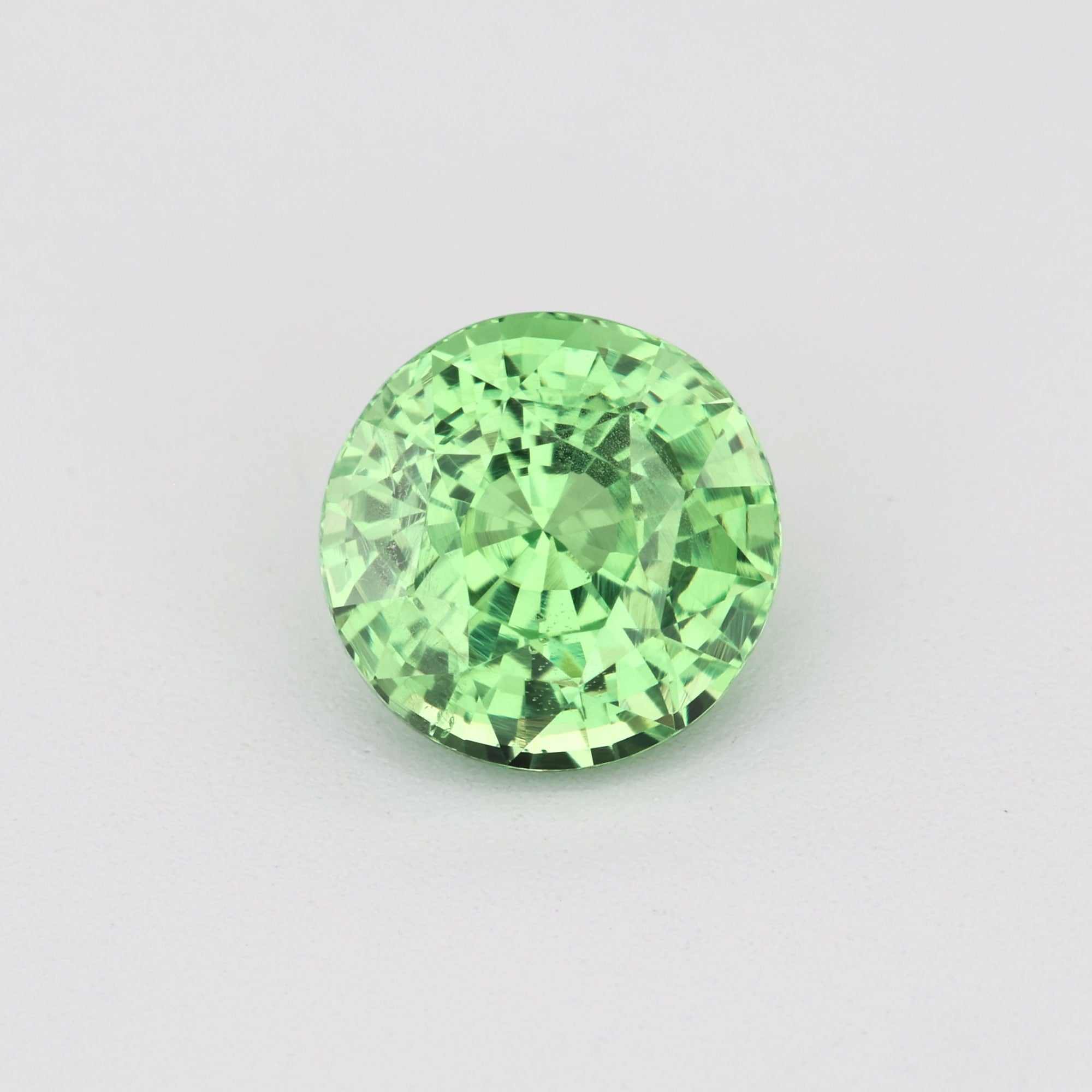
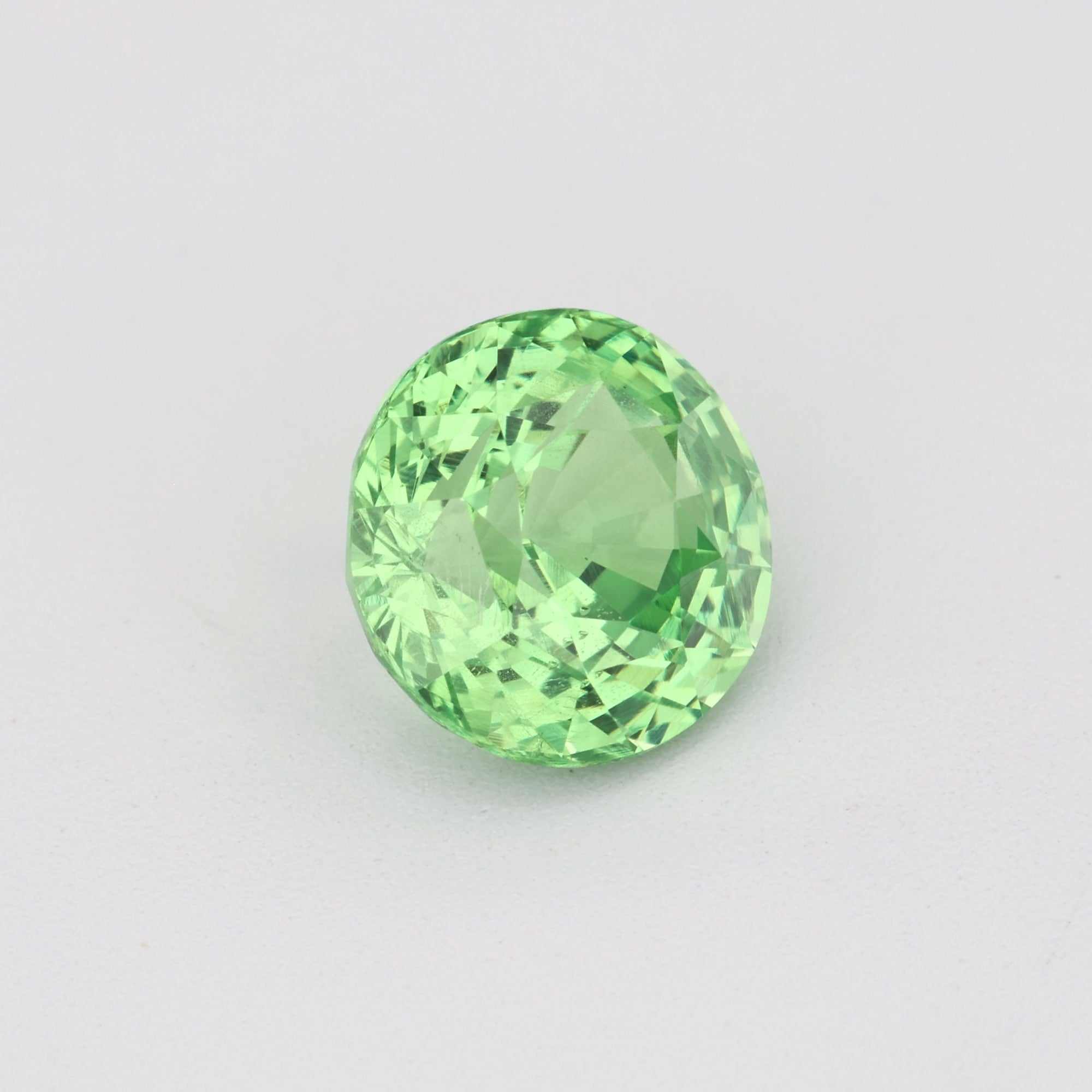
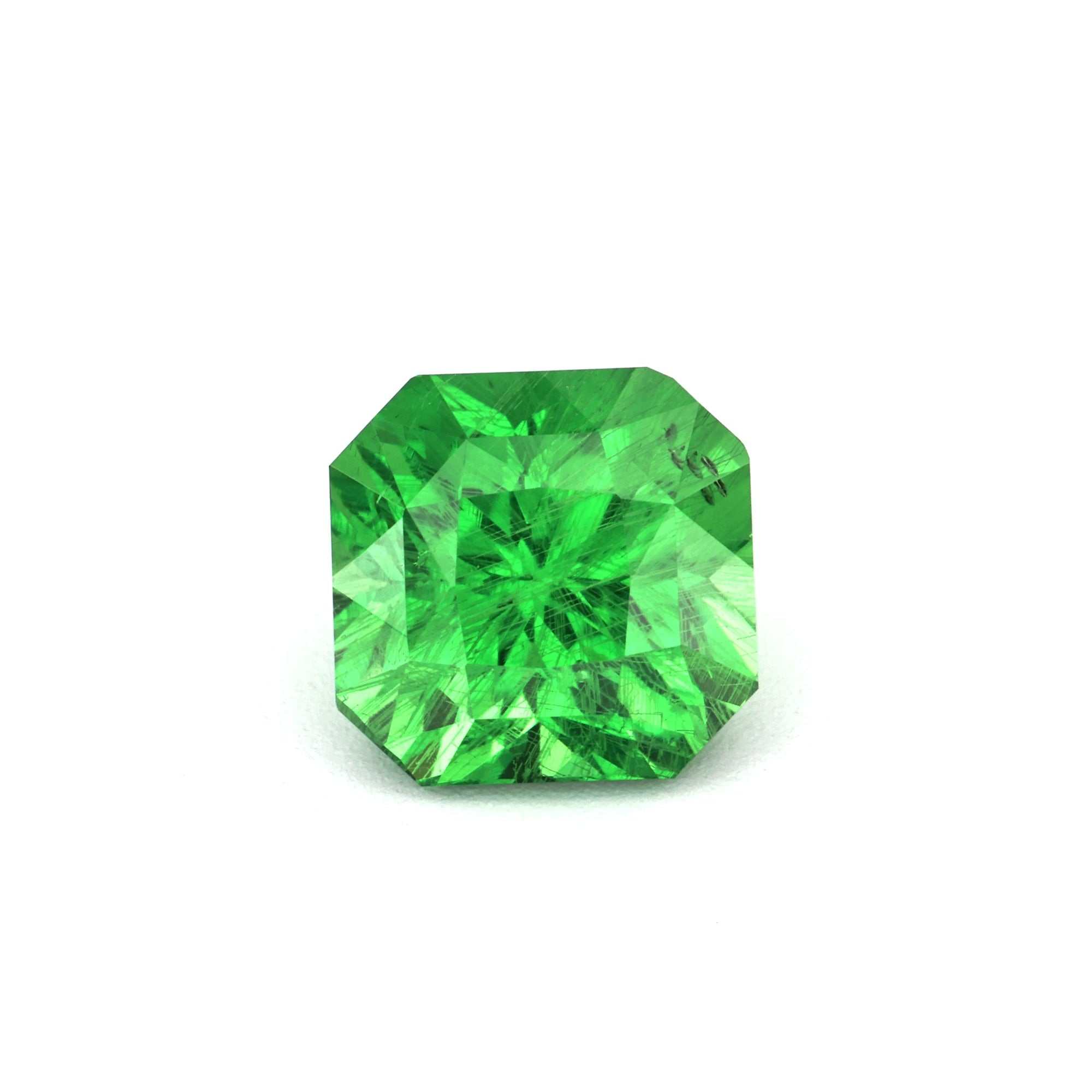
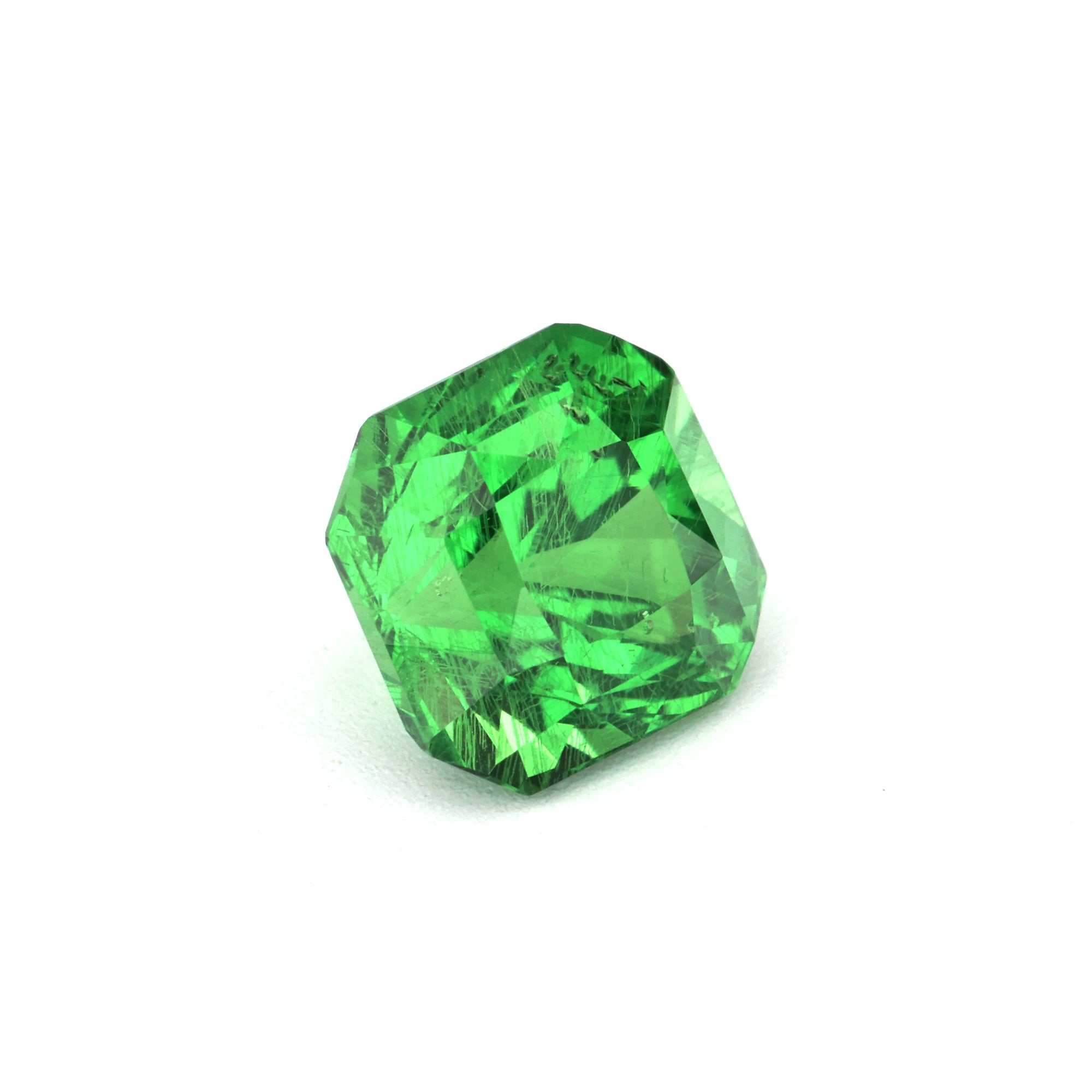
So any description of how a particular tsavorite looks, ours included, is the seller's own observation, and no document can be produced to substantiate it. We would rather send you a video of the stone than an adjective.

These are the three things we use to describe a stone to ourselves. They are a way of looking, not a scale, and we attach no ranking of worth to any of them.
On value and size, GIA says only that "value goes up significantly with size". There is no published price-per-carat data for tsavorite to put underneath that, so there are no price bands on this page. The one sourced scarcity marker worth quoting is the International Colored Gemstone Association's: "a cut tsavorite of more than two carats is a rare and precious thing." Each stone's own listing carries its weight and its price, which is where a figure you can rely on lives.
Our tsavorite is listed in the tsavorite collection, where each stone carries its own weight, color and price.
AGTA's Gemstone Information Manual assigns tsavorite code N — "Natural: No modification (or currently has no known modification process)." That is a statement about the material rather than a selling point about any particular stone, and we do not price it as a feature. It is simply how tsavorite normally works.
Clarity enhancement does occur in this material. Where it is present on a stone, that stone's own listing says so plainly, in its title and in its description, and names the laboratory and the report number. Where a stone has no report at all, the listing says that plainly too.
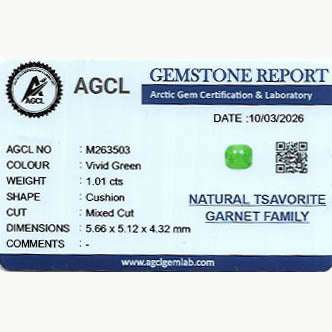
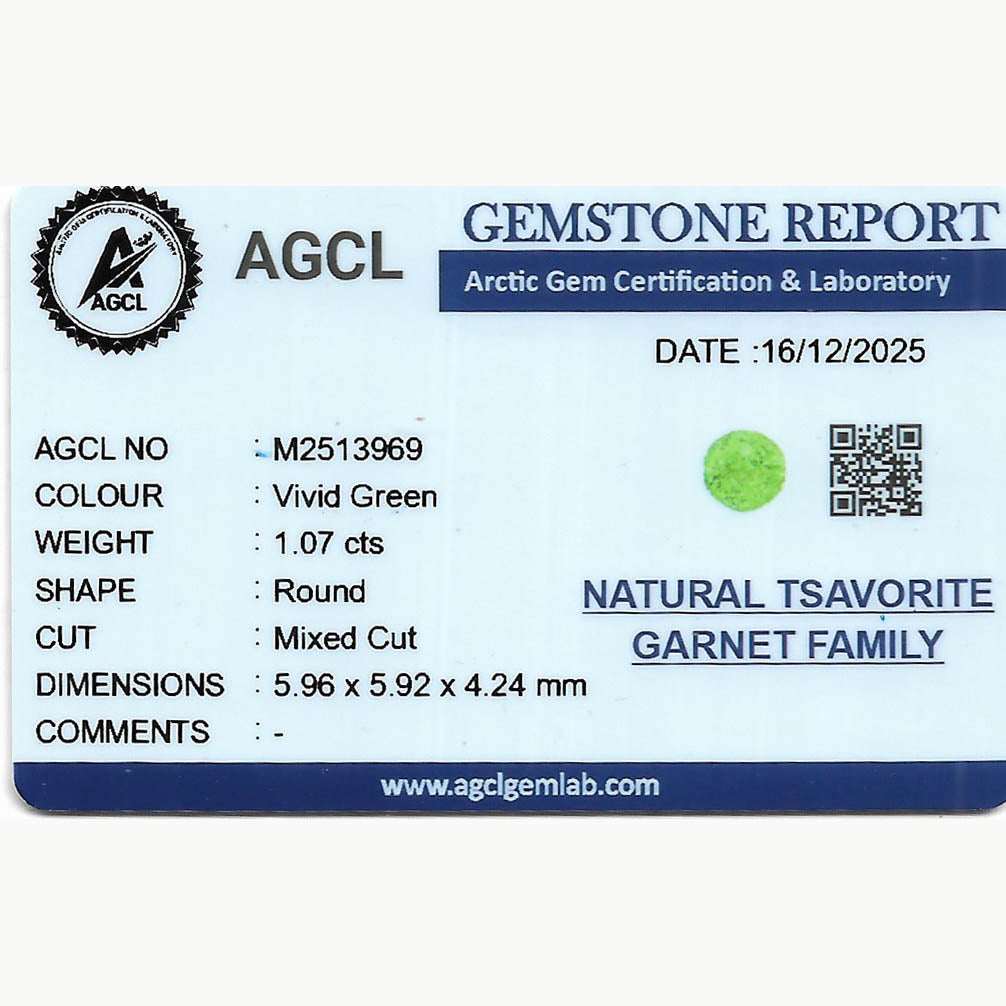
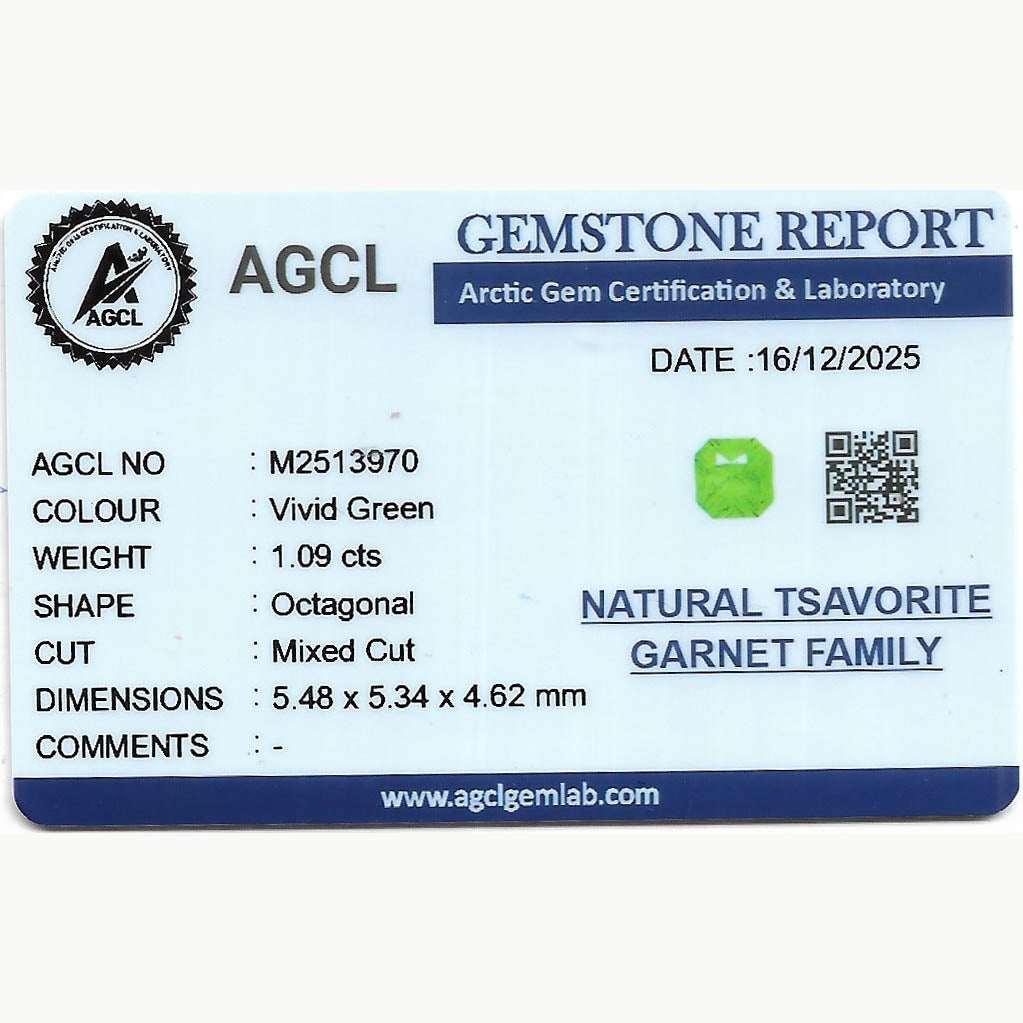
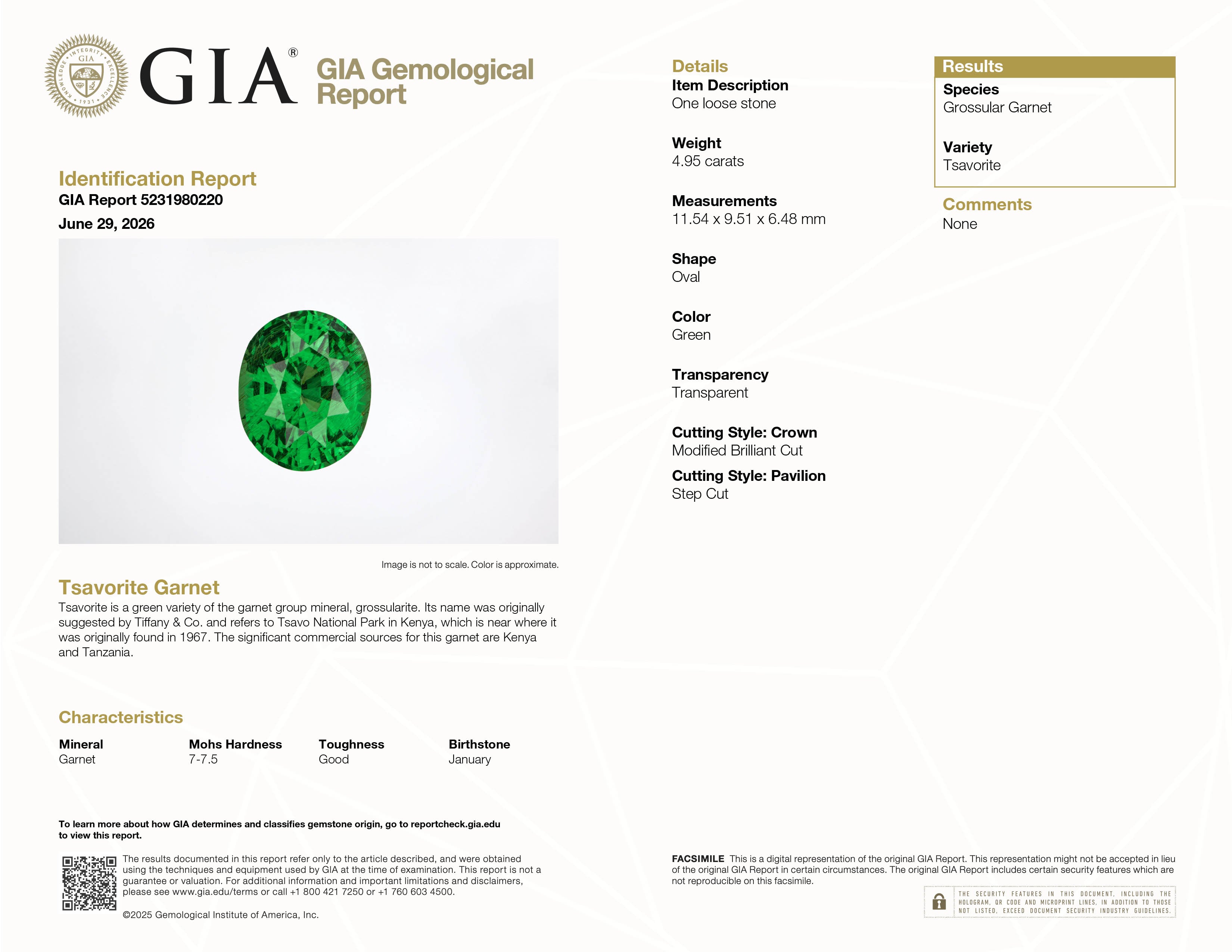
GIA publishes that its Identification Report "identifies and describes a material and lists detectable treatments". Not every stone of ours carries that report; some carry one from a different laboratory, with a different scope, and we have not established what that report records about treatment. So rather than rest the disclosure on whichever document a stone happens to have, we state the treatment on the listing ourselves. What you can check on an individual stone is its report and the seller's written treatment disclosure. The species name is not a substitute for either of them.
A setting's job on a tsavorite is to cover the edges, because the stone's vulnerability is impact on an exposed corner or girdle — which is a matter of toughness, not of hardness. Everything in this section is a recommendation of ours rather than a reported finding. That is our own recommendation, from handling these stones — no laboratory publishes guidance on settings, and we are not reporting one.
A full bezel wraps the girdle in a metal rim and takes the knock before the stone does. For a tsavorite that will be worn every day, this is the setting we would choose. A bezel covers a little of the stone's outline compared with a prong head, and that is the trade. Yellow gold sits warmly against green; white metal reads cooler.
Prongs expose more of the stone and let more light in. On this stone we would use six prongs rather than four, because more prongs spread the pressure and leave less girdle unsupported, and we would ask for rounded or flat prong tips that sit over the girdle edge rather than claw tips that leave it standing proud at the sides. Have the setting checked from time to time, and any time the stone feels loose or the ring has taken a hard knock.
A halo of small diamonds or sapphires around the center stone works as a partial bumper around the girdle, and it makes the center stone read larger than it is. It is a reasonable middle course between a bezel and an open prong head.
Elongated outlines have points, and a point is the most exposed part of a faceted stone. On a tsavorite in one of these shapes, ask your setter for a V-tip at each point, or a partial bezel over the tips. Cushions and rounds have no points and are the easier shapes to protect.
| Metal | How it reads against the stone | Our note |
|---|---|---|
| Yellow gold (18k or 14k) | Warm; the green reads warmer against it | The most traditional pairing for this stone |
| Rose gold | Warm contrast; the strongest contrast of the three | Worth seeing in a video before deciding |
| White gold or platinum | Cool contrast; the green reads cooler and cleaner against it | Platinum is white throughout and is never plated; white gold is normally rhodium plated and the plating wears |
GIA publishes care guidance for garnet, so on this stone there is a published position to give you rather than only ours. GIA's is that warm soapy water is always safe for garnet; that ultrasonic cleaning is usually safe except for stones with fractures; and that steam cleaning is not recommended.
Ours is stricter in one place and identical in the rest. We clean with warm water, a mild soap and a soft brush, and we would keep a tsavorite out of an ultrasonic tank altogether. That is our own preference and not GIA's, and we say so rather than leave it implied, because we do not want GIA made to appear to endorse a caution it did not publish. On steam we are simply following GIA: do not steam a garnet. Gems & Gemology names tsavorite as heat-sensitive, which is a second reason to keep sudden heat away from it.
Where a stone has a disclosed clarity enhancement the instruction does not merely tighten — it changes, and GIA publishes the changed form itself: "Only warm soapy water should be used to clean fracture-filled stones." No ultrasonic and no steam, and tell the bench about the enhancement before any work is done on the ring. Note what that exclusion is keyed to: a disclosed treatment, not a visible fracture. A filled stone need not show one, so "no visible fractures" is not the test.
A stone that has gone dull is usually carrying residue, and cleaning deals with that. If cleaning does not, the cause is something else — an abraded facet, a chipped edge, a loose setting — and that is worth having looked at rather than scrubbed harder.
Our Sapphire Engagement Ring Care Guide covers the parts that are the same whatever the stone is: the band, the prongs, the metals, what to take a ring off for and when to have a setting checked. Its cleaning instructions are written for sapphire and do not transfer to a garnet — that guide says so itself. For the stone, use this page.
| What you are after | Is tsavorite it? | Notes |
|---|---|---|
| A green stone you can wear every day | Yes | A setting that covers the edges and a habit of taking the ring off for rough work are what make this work |
| The hardest stone you can get | Sapphire is harder | Sapphire is Mohs 9 against tsavorite's 7-7.5. Hardness is not the whole of durability — corundum has no cleavage either, although it does have parting — but if scratch resistance is the deciding factor, that is the honest answer |
| To know exactly what was done to the stone | Read the listing | Every listing states the treatment and names the laboratory and report number where a report exists, and says plainly where one does not |
| Something that is not the usual choice | Yes | A green garnet is an unusual choice for a ring, and that is the reason people who choose one usually give us |
| A ring for an active life with frequent hard knocks | Yes, in a bezel | The setting is doing the work here, not the stone. See the setting section above |
| A large center stone at a modest price | Difficult | The ICA writes that "a cut tsavorite of more than two carats is a rare and precious thing", and price follows that. A smaller tsavorite, or a different species, may suit the budget better |
| A stone whose name everyone knows | No | Tsavorite is not a name most people will know. That is a fact about the name, not about the stone |
Yes, with a setting that covers the edges. The reason is not its hardness: Mohs measures resistance to scratching and abrasion only, and the property that governs chipping is toughness. GIA gives garnet "fair to good toughness" and says it "should not be subjected to any hard blows or rough wear". Grossular garnet also has no cleavage, so there is no plane along which a knock can split it. A bezel, a halo, or a six-prong head with the prongs over the girdle will protect the edges, and inclusions affect how tough an individual stone is, so the particular stone's listing is the real answer.
Because what does not exist is any published laboratory grading of color. GIA states that it "doesn't grade or provide quality analysis for sapphire or other colored stones", and that sentence covers garnet. CIBJO defines the category and stops there. A report records that a stone is green; it does not score the green, and "vivid" is an adjective rather than a graded value. So any description of how a particular tsavorite looks, ours included, is the seller's own observation, and no document can be produced to substantiate it.
AGTA's Gemstone Information Manual assigns tsavorite code N, "Natural: No modification (or currently has no known modification process)." That describes the material, not a particular stone. Clarity enhancement does occur in tsavorite, and where it is present on a stone of ours the listing says so and names the laboratory and the report number. GIA publishes that its Identification Report "identifies and describes a material and lists detectable treatments". Not every stone carries that report, so we state the treatment on the listing ourselves rather than resting it on whichever document a stone happens to have.
Three things, none of which is a grade: hue, which is where the green sits and whether it reads cooler and bluer or warmer and more yellowish; tone, which is how light or dark the stone is; and saturation, which is how strong the color is at that hue and tone. We attach no ranking of worth to any of them, because nothing published supports one. All three are obvious in a video of the stone and almost impossible to convey in a word, which is why we would rather send you the video.
A stone of about half a carat to two carats is the range we are usually asked for, which is a matter of what the material offers at a workable price rather than a rule. The International Colored Gemstone Association writes that "a cut tsavorite of more than two carats is a rare and precious thing", and price follows that. We publish no price bands for tsavorite because no published price-per-carat data exists for it; each stone's own listing carries its weight and its price.
Warm water, a mild soap and a soft brush, whenever it looks dull. GIA publishes that warm soapy water is always safe for garnet, that ultrasonic cleaning is usually safe except for stones with fractures, and that steam cleaning is not recommended. We go further than GIA on one point only: we would keep a tsavorite out of an ultrasonic tank altogether, and that is our own preference and not GIA's. Where a stone has a disclosed clarity enhancement GIA publishes the stricter instruction itself, that "only warm soapy water should be used to clean fracture-filled stones", and the bench should be told about the enhancement before any work on the ring.
The color comes from vanadium and chromium inside the crystal rather than from a dye or a coating. We do not give a forward guarantee about color, because no laboratory gives one either: a color-stability test reports that no change was observed under the conditions of the test, and that is a different statement. What we will say plainly is that GIA's own journal, Gems and Gemology, names tsavorite as heat-sensitive, and that the stone should be kept away from sudden changes in temperature. That is a care instruction rather than a color one.
A bezel gives the most protection, because the metal rim takes the knock before the girdle does. A halo works as a partial bumper and makes the center stone read larger. A six-prong head with the prongs sitting over the girdle edge gives more light and more to keep an eye on. On an oval, a pear or a marquise, ask your setter for a V-tip at each point. That is our own recommendation, from handling these stones — no laboratory publishes guidance on settings, and we are not reporting one.
Our tsavorite is Kenyan. Every listing states the weight, the color, the origin and the treatment, and names the laboratory and the report number where a report exists. We buy our tsavorite garnets ourselves. The collection page below is the current list.
A personal video of any stone is available on request. Email crescentgems@gmail.com with a question about a particular stone's suitability for a ring design, a setting, or a size.

CG8447
Prices are shown in your local currency and may change.

CG8417
CG8460
CG8359
CG8360
CG8465
CG8447


Blue Star Sapphire Price Guide — What They Cost and Why
Read moreabout Blue Star Sapphire Price Guide — What They Cost and Why
Tsavorite Garnet Price Guide — What They Cost and Why
Read moreabout Tsavorite Garnet Price Guide — What They Cost and Why
Color-Change Sapphire Price Guide — What They Cost and Why
Read moreabout Color-Change Sapphire Price Guide — What They Cost and Why
Is Cat's-Eye Chrysoberyl Good for an Engagement Ring?
Read moreabout Is Cat's-Eye Chrysoberyl Good for an Engagement Ring?
Cat's Eye Chrysoberyl Price Guide — What They Cost and Why
Read moreabout Cat's Eye Chrysoberyl Price Guide — What They Cost and Why