- by Ahmed Shareek
Color-Change Sapphire Price Guide — What They Cost and Why
- by Ahmed Shareek
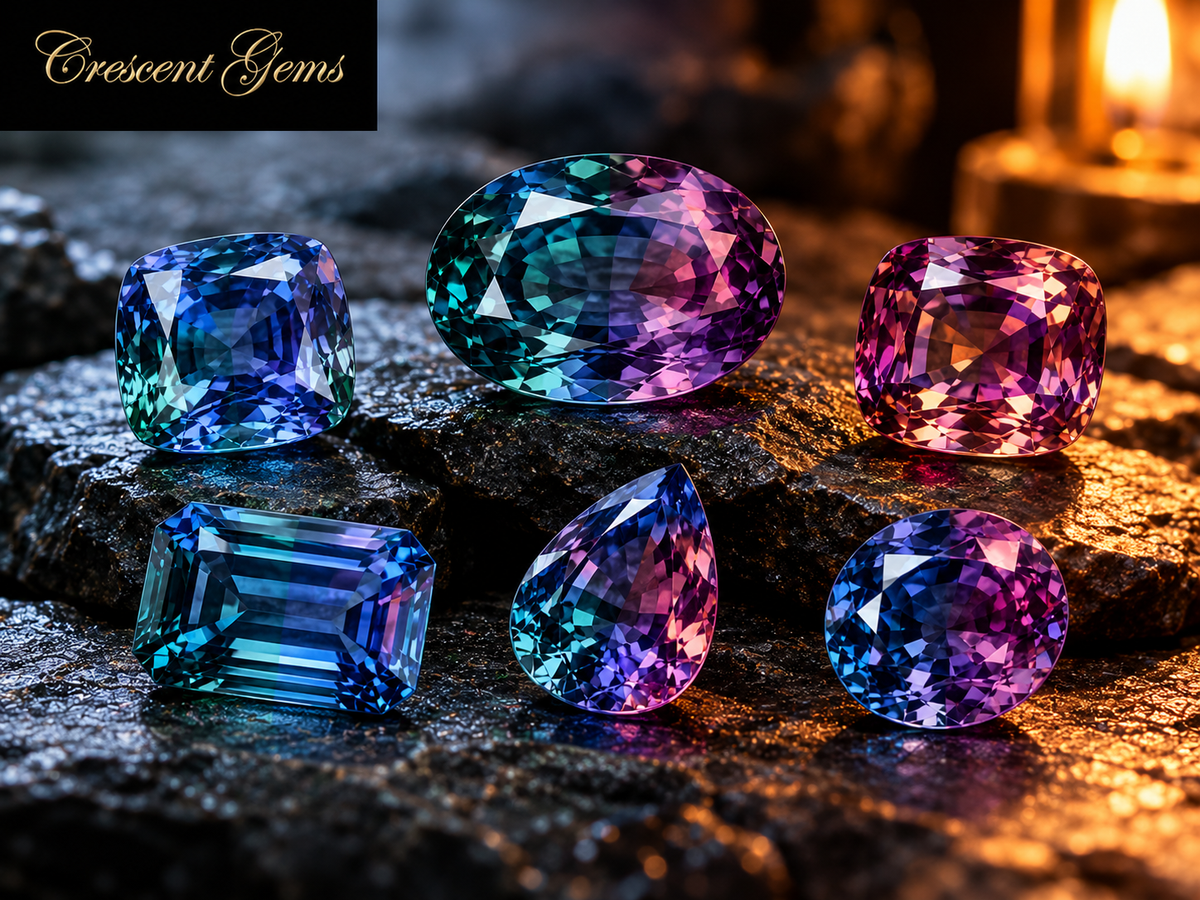
Color-change sapphire shifts hue with the light source: one color under a daylight-equivalent source, another under incandescent light. This guide sets out what the two color-change sapphires we own cost, and it prices them on the things a report and an invoice actually record — the colors, the carat weight, and what documentation comes with the stone.
GIA describes the material plainly: color-change sapphires are "corundum's chameleons — stones that change color under different lighting." GIA also publishes what the category typically looks like: "Under daylight equivalent (fluorescent or LED daylight-balanced) light, the typical color-change sapphire's basic color ranges from blue to violet. Under incandescent light, it ranges from violetish purple to strongly reddish purple." That is a statement about the category and not about any individual stone; our own two stones are described further down in their own recorded words rather than as instances of it. For the full mechanism and the different shift patterns that occur, see our Color-Change Sapphire Guide.
This guide quotes no market range for the category, because we have no source for one: we have not surveyed the market, we hold nobody else's sales data, and a range we could not source would read as a measurement. What we can set out is what our own two stones cost. The headings matter: these are two prices, not quality grades. No laboratory grades the color change, so nothing here is a grading scale.
| Stone | Carat weight | Price | Price per carat | Laboratory report |
|---|---|---|---|---|
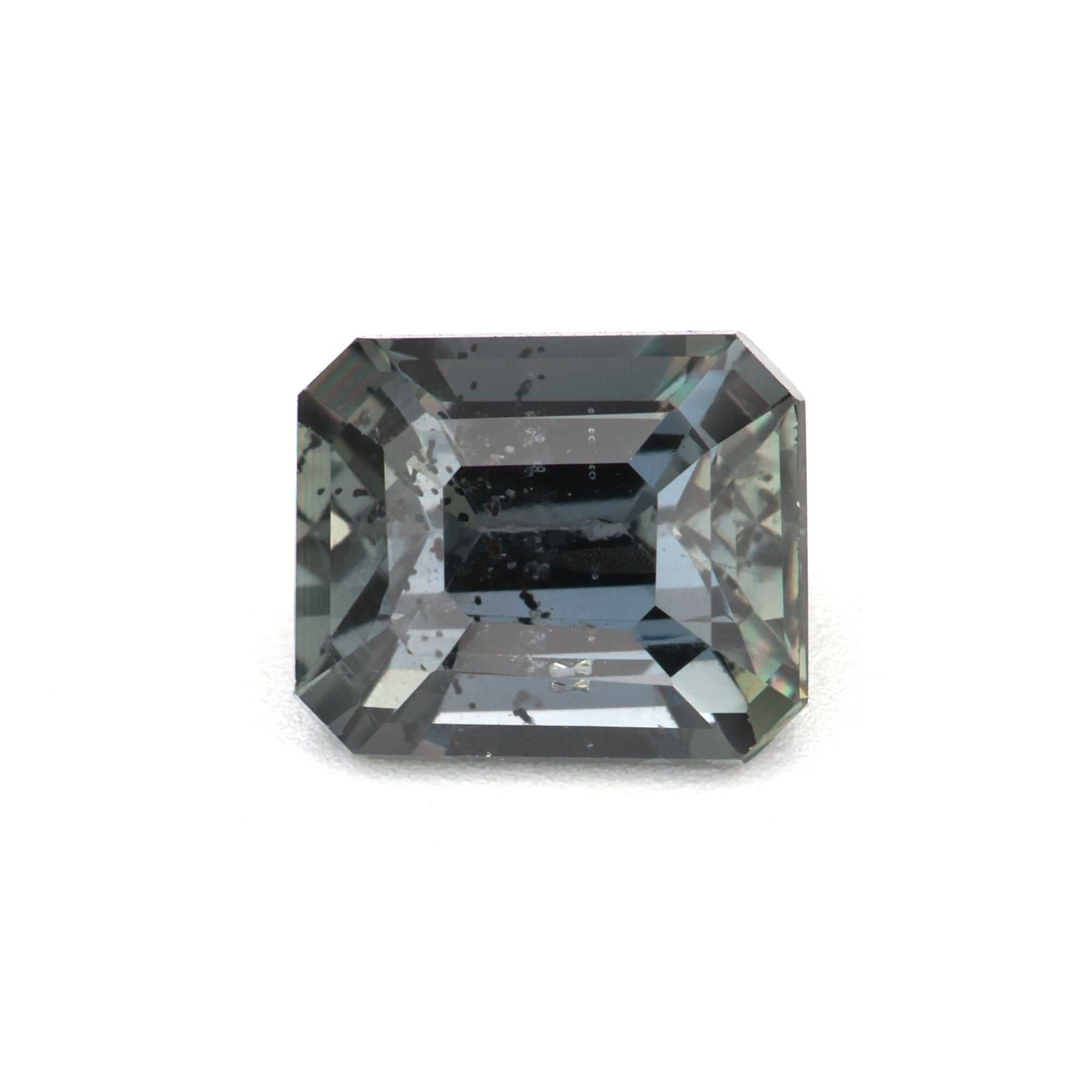
| Emerald cut | 1.03 ct | $824 | $800 | AGCL report M263506 |
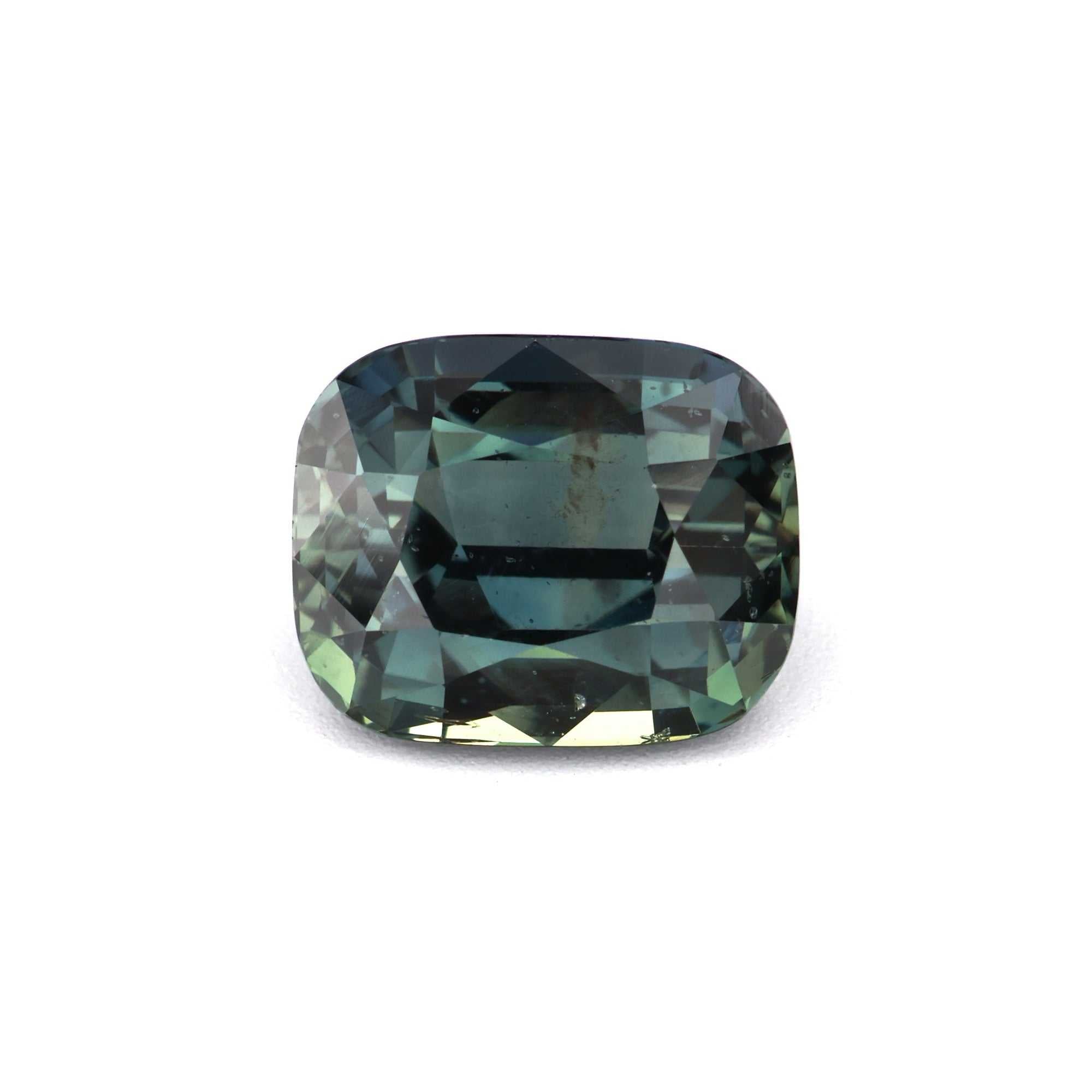
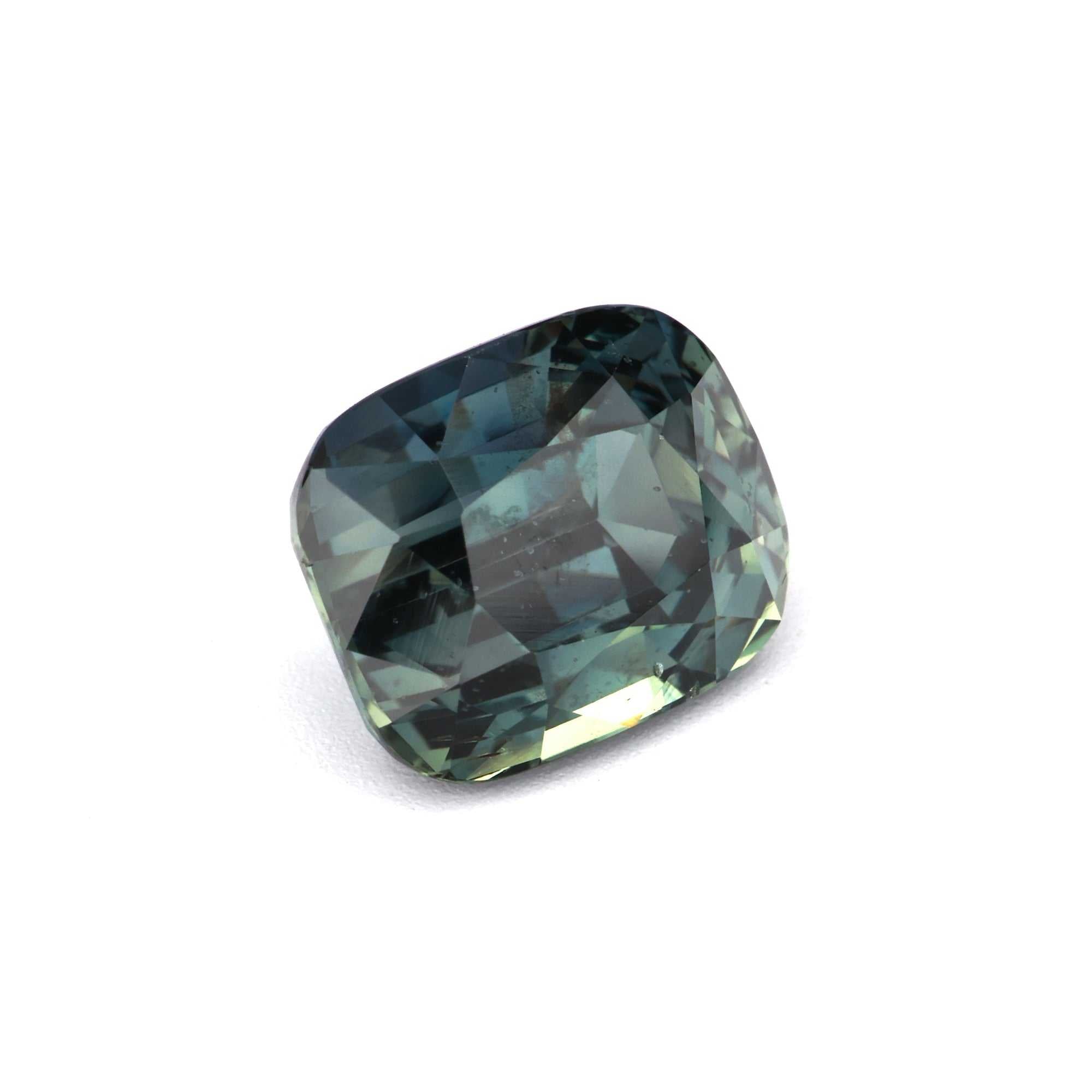
| Cushion | 2.01 ct | $2,211 | $1,100 | GIA Sapphire Report 1236949156 |
Our own stock, read from our own product listings on 16 November 2026: two listings, two stones — the whole of our color-change holding, and not a sample of anything. The per-carat column is each stone's price divided by its own carat weight, and both divisions come out exact: $824 ÷ 1.03 ct = $800 per carat, and $2,211 ÷ 2.01 ct = $1,100 per carat. No figure on this page is rounded. That is arithmetic about two prices, not a position on a quality scale.
Of the two, only the 2.01 ct cushion can be bought today. The 1.03 ct emerald cut is away at GIA and is expected back on 23 November 2026; it stays listed, and we can send video of it in the meantime, but it cannot be ordered until it is back.
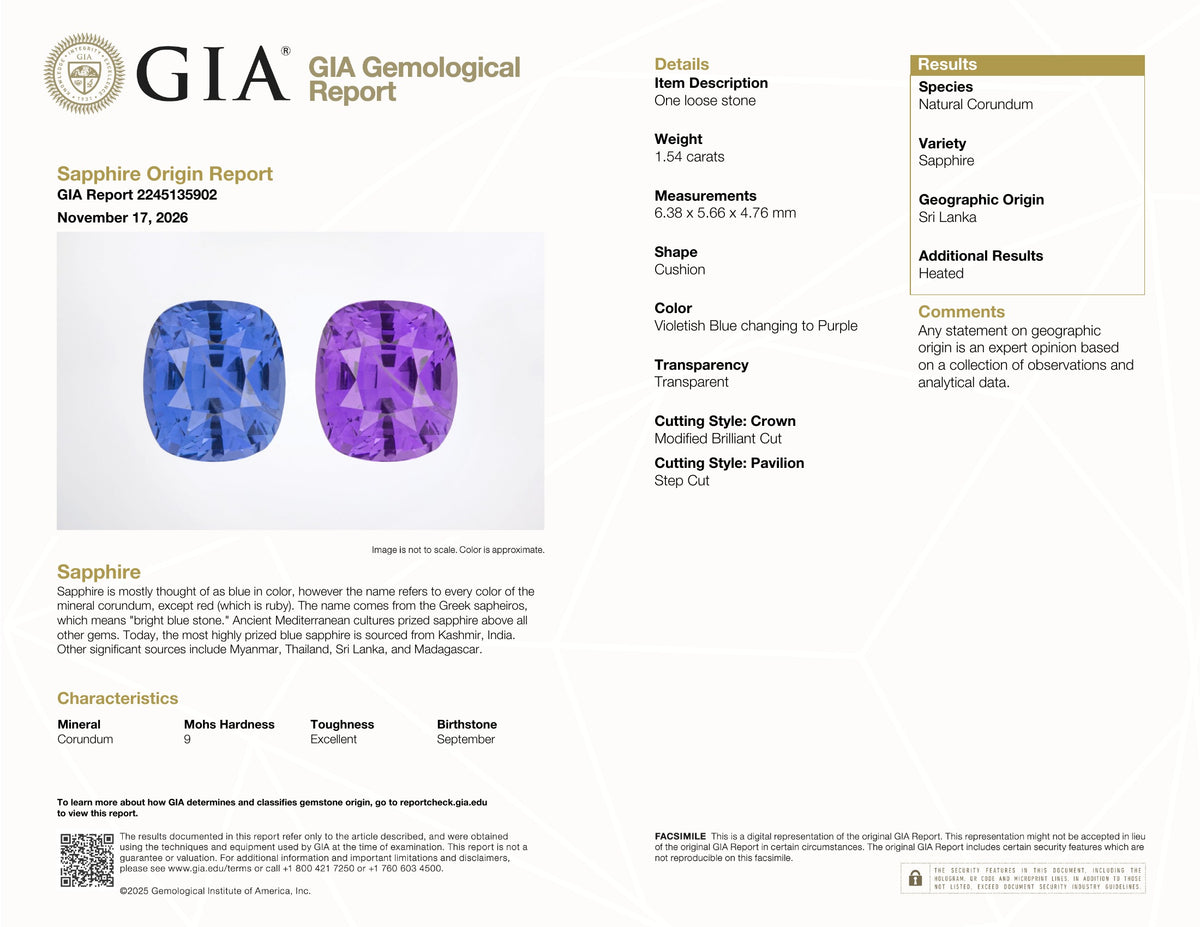
The 1.03 ct is priced at $824; the store's own color description for it reads "Green to Reddish Purple", which sits outside the daylight-side range GIA describes as typical for the category. The 2.01 ct is priced at $2,211; GIA's own Color field for that stone reads "Greenish Blue changing to Purple", and GIA's Comments section records that it exhibits a change of color when viewed under daylight or fluorescent versus incandescent light. Those are two prices and two descriptions, not two positions on a quality scale.
Origin is also not a quality grade, which is why it is not one of the columns in the table above. Where a stone was formed and how it looks are two separate findings, and pricing one as though it were the other is a habit worth breaking.
The change is what makes the stone, and it is the one thing on this page we will not attach a price to. The reason is worth stating plainly.
The trade does price color-change stones on the phenomenon, and that much is not in dispute. GIA even records the vocabulary the trade uses: "When gem experts judge color-change sapphires, they describe the color change as weak, moderate, or strong." Read the subject of that sentence — it is gem experts, not GIA, and not the report. What does not exist is any published laboratory grading of the change. GIA states that it "doesn't grade or provide quality analysis for sapphire or other colored stones." The Laboratory Manual Harmonisation Committee, whose information sheets standardize report wording across the major laboratories, publishes none that covers color change. So weak, moderate and strong are usable trade words for describing what a change looks like, and they are not a scale any laboratory will place a stone on. A description of how a particular stone shifts is the seller's own opinion — ours included — and no report can be produced to substantiate it.
The two prices above rest instead on what a report or an invoice actually records: the colors themselves, the carat weight, and what documentation comes with the stone. The change is the reason the stone exists. It is simply not something any laboratory will grade for you.
We own two color-change sapphires, and two stones are not a price curve. One is 1.03 ct, with an AGCL report. Our own listing records that stone as Sri Lankan, and that is our sourcing record rather than a laboratory finding — an AGCL report carries no geographic origin field for one to appear in.
The other is 2.01 ct, with a GIA report whose Geographic Origin field reads "Not Requested". Our own listing records that stone as mined in Madagascar and bought by us in Sri Lanka. That is our record too, and not GIA's opinion.
They differ in origin, in laboratory, in shape, and in how each one's color change is described, so the $800 and $1,100 per carat they work out to are two separate prices rather than two points on one line. Set a budget against the stone you actually want rather than against a curve, and on any individual stone ask to see images under both light sources before buying.
A photograph cannot settle what a color-change stone does, because the color in any photograph is a product of the light it was taken under. That is a fact about photography rather than a claim about anybody's listings, and it is why we would rather send you video of a stone under both light sources than describe the change in adjectives. What a report does is identify the material, state whether it is natural or laboratory-grown, and record detectable treatment indications. It will record that a stone changes color; it will not rate the change.
Each stone's heat finding comes from its own document. GIA's Additional Results field on the 2.01 ct reads "No Indications of Heating"; the 1.03 ct's no-heating finding is recorded in the comments field of AGCL report M263506, which is the only treatment-related field an AGCL report carries. What each laboratory recorded is set out on that stone's own product page and on its report, and that is where to read it for the stone you are considering.
The 2.01 ct is on GIA report 1236949156. It is at present the only color-change sapphire we own with a GIA report, and it is the single stone in our GIA-documented color-change sapphires collection.
We publish no market range for the category, because we have no source for one. What we can tell you is what our own two stones cost: the 1.03 ct is $824, which is $800 per carat, and the 2.01 ct is $2,211, which is $1,100 per carat, both divisions exact. Those are two prices from our own stock as at 16 November 2026, not a measurement of the market. Only the 2.01 ct can be bought today; the 1.03 ct is away at GIA and is expected back on 23 November 2026.
No. GIA states that it "doesn't grade or provide quality analysis for sapphire or other colored stones," and the Laboratory Manual Harmonisation Committee, whose information sheets standardize report wording across the major laboratories, publishes none that covers color change. GIA does record the trade's own vocabulary — "When gem experts judge color-change sapphires, they describe the color change as weak, moderate, or strong" — but the subject of that sentence is gem experts, not the laboratory, and no report places a stone on that scale. A report will record that a stone changes color; it will not rate the change. So any description of how a particular stone shifts is the seller's own opinion, ours included, which is why we would rather send you video of the stone under both light sources than hand you an adjective.
Yes. Color-change sapphire is natural corundum that shows one color under a daylight-equivalent source and another under incandescent light — GIA calls these stones "corundum's chameleons." What a photograph shows depends on the light it was taken under, so a single image settles very little either way, and a laboratory report is what identifies the material and states whether it is natural or laboratory-grown. Each of our two stones has its own report, and the report is named on that stone's listing.
No, and the two words are worth keeping apart. GIA's Additional Results field on our 2.01 ct reads "No Indications of Heating", and the 1.03 ct's no-heating finding is recorded in the comments field of its AGCL report. Each of those is a finding about heat. We do not read either one as reaching further than heat, and we do not describe either stone as untreated. What each laboratory recorded is set out on that stone's own product page and on its report.
In stock now: our 2.01 ct GIA-documented natural unheated color-change sapphire, cushion cut, priced at $2,211. Our 1.03 ct natural unheated color-change sapphire, emerald cut, priced at $824, is away at GIA and is expected back on 23 November 2026; it cannot be ordered until then, and we are glad to send video of it before it returns.
Have a question about a specific color-change sapphire, or want to see the shift on video before buying? Email crescentgems@gmail.com — we respond within one business day. Shipping is free at any order value to the USA, Canada, China, Japan, Australia, New Zealand, Germany and Austria; everywhere else we ship, it is $60 up to $499 and free above that. We do not ship to India, Israel, Russia, Belarus, Ukraine or Sri Lanka. Import duties and taxes, where a country charges them, are collected on delivery and are not included in the price, except to Canada, where duties are included. Every order carries a 14-day return, and outside the USA the buyer pays return shipping.

Prices are shown in your local currency and may change.
CG8350


Blue Star Sapphire Price Guide — What They Cost and Why
Read moreabout Blue Star Sapphire Price Guide — What They Cost and Why
Tsavorite Garnet Price Guide — What They Cost and Why
Read moreabout Tsavorite Garnet Price Guide — What They Cost and Why
Color-Change Sapphire Price Guide — What They Cost and Why
Read moreabout Color-Change Sapphire Price Guide — What They Cost and Why
Is Cat's-Eye Chrysoberyl Good for an Engagement Ring?
Read moreabout Is Cat's-Eye Chrysoberyl Good for an Engagement Ring?
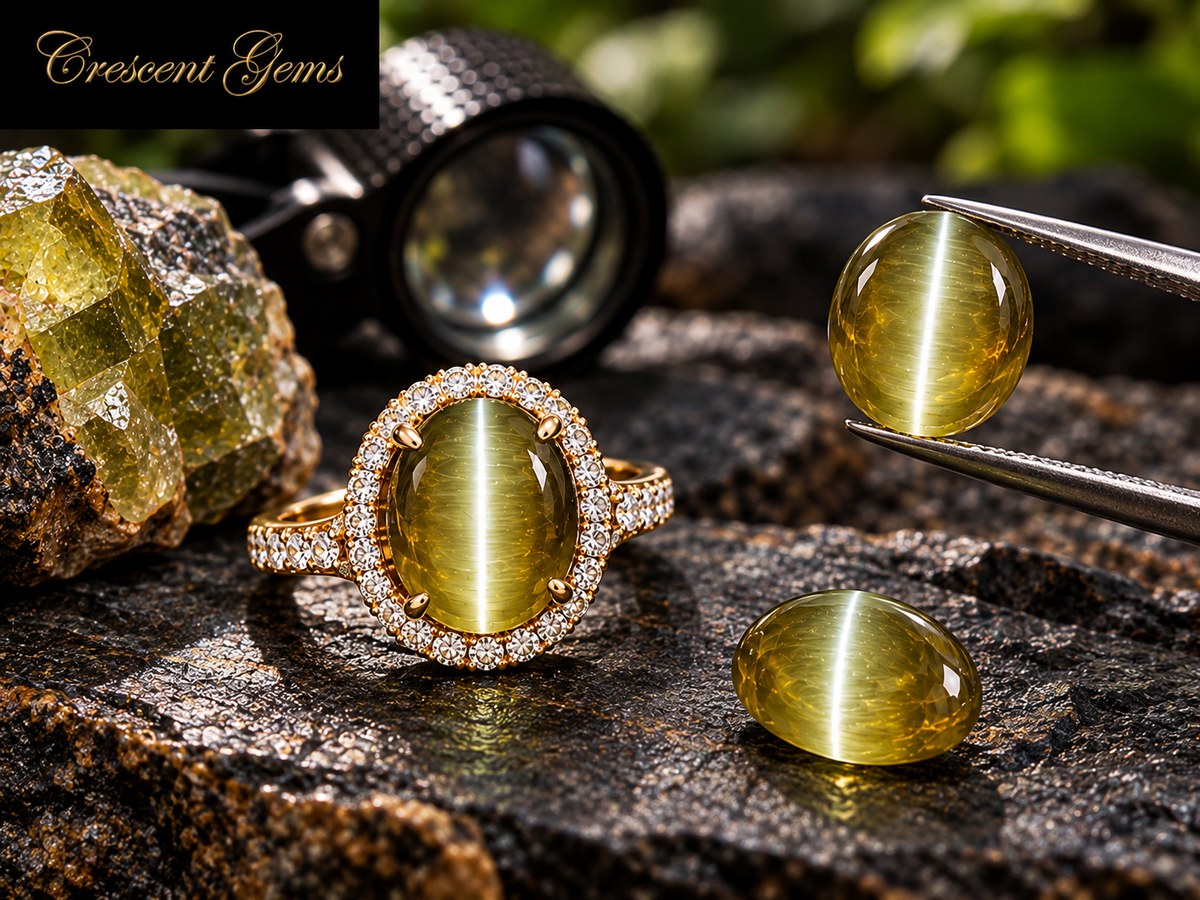
Cat's Eye Chrysoberyl Price Guide — What They Cost and Why
Read moreabout Cat's Eye Chrysoberyl Price Guide — What They Cost and Why